
Spanish Squat Iso Hold: A Complete Guide to Building Knee Resilience Through Isometric Strength
The Spanish squat iso hold represents one of the most effective isometric exercises for developing knee health, strengthening the quadriceps and patellar tendon, and addressing common knee pain conditions. This deceptively simple exercise creates a unique loading environment that challenges the knee extensors in a mid-range position while providing anterior tibial support through band resistance. Whether you’re managing patellar tendinopathy, recovering from jumper’s knee, or simply looking to bulletproof your knees for athletic performance, understanding the proper execution and programming of this movement can make a significant difference in your training outcomes.
Watch the video below on how to maximize this exercise.
Understanding the Spanish Squat Iso Hold
The Spanish squat iso hold builds upon the foundation of the traditional Spanish squat by eliminating the concentric and eccentric phases and focusing exclusively on sustained isometric contraction. This approach targets the knee extensors—primarily the quadriceps muscle group and their associated tendons—in a position that simultaneously loads the tissue while providing a forward shear force through band tension. The band positioned behind the knees creates anterior translation of the tibia, which paradoxically unloads certain structures within the knee joint while creating targeted tension in the patellar tendon and quadriceps attachment points.
What makes this exercise particularly valuable is its ability to strengthen tissues in a controlled, relatively safe manner. Isometric contractions allow you to develop force production without the mechanical stress associated with moving through full ranges of motion. For individuals dealing with anterior knee pain, patellar tendinopathy, or post-injury rehabilitation, this provides a critical training stimulus that builds resilience without aggravating sensitive structures.
Equipment Setup and Execution
To perform the Spanish squat iso hold effectively, you’ll need a resistance band and a stable anchor point such as a power rack, squat stand, or sturdy pole. The band selection matters more than you might initially think. While you could use a lighter band for dynamic Spanish squats, the isometric hold variation demands a moderately strong to strong band that can maintain consistent tension throughout your hold duration. This sustained resistance ensures adequate loading stimulus for the quadriceps and knee structures.
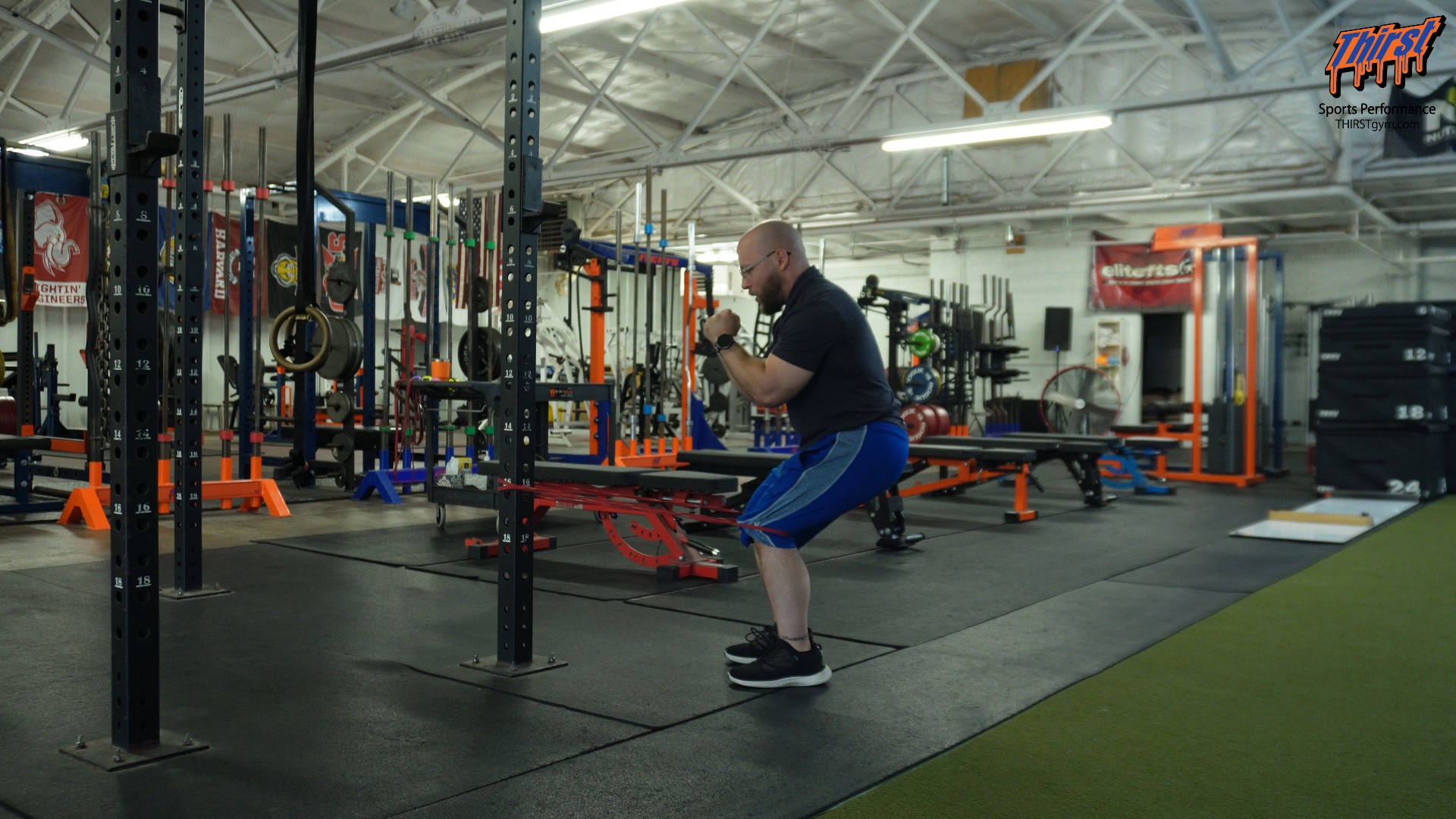
Begin by positioning the band at approximately knee height on your rack or anchor point. Create two loops in the band—you can tie it through itself or use a band with handles. Step into the loops with both feet, positioning the band securely behind each knee, ideally tucked behind your shorts or pants to minimize discomfort against leg hair. The setup should feel stable and secure before you begin the actual hold.
Once positioned, step backward from the anchor point until you feel moderate tension pulling your knees forward. From an upright standing position with feet completely flat on the ground, unlock your hips and allow your knees to bend into approximately a quarter squat position or slightly deeper. The key technical point here is maintaining flat feet—your heels should remain planted throughout the entire hold. Find a depth where you feel challenged but can maintain proper positioning, then hold this position for the prescribed duration.
The Biomechanics Behind the Benefits
The Spanish squat iso hold creates a unique mechanical environment that explains its effectiveness for knee health and rehabilitation. The forward band tension produces anterior tibial translation, which shifts some of the compressive forces within the knee joint while simultaneously creating targeted tension in the patellar tendon. This positioning allows you to load the quadriceps and their tendinous attachments while potentially reducing patellofemoral joint compression compared to traditional squatting movements.
Isometric contractions in mid-range positions offer specific advantages for tendon health and strength development. When you hold a static position under load, you create sustained tension in both muscle and connective tissue without the repetitive stress of movement. This approach allows for progressive tissue adaptation—the gradual strengthening of tendons and their attachments—which is particularly valuable when managing conditions like patellar tendinopathy or jumper’s knee. The mid-range position also tends to be a mechanically advantageous position for force production, allowing you to handle more total load than you might at end ranges of motion.
Applications for Common Knee Conditions
The Spanish squat iso hold proves particularly valuable for individuals managing anterior knee pain presentations. Patellar tendinopathy, commonly known as jumper’s knee, responds well to properly programmed isometric loading. The sustained tension created during the hold stimulates tendon remodeling and adaptation without the repetitive impact forces associated with jumping or running activities. Athletes dealing with this condition can maintain training stimulus while allowing irritated tissues to adapt and strengthen.
Similarly, young athletes experiencing Osgood-Schlatter disease—characterized by pain and inflammation at the tibial tuberosity where the patellar tendon attaches—benefit from controlled quadriceps strengthening that doesn’t aggravate the growth plate. The isometric nature of this exercise provides that strengthening stimulus without excessive mechanical stress at the insertion point. Patellofemoral pain syndrome, another common presentation of anterior knee discomfort, often improves with exercises that strengthen the quadriceps while controlling patellar tracking, making the Spanish squat iso hold a valuable addition to rehabilitation programs.
Programming and Progression Strategies
Effective programming of the Spanish squat iso hold requires attention to hold duration, intensity, and progression variables. Start with holds of thirty seconds minimum, working toward full sixty-second durations as your strength and endurance improve. Perform two to three sets per training session, allowing adequate rest between sets—typically sixty to ninety seconds—to maintain quality positioning and tension throughout each hold.
Progression can occur through multiple variables. Band tension provides the primary progression pathway—moving from lighter to heavier bands increases the forward pull on your knees and demands greater quadriceps engagement to maintain position. You can also add external load by holding dumbbells, kettlebells, or other weights, which increases the total demand on your knee extensors and challenges your ability to maintain proper posture. Depth variation offers another progression option—holding in deeper squat positions increases the mechanical challenge, though you should only progress depth as your knee tolerance improves.
The beauty of the Spanish squat iso hold lies in its accessibility and versatility. You can perform this exercise in virtually any training environment with minimal equipment, making it practical for both gym-based training and home rehabilitation programs. The ease of setup and execution encourages consistency, which ultimately determines the success of any strength or rehabilitation protocol. By systematically progressing this movement and integrating it appropriately into your training, you create a powerful tool for developing knee resilience and addressing common lower extremity concerns that might otherwise limit your athletic potential or training capacity.