

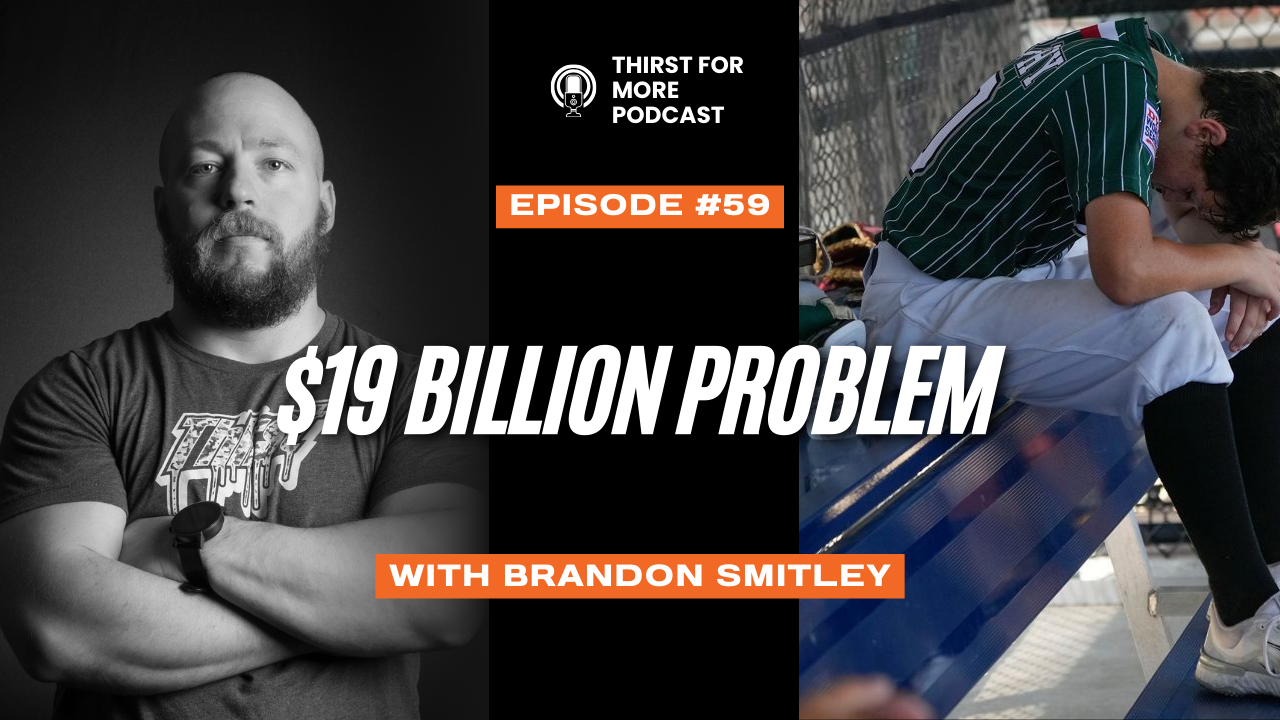
Youth Travel Sports: What Coaches and Parents Both Need to Hear
The youth travel sports system in America has fundamentally changed over the last two decades, and not entirely for the better. As a strength coach and gym owner, I work with young athletes every single day who are caught in the middle of a culture that prioritizes competition, early specialization, and year-round single-sport training — often at the direct expense of their physical health, psychological well-being, and long-term athletic development. This episode of the THIRST More Podcast is directed at two audiences simultaneously: strength coaches and parents. Both groups need to hear the same information, because the disconnect between what the research tells us and what travel sports culture promotes is enormous, and kids are the ones paying the price.
You can also watch the video below that goes along with this article.
How We Got Here: The Rise of Travel Sports Culture
Youth travel sports — also called club sports or select sports — have exploded over the past generation. According to the Aspen Institute’s Project Play Initiative, approximately 21.5 million children between the ages of 6 and 17 participate in team sports in the United States. Of those kids, roughly 20 percent are involved in travel or competitive club-based sports. That’s over 4 million children in a system that generates an estimated $19 billion annually. That number includes tournament fees, private coaching, specialized training facilities, sports psychology services, physical therapy, nutrition coaching, and every other service that has built up around this ecosystem. Whether you realize it or not, if you’re running a gym or training business, you’re likely part of this supply chain.
The growth hasn’t just been in raw participation numbers — it’s been in the intensity and exclusivity of that participation. Research published in the Journal of Athletic Training shows that between the year 2000 and 2020, overall youth sports participation remained relatively stable, but single-sport specialization among athletes under the age of 14 increased from approximately 30 percent to over 70 percent in some parts of the United States. In one generation, we went from most kids playing multiple sports to most kids focusing exclusively on one sport before they ever set foot in a high school.
Several forces are driving this shift. College coaches are now identifying and recruiting at younger ages, creating enormous pressure for early specialization. Private organizations have replaced many community-based recreation programs, meaning the free local league got replaced by the expensive club team with professional coaching and travel schedules. And research identifies what some call “opportunity hoarding” among upper-middle-class families, where sports participation has become a vehicle for college scholarships, social capital, and résumé building. These are real pressures, and parents navigating them deserve better information — not judgment.
What the Research Actually Says About Youth Athletic Development
Let’s be direct here: the gap between what the science shows and what travel sports culture promotes is enormous, and closing that gap starts with both coaches and parents understanding the same research.
The American Academy of Pediatrics, along with virtually every major sports medicine organization, recommends against single-sport specialization before adolescence. Their clinical guidance is specific — children should participate in multiple sports until at least age 15 to 16, take at least one to two days off per week from organized sports, and take two to three months off per year from any single sport. These aren’t theoretical preferences. They’re grounded in serious developmental science.
From a physical standpoint, a study published in the American Journal of Sports Medicine found that young athletes who specialized in a single sport were 70 to 93 percent more likely to be injured than children who played multiple sports. That’s nearly double the injury risk. And research from the American Orthopedic Society for Sports Medicine shows that overuse injuries now account for nearly half of all sports injuries in middle and high school students, with strong correlation to single-sport specialization and year-round training. We’re talking about stress fractures in shins and feet, tendinopathies in shoulders and knees, growth plate injuries, and chronic pain conditions in children. These aren’t minor bumps and bruises — some require surgery, lengthy rehabilitation, and in some cases end athletic careers before they even get started.
The physiology behind this makes complete sense when you understand skeletal development. Young athletes have growth plates, developing bones, and connective tissues that are significantly more vulnerable to repetitive stress than adult tissues. When a 12-year-old pitcher throws year-round with no break, or a young soccer player performs the same cutting and sprinting movements 52 weeks a year, those repetitive forces on developing structures create injury risk that compounds over time.
From a motor development standpoint, the research is equally clear. A landmark study examining the developmental pathways of elite athletes across multiple sports found that the vast majority of Olympians and professional athletes participated in multiple sports during childhood and didn’t specialize until their mid-to-late teens. The nervous system during childhood and early adolescence is building fundamental movement patterns, developing body awareness and coordination, and creating a diverse motor skill base. A basketball player benefits from soccer’s endurance and footwork demands. A baseball player benefits from football’s power and agility development. A volleyball player benefits from basketball’s jumping and spatial awareness training. Multi-sport participation doesn’t set athletes behind — it builds a more complete athletic foundation that serves them better in their primary sport over the long run.
The Psychological Cost Nobody Talks About Enough
Physical injury risk gets a lot of attention, but the psychological impact of travel sports culture is equally serious and often overlooked. Research published in the Journal of Clinical Sport Psychology has documented clinical-level athlete burnout in children as young as 10 years old. We’re seeing the same kind of burnout that affects adults in high-stress careers showing up in elementary school children.
Youth athlete burnout presents as reduced sense of accomplishment, emotional and physical exhaustion, and devaluation of a sport the child once loved. The research identifies three primary contributors: the sheer volume and intensity of training without adequate recovery, external pressure from parents, coaches, and the culture around results and winning, and the loss of autonomy and intrinsic motivation when sports stop being something kids choose for enjoyment and become obligations driven by adult expectations.
Here’s a number that should stop everyone cold: a longitudinal study tracking youth athletes over five years found that approximately 70 percent of children who participate in organized sports quit before the age of 13. Seven out of ten kids are done before high school. And the primary reasons cited aren’t lack of ability or even lack of interest in the sport itself — they’re that it’s no longer fun, there’s too much pressure, and the time commitment conflicts with other aspects of normal childhood. Parents, that means the thousands of dollars and countless hours you’re investing are often pushing kids toward quitting the sport they love, not toward the long-term participation and college opportunity you’re hoping for.
The Economics of Travel Sports: Honest Expectations
Research from the Aspen Institute’s Project Play reports that families with household incomes above $75,000 are twice as likely to have children in team sports compared to families earning under $25,000. When you focus specifically on travel sports, that economic stratification becomes even more pronounced.
The average annual cost for one child in travel sports ranges from $2,000 to over $15,000, depending on the sport and level of competition — and for sports like ice hockey, club volleyball, or competitive gymnastics, those costs can exceed $20,000 per year. For families with multiple athletes in travel sports, the financial commitment approaches what many households spend on basic living expenses.
This creates a specific pressure that parents need to examine honestly. Many families frame this investment around the goal of an athletic scholarship. The reality: the NCAA reports that fewer than 2 percent of high school athletes receive any athletic scholarship money for college, and full-ride scholarships are far rarer. The average scholarship when awarded covers only a portion of total college costs. If you’re spending $10,000 per year for eight years — $80,000 — chasing a statistically unlikely outcome, the math deserves a hard look. That same money invested in a college savings account would provide substantially more certain educational funding.
None of that means sports participation should be reduced to a financial calculation. Sports develop discipline, teamwork, goal-setting, physical health, and social connection. But if the scholarship hope is the primary justification for significant financial strain, realistic expectations are essential. And coaches, understanding this economic pressure is critical to working effectively with families — because it shapes the expectations parents bring through your door.
The Specialization Debate: What the Science Says
A systematic review published in Sports Health examining over 40 studies on youth sport specialization concluded that early specialization increases injury risk and does not necessarily lead to better long-term performance outcomes. The more common developmental pathway to elite performance is late specialization — typically in mid-to-late adolescence — not the early and exclusive focus that travel sports culture pushes.
The critical distinction here is between sport-specific skill development and exclusive year-round participation. A young athlete can develop sport-specific skills and compete seriously while still participating in other sports. The problematic pattern is training and competing in a single sport year-round, to the exclusion of all other physical activity, with no planned recovery periods. That’s what the research flags — not serious training, not competitive participation, but the complete elimination of variation and rest.
For coaches, this framing matters for how you advise families. Advocating against early specialization isn’t advocating against serious athletic development. It’s advocating for strategic periodization, involvement in complementary activities, and planned recovery through movement variation. When I work with a young baseball player who’s training year-round, I’m nudging them toward soccer, basketball, wrestling, or cross-country — not because those sports are more important, but because the physical and psychological demands of a different sport give that young athlete’s body and mind a genuine break while continuing to build athletic quality. And crucially, if they’re running cross-country, they’re not playing in a fall baseball tournament. That’s not falling behind. That’s smart development.
A practical model that works: a young basketball player competes during the winter season, plays soccer in the spring, and focuses on general strength and conditioning in the summer. A baseball player plays their spring and summer season, participates in football in the fall, and dedicates winter to developing strength, power, and movement quality with a performance professional. The sport that’s in season is the sport that gets priority. That’s sustainable, developmentally sound, and reduces injury risk dramatically.
If a club coach or travel organization tells you that your 10-year-old must quit all other sports and commit exclusively to their program, treat that as a significant red flag. That organization is prioritizing their own interests over your child’s long-term development. The research is unambiguous on this point.
What Coaches Need to Be Doing Differently
First, movement screening matters for youth athletes specifically. Many young athletes competing at high levels in their sport have surprisingly poor fundamental movement quality. The baseball player with an elite swing who can’t properly squat. The soccer player with great ball skills and dangerous landing mechanics that put them at serious ACL risk. Our job is to identify these gaps and systematically address them before they become injuries.
Second, understand growth and maturation assessment. Two 13-year-olds can be at completely different biological stages of development, which has profound implications for programming, injury risk, and appropriate performance expectations. A late-maturing 13-year-old and an early-maturing 13-year-old should not be running identical training programs, even if they’re on the same team. Individualized programming accounts for this — and it’s one of the strongest arguments for individualized training over cookie-cutter group programs.
Third, develop the communication skills to have difficult conversations with parents about training volume, intensity, and developmental timelines. This isn’t taught in most certification programs, but it’s one of the most critical skills a performance coach can develop. When a parent wants their 12-year-old doing heavy barbell work six days a week because they saw it on social media, explaining why that’s developmentally inappropriate without making the parent feel dismissed takes real interpersonal skill. The goal isn’t to load a 12-year-old with a barbell — it’s to build movement competency first. Can we get a 12-year-old to a barbell deadlift eventually? Absolutely. But getting there through a goblet squat, a hip hinge pattern, and foundational movement education is the right path. Walk before you run.
Fourth, program with recovery in mind. Young athletes in travel sports are often already undertrained in terms of movement quality and overtrained in terms of sport-specific volume. They’re frequently not sleeping well, not eating well, and not recovering adequately. Piling more volume and intensity on top of that doesn’t help anyone. Address movement quality, build general work capacity, and be willing to make sessions active recovery when the athlete walks in beaten down. That pivot isn’t weakness — it’s good coaching.
Fifth, create environments that build intrinsic motivation. Many young athletes coming through the door are carrying serious psychological weight — performance anxiety, fear of failure, motivation systems driven entirely by external expectations. The weight room can be a place where they experience something different: where effort and process are valued over outcomes, where mistakes are learning opportunities, and where getting stronger is something they can see and own for themselves. That’s one of the things I love most about strength and conditioning — it rewards effort visibly. The weight goes up, the reps improve, the times get faster. You only have to compete with yourself, and progress is tangible when you track it.
What Parents Need to Hear
Get honest with yourself about your goals and motivation. Are you pursuing travel sports because your child is passionate about the sport and has expressed genuine goals that require that level of competition? Or are you doing it because other families are doing it and you’re afraid your child will be left behind? Are you hoping for a scholarship return on investment, or are you living vicariously through your child’s athletic achievements? These are uncomfortable questions, but answering them honestly is what allows you to make genuinely good decisions for your child.
Pay attention to your child’s actual experience, not just their performance outcomes. Is your child still genuinely enjoying their sport, or have they started dreading practice and games? Are they talking about their sport with excitement, or with stress and obligation? Are they experiencing chronic fatigue, persistent soreness, or recurring injuries? Are they choosing to practice and play on their own time, or only doing it when required? These signals matter far more than what team they made or how many tournaments they won.
Resist the pressure to specialize early just because the club organization is pushing it or because other families are doing it. The research is overwhelmingly clear: multi-sport participation until mid-adolescence leads to better long-term athletic outcomes, lower injury rates, and better psychological well-being. Your child playing multiple sports is not falling behind. They’re building a more complete athletic and developmental foundation.
Build a real relationship with your child’s strength coach or performance trainer, and listen to their developmental expertise. When they recommend reducing training volume, addressing movement quality, or taking time off a primary sport, they’re not undermining your child’s competitiveness. They’re applying developmental science to protect your child’s long-term health and athletic potential. A good performance coach wants your kid to get a scholarship more than you might realize — not for the credit, but because that outcome represents a kid we helped develop into a complete athlete and person.
And finally, make room in your child’s life for things that aren’t sports. Time with friends, involvement in music or art, unstructured free time, adequate sleep, family dinners — these are not obstacles to athletic development. They’re essential to raising a healthy, psychologically resilient kid. When sports become the only identity and the only valued activity in a child’s life, burnout and psychological problems reliably follow.
The Bottom Line
The youth travel sports system has serious problems. Early specialization, year-round training, and intense competitive pressure at young ages are creating more injuries, more burnout, and not better long-term outcomes. But the system isn’t going away. What coaches and parents can do — right now, within the system — is make better decisions.
Multi-sport participation, appropriate recovery, emphasis on movement quality and fundamental athletic development, and support for intrinsic motivation don’t just produce better athletes. They produce healthier, more resilient, more well-rounded young people who carry their love of physical activity into adulthood. That’s worth fighting for.
Interested in having us help your youth athlete stay healthy and improve their athletic performance? Contact us to see how we can help you!