
Drop Lunge to Rotational Medball Shot Put: Full-Body Power Development for Athletes
The drop lunge to rotational medball shot put is a dynamic power exercise that bridges the gap between traditional lower body strength work and explosive rotational athleticism. This movement pattern combines hip loading mechanics, rotational force generation, and upper body power expression into a single integrated exercise that develops the type of coordinated explosiveness essential for athletic performance. Whether you’re training combat athletes who need to generate rotational power from their hips, baseball players working on throwing mechanics, or general fitness enthusiasts looking to develop functional full-body power, this exercise offers significant training value through its unique movement sequencing.
Watch the video below on how to maximize this exercise.
Equipment Setup and Space Requirements
To perform the drop lunge to rotational medball shot put effectively, you’ll need relatively minimal equipment but adequate training space. A medicine ball is your primary tool here, and weight selection matters significantly for this movement. Because this exercise emphasizes power development and explosive qualities rather than maximal strength, keeping your medicine ball on the lighter side is crucial—typically anywhere from 6 to 12 pounds for most athletes, with stronger individuals potentially working up to 15 or 20 pounds while maintaining movement quality and velocity. You’ll also need a sturdy wall or throwing target that can safely receive repeated medicine ball impacts, along with enough floor space to perform a lateral lunge movement without spatial constraints limiting your range of motion.
Movement Execution and Technical Breakdown
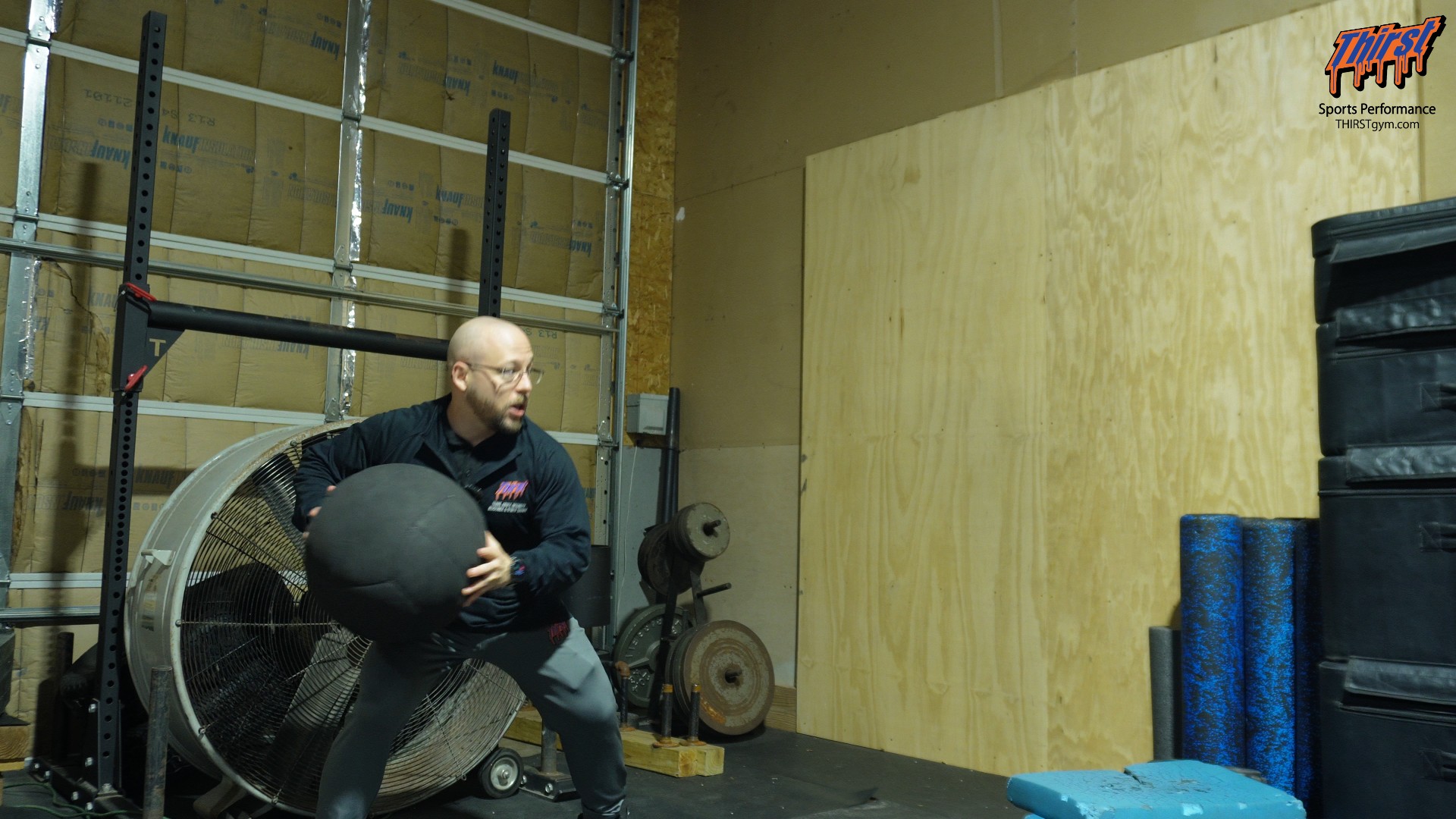
The drop lunge to rotational medball shot put begins from a starting position facing the wall directly, holding the medicine ball at chest level with both hands in a shot put grip position. The unique aspect of this exercise lies in the drop lunge initiation pattern. Unlike a standard forward or reverse lunge, this movement requires you to take the same-side leg as your throwing arm and step it backward and laterally simultaneously. If you’re throwing with your right arm, you’ll take your right leg and drop it back and to the side, creating a position that resembles a lateral lunge but with the back leg positioned behind you rather than directly to the side.
This drop back movement serves multiple biomechanical purposes. First, it loads your rear hip, creating elastic energy through the stretch of your hip musculature and allowing you to tap into the stretch-shortening cycle for greater power output. Second, it creates a rotational pre-stretch throughout your torso, loading the obliques and deep core stabilizers that will contribute to your throwing force. From this loaded position, you’ll explosively drive through your back leg, rotating your hips and torso toward the wall while simultaneously pressing the medicine ball forward in a shot put motion. The movement should feel like a coordinated full-body effort where power flows from your loaded hip through your rotating torso and finally expresses through your arms as you release the ball.
After each repetition, you’ll return to your starting position facing the wall with the ball at chest level, then repeat the drop lunge loading pattern before your next throw. This reset between repetitions is important because it ensures you’re generating power from the proper starting position rather than rushing through repetitions with diminishing movement quality.
Biomechanical Benefits and Training Applications
The drop lunge to rotational medball shot put excels at teaching athletes proper hip loading mechanics in a rotational context. Many rotational power exercises suffer from athletes generating force primarily from their upper body or through excessive spinal rotation, which not only limits power output but also creates injury risk. By requiring the drop lunge setup, this exercise forces you to load your back hip first, establishing the movement pattern of generating rotational power from the ground up through the lower body rather than manufacturing it through compensatory upper body mechanics.
This exercise trains what’s often called the posterior oblique sling—the fascial and muscular connection running from your back hip, through your opposite side obliques, and into your upper torso. This full-body sling system is essential for transferring force in rotational movements, whether you’re throwing a punch, swinging a bat, or executing a golf swing. The medicine ball throw provides immediate feedback about the quality of this force transfer; if you’re not properly loading your hip and coordinating the full-body sequence, your throw distance and velocity will suffer noticeably.
Programming Recommendations and Volume Guidelines
For power development purposes, this exercise works best with moderate volume across multiple sets. Three to five sets of three to five repetitions per side provides enough training stimulus to develop neuromuscular coordination and power output without accumulating excessive fatigue that would diminish movement quality. The key coaching point is that every single repetition should be performed with maximal intent—you’re throwing that medicine ball as explosively as possible each time. This isn’t a conditioning exercise where you’re trying to maintain a certain pace or accumulate high volume; it’s a power development tool where each repetition quality matters more than total volume.
This exercise fits well early in training sessions after your warm-up but before heavier strength work. Because it requires high-quality explosive effort and neurological freshness, performing it while you’re still mentally and physically sharp yields better training results than relegating it to the end of your workout when fatigue has accumulated.
Variations and Modifications
While the shot put throwing position is generally preferred for this exercise because it better emphasizes the transfer of lower body power through a stable upper body position, you can also perform this movement with a scoop toss variation. The scoop toss involves more hip hinge and allows the medicine ball to travel in an underhand arc rather than a linear shot put trajectory. This variation can be useful for athletes who struggle with shoulder mobility or for adding variety to training, though the shot put version typically provides better transfer to rotational athletic movements.
The drop lunge to rotational medball shot put represents an efficient training tool for developing the coordinated power output that separates athletic movement from general fitness. By combining hip loading, rotational mechanics, and explosive expression into a single movement pattern, this exercise builds the type of full-body integration that translates directly to improved athletic performance across numerous sports and movement contexts.