
Front Foot Elevated Split Stance Cable Row: Building Single-Arm Strength with Perfect Positional Control
The front foot elevated split stance cable row represents one of the most effective variations for developing unilateral upper back strength while simultaneously addressing postural control and hip mobility. This exercise combines the proven benefits of single-arm rowing movements with a strategically designed lower body position that enables lifters to maintain optimal spinal alignment throughout the movement pattern, making it particularly valuable for athletes, clients dealing with mobility limitations, and anyone seeking to improve their movement quality during pulling exercises.
What sets this variation apart from standard cable rows or split stance variations is the subtle but significant detail of elevating the front foot. This seemingly minor adjustment creates a cascade of biomechanical advantages that allow you to maintain a more vertical torso position, keep your pelvis properly stacked underneath your hips, and access greater ranges of motion without compensation patterns that typically lead to low back discomfort during rowing movements.
Watch the video below on how to maximize this exercise.
Equipment Setup and Requirements
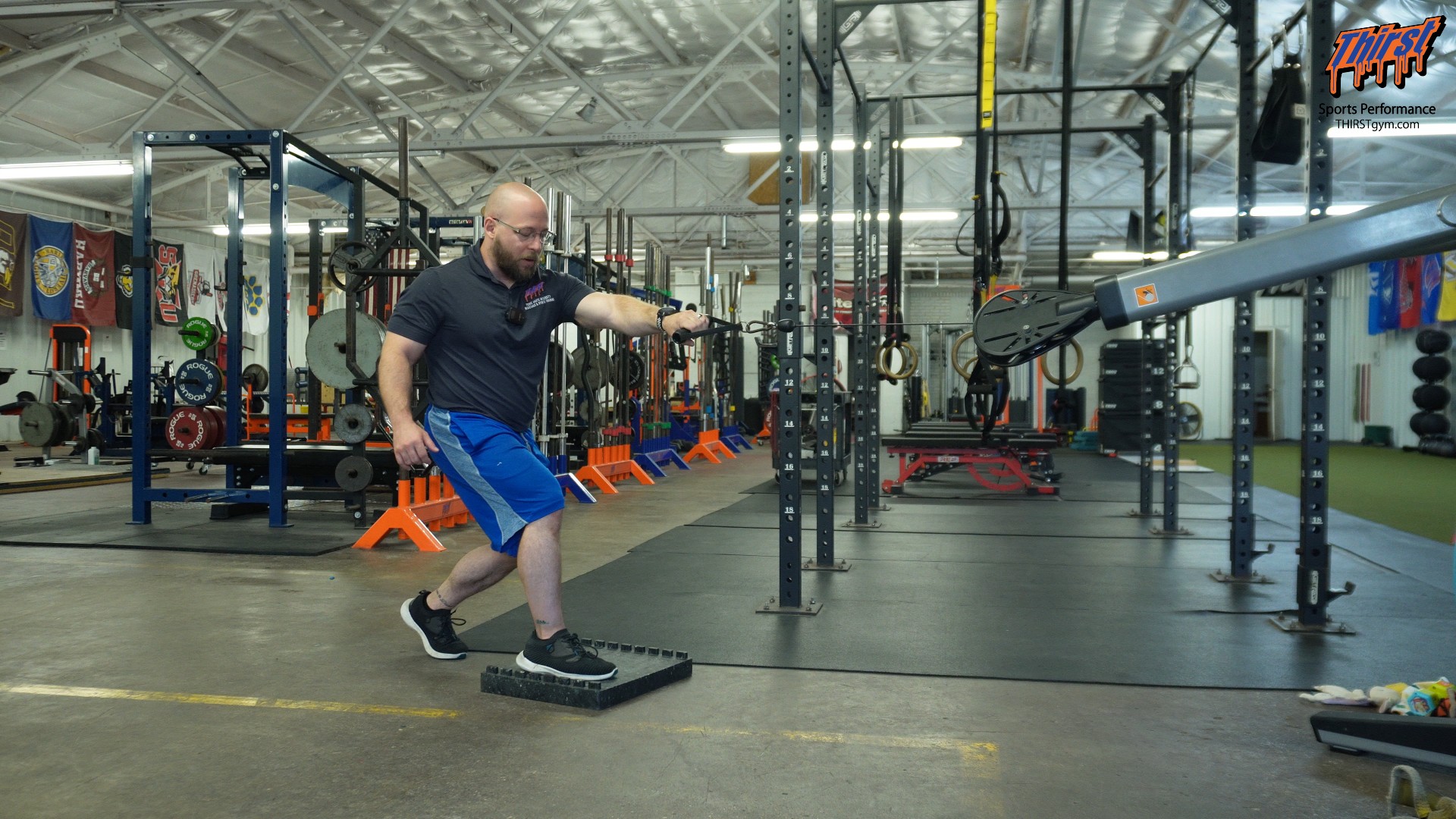
To perform the front foot elevated split stance cable row effectively, you need an adjustable cable machine with a D-handle attachment positioned at approximately mid-torso height. For the elevation component, any stable platform measuring two to three inches in height works perfectly—this could be a dedicated deadlift block, a standard 45-pound weight plate, or a low aerobic step. The key is selecting something stable enough to support your front foot throughout the entire set without wobbling or shifting.
The handle should be attached to the cable at a height that allows the cable to track horizontally when you’re in your rowing position, ensuring optimal line of pull for engaging your lat, rhomboid, and rear deltoid musculature throughout the complete range of motion.
Movement Execution and Technique Breakdown
Begin by placing your front foot on the elevated surface, positioning yourself far enough from the cable machine that you establish moderate tension on the cable before initiating any rowing motion. Your stance configuration follows a split stance pattern where whichever leg is elevated forward corresponds to the working arm—meaning if your right foot is elevated and forward, you’ll be rowing with your right arm. This creates what’s known as an ipsilateral loading pattern, where the working limb and forward leg exist on the same side of your body.
Your back leg extends behind you with only your toe in contact with the floor, functioning primarily as a stabilizing post rather than a heavily weighted base of support. The majority of your body weight should shift toward your front foot, specifically loading through your heel while maintaining full foot contact with the elevated surface. This heel-loaded position on your front foot is critical—it allows you to actively push your entire body backward during the rowing motion, using your front leg as an anchor point that helps you generate force and maintain your vertical torso position.
From this established position, your torso should remain relatively upright and centered over your midsection, avoiding the forward lean that commonly occurs in traditional rowing variations. Notice how the front foot elevation allows your front shin to maintain a nearly vertical orientation rather than driving forward at an angle. This vertical shin position is the biomechanical key to the entire exercise, as it enables you to stay tall through your spine while still maintaining significant knee flexion in your front leg.
Execute the rowing motion by driving your elbow backward along your ribcage, focusing on scapular retraction and depression as your shoulder blade moves toward your spine and down your back. Throughout each repetition, your front knee position should remain relatively constant—you’re not performing a lunge or creating significant depth changes in your split stance. Instead, you’re maintaining a stable lower body platform that allows your upper body to perform quality rowing repetitions without compensatory movement patterns.
Why the Front Foot Elevation Matters
The elevation of your front foot serves multiple critical functions that distinguish this variation from standard split stance rows. First, it positions your pelvis underneath your hips and ribcage rather than allowing it to shift into anterior tilt or extension-based positioning that commonly occurs when performing rows from ground-level split stances. This alignment keeps your lumbar spine in a more neutral position throughout the movement, significantly reducing the likelihood of low back discomfort that many lifters experience during rowing variations.
Second, the elevated front foot creates space for improved hip flexion mobility on that front leg without requiring compensation through your lumbar spine. Many clients and athletes struggle with adequate hip flexion range of motion due to prolonged sitting, previous injuries, or simply individual anatomical variations. By elevating the front foot and allowing the shin to stay vertical, you can access deeper hip flexion angles while maintaining spinal neutrality—essentially training hip mobility while building upper body strength.
Third, this position demands significant proprioceptive awareness and positional control from your entire body. Your nervous system must coordinate the rowing motion while simultaneously maintaining balance and stability through an asymmetrical stance pattern. This full-body integration component makes the exercise particularly valuable for athletic populations who need to develop strength in positions that demand coordinated total-body control rather than isolated muscle activation.
Programming Recommendations and Applications
The front foot elevated split stance cable row works exceptionally well when programmed for moderate to moderately high repetition ranges. Target two to four sets of eight to twelve repetitions per arm as your primary working range. This rep scheme allows you to accumulate sufficient training volume for muscle growth and strength development while maintaining the positional control that makes this exercise valuable.
Avoid pushing into very low repetition ranges like sets of six reps or fewer, as the load required to make six reps challenging typically becomes too heavy to maintain the precise positioning and control that defines this variation. When weights become too heavy, most lifters begin compensating through their lower body position or losing the vertical torso alignment, which defeats the primary purpose of the exercise.
This movement excels as a primary or secondary pulling exercise in upper body training sessions, works well within athletic development programs focused on building positional strength, and serves as an excellent option for individuals who struggle with maintaining neutral spine positions during traditional rowing variations due to hip mobility limitations or postural control challenges.