

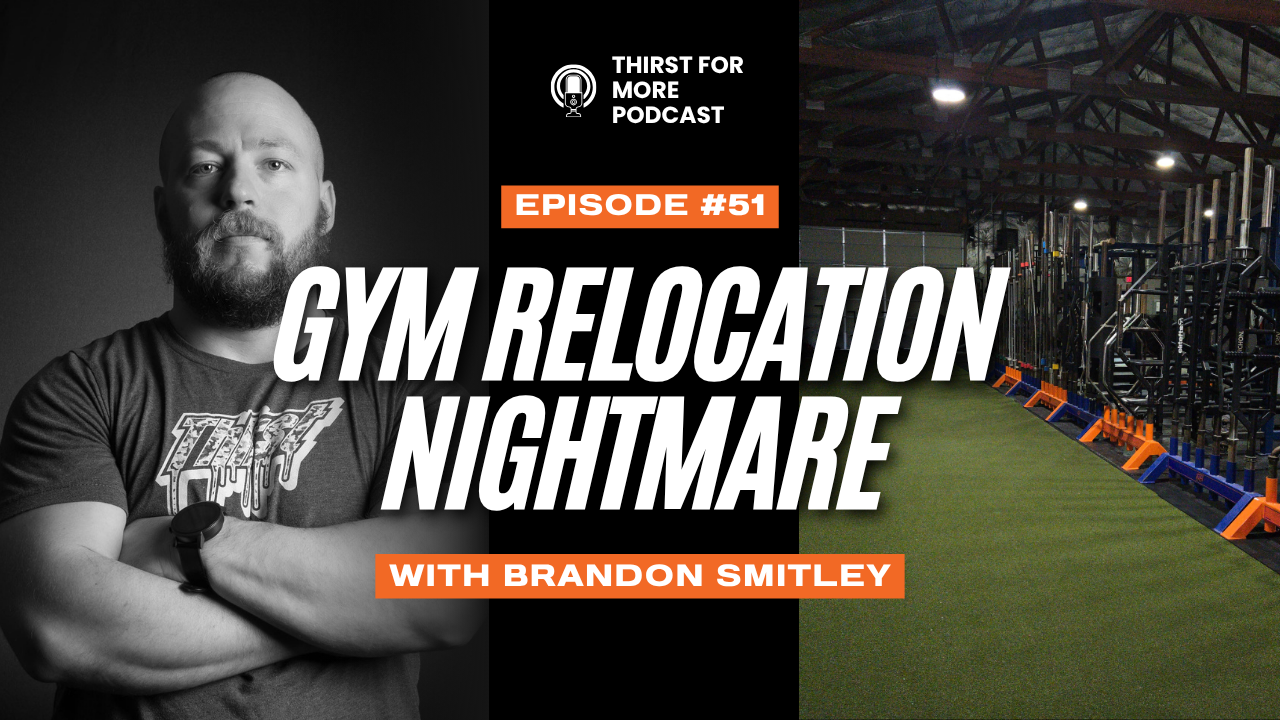
Our Gym Relocation Journey: Three Years of Challenges, Lessons, and Starting Over
When I received that phone call in May 2022, I never imagined the three-and-a-half-year journey that would follow. The voice on the other end informed me that our gym, THIRST in Terre Haute, Indiana, would be taken through eminent domain. In that moment, everything we had built over seven years felt suddenly uncertain.
This is the complete story of relocating our gym, the financial hurdles we faced, the properties that almost worked out, and why we ultimately ended up owning our building instead of renting. If you’re a gym owner facing relocation, considering opening your own facility, or dealing with commercial real estate challenges, this experience might help you navigate your own journey.
You can also watch the video below that goes along with this article.
The Beginning: Seven Years in Our First Location
THIRST officially opened in June 2018, though the dream had been years in the making. After graduating in 2011 and spending seven years working in fitness, strength and conditioning, and powerlifting, I finally had the opportunity to open my own facility. My powerlifting career helped catapult the business, and those years of personal training experience gave me the foundation I needed.
Our initial location was nearly perfect for a startup gym. We secured almost 6,500 square feet of space that had never been leased before. The landlords invested in upgrades to meet code requirements, and most importantly, the price was incredibly affordable. It was a triple net lease, meaning as the business owner, I was responsible for rent, taxes, and insurance for my portion of the building. While the base rent stayed relatively flat, we watched our taxes increase substantially over those seven years.
The space wasn’t without problems. The building was constructed in the 1940s and had seen better days. We dealt with constant roof leaks that the landlords never properly addressed. From a code perspective, they failed to build the required second bathroom given our square footage. The building was old and deteriorating, but for a young business, the price made these headaches manageable. Looking back, we were willing to endure quite a bit to maintain that affordable rate.
Understanding Eminent Domain: When Government Takes Property
For those unfamiliar with eminent domain, it’s the government’s power to acquire private property for public use. Whether local, state, or federal authorities, they can take property as long as they demonstrate it serves the greater public good. While property owners receive compensation, they ultimately have no choice but to relocate.
As a tenant rather than the property owner, I wasn’t losing my own real estate. However, what the government planned for the property would directly impact my business. In our case, the State of Indiana needed the land to build an elevated double roundabout over railroad tracks near a major intersection.
This intersection posed serious problems for Terre Haute. Railroad tracks ran through both the east and south sides, creating significant traffic delays. Trains would stop for twenty to thirty minutes at a time, and this particular track carried heavy traffic volume. More concerning, there’s a hospital less than half a mile away, and emergency vehicles were reportedly delayed reaching patients because of stopped trains blocking the intersection.
The city’s solution was an ambitious engineering project: an elevated double roundabout that would allow traffic to flow freely regardless of train activity. The exit ramps for this roundabout required the parcel where our building sat. When eminent domain involves a structure on the needed land, the government typically acquires the entire parcel and demolishes everything rather than attempting to work around existing buildings.
The Initial Timeline and Growing Uncertainty
During that first phone call, I was told we’d have approximately one year before needing to vacate. The state anticipated accepting bids for the construction project that fall, with actual demolition and construction beginning by May 2023. We immediately contacted our real estate agent and began the search for a new location.
What we didn’t know then was that the timeline would stretch to three and a half years. Government projects rarely move as quickly as initially projected, and each delay added another layer of uncertainty to our situation. We couldn’t make long-term commitments to our current space, yet we also didn’t know exactly when we’d need to leave.
The Search Begins: Navigating a Hot Real Estate Market
Our search for a new location coincided with one of the most challenging real estate markets in recent memory. Post-2020, interest rates were historically low, which drove property prices sky-high. The market was intensely competitive for both commercial rentals and purchases. For a business being forced to relocate rather than choosing to expand, the timing couldn’t have been worse.
We needed specific features for our gym to operate effectively. The space required an open floor plan with high ceilings for Olympic lifting and other movements. Concrete floors were essential for the heavy equipment we use. We needed adequate bathroom facilities, preferably multiple restrooms given the square footage and our member base. Ideally, we wanted to stay within five to six thousand square feet and avoid moving too far from our existing location to retain our current members.
Property Number One: The Old Dollar General
By fall 2022, we found what seemed like an opportunity. An old Dollar General building with approximately eight to nine thousand square feet sat on a property that also included rental units. The business model looked compelling: we could occupy the main space while collecting rent from the additional units to offset our own costs. We might even end up with a larger facility for less money than we were currently paying.
The building needed work. The drop ceilings would need complete removal to gain adequate height. Some walls required demolition. Previous tenants had left behind equipment and security cameras, and the entire space needed substantial renovation. However, the parking was excellent, and that rental income potential made the project attractive despite the required investment.
We ran the numbers with our bank and determined the purchase was within our budget, particularly if we could keep both rental units occupied. One unit was currently leased, though that tenant informed us they planned to move within a year. Still, we moved forward with due diligence.
The Environmental Examination Obstacle
Anyone purchasing commercial real estate quickly learns about environmental assessments. We paid several thousand dollars for a Phase One Environmental Examination, which investigates the property’s history to identify potential environmental hazards. The good news was that as part of our relocation benefits, we could be reimbursed for these costs. The bad news came when the Phase One results indicated we needed a Phase Two assessment.
A Phase Two Environmental Examination involves actual soil testing and can cost anywhere from fifteen thousand to two hundred thousand dollars depending on the scope of work required and any remediation needed. Two major red flags emerged for this property.
First, one of the rental structures had previously housed an automotive repair operation. There was no documentation proving proper disposal of oil, transmission fluid, and other automotive fluids. Environmental assessors assumed these materials had likely leached into the ground, creating contamination.
Second, the property sat directly adjacent to a Marathon petroleum gas station. Underground fuel tanks can develop leaks over years of operation, and groundwater flow could potentially carry contamination onto neighboring properties. Even if we weren’t responsible for creating the environmental hazard, we would bear the cost of remediation on our parcel.
My wife and I looked at the potential costs and realized this property wasn’t viable. We approached the seller asking them to pay for the Phase Two assessment since the contamination occurred during their ownership. They refused. We commissioned an appraisal, which came back thirty to forty thousand dollars below the asking price. When we offered to purchase at the appraised value, the seller declined.
The seller then proposed a private contract: a five-year rent-to-own arrangement where our payments would build equity toward eventual ownership. The interest rate they offered was actually lower than traditional bank financing, and the final purchase price would be reduced from the original asking price. After five years, we could obtain traditional financing for the remaining balance.
We consulted our attorney and reviewed the contract carefully. The arrangement had merit, but we kept returning to the Phase Two environmental assessment. If we didn’t complete that testing and remediation before taking ownership, we’d face the same obstacles when seeking bank financing five years down the road. The seller still refused to share that financial responsibility, and we walked away from the deal.
Looking back, I believe we dodged a serious financial liability. That property remained on the market months after we withdrew our offer, suggesting other potential buyers encountered similar concerns.
The Building Dream: Purchasing Land and Custom Construction
By winter 2023, with the relocation timeline still unclear, we shifted strategies. If we could find affordable land, we might have time to design and build exactly what we needed. We wouldn’t have to compromise on ceiling height, bathroom facilities, or layout. Everything could be purpose-built for our training methodology and business model.
By summer 2023, we found approximately one acre of properly zoned land at an attractive price. The location worked well, and preliminary research showed electrical and water hookups were available. We made an offer about ten to twelve percent below asking price, and the seller immediately accepted.
The Design Process and City Requirements
After purchasing the land in early fall 2023, we began working with contractors on design. We envisioned nearly ten thousand square feet with full bathroom and shower facilities, office space, and an additional room we could rent to chiropractors, physical therapists, or massage therapists for additional income.
The state approved our plans without issue. The city, however, required modifications to our parking design. Initially, they wanted us to provide fifty parking spaces based on our square footage. Anyone familiar with training facilities knows that’s excessive unless you’re operating a big-box gym with hundreds of members coming and going throughout the day. We’ve never had fifty cars in our parking lot except during powerlifting competitions, which occur once or twice per year.
We worked with the city to reduce the requirement to twenty-five parking spaces and filed for a variance. This process required notifying all adjacent property owners and giving them the opportunity to object. We prepared professional letters explaining our request and appeared before the city council to present our case. They understood our business model and approved the variance.
Then engineering review revealed the deal-breaker.
The Water Main Requirement
City code required a water main to front the property. Our parcel had no water main on either the south or west side where the building would face. The existing water main sat across a small side street, less than twenty-five feet away. Our contractor and plumber both confirmed they could easily run service from that main.
However, city code mandated that we install a new water main on our property frontage. The primary purpose of this requirement is providing fire department access to high-volume water supply during emergencies. From the city’s perspective, this infrastructure serves the greater community good.
The engineering firm quoted between sixty thousand and two hundred thousand dollars to install this water main. Those drastically different estimates reflected uncertainty about underground conditions, required permits, and potential complications. The city indicated we could eventually recoup this expense through reduced water and sewage bills, but that wouldn’t put money back in our pockets when we needed it most.
We made phone calls to everyone we could reach in city government, hoping to find an exemption or alternative solution. The answer remained the same: if we wanted to build on that land within city limits, we needed to install the water main at our expense.
We couldn’t justify spending sixty to two hundred thousand dollars on underground infrastructure when we still needed to fund the actual building construction. That property remains vacant to this day. We wasted thousands on engineering and design work only to discover we couldn’t afford to build there.
The Second Building Attempt
Around winter or early spring 2025, we found another existing building outside city limits. The county regulations seemed more manageable, and the asking price was excellent. When we inspected the property, however, we discovered it was essentially a shell. Gravel covered portions of the interior floor where concrete work remained incomplete. Most critically, there was no sewage connection and no septic system.
We researched the costs of installing a septic tank and running the necessary infrastructure. When we totaled the purchase price plus required improvements to make the building operational, the investment exceeded what we would spend on our owned land with new construction. For a building already fifteen years old and smaller than what we planned to build, the math didn’t make sense.
While we were conducting this analysis, another buyer made an offer and the property went under contract. Perhaps that was a blessing in disguise.
The Ninety-Day Window: When Everything Became Real
Just as we were evaluating that second building, I received the call I’d been dreading and anticipating for three years. The relocation timeline was official. We had a minimum ninety-day window to vacate our current location. This grace period is guaranteed by the state to prevent immediate displacement, but ninety days isn’t much time when you’re searching for commercial property, negotiating purchases, and planning a complete business relocation.
My wife Adrian was actually in the hospital with a ruptured appendix when we began our emergency property search. I immediately contacted our real estate agent and explained the situation. We needed to find something quickly.
Finding Our Current Location: THIRST 2.0
The property we found was smaller than ideal, around five thousand square feet rather than the six thousand we wanted. However, it included features we hadn’t had before: shower facilities, multiple bathrooms, a full kitchenette, and a fenced backyard area. The building had an open floor plan with adequate ceiling height and concrete floors. There was parking out front, and the price point came in below what we would have spent on new construction.
When I first toured the property, numerous red flags jumped out. From a fire code perspective, the building was nowhere near compliant. Electrical work was haphazard, with wiring connected directly to breakers in ways that violated code. I asked a friend who conducts fire inspections to walk through with me and provide an honest assessment. He estimated several thousand dollars minimum to bring electrical and fire safety up to code.
After Adrian recovered from her appendicitis and saw the property herself, we agreed this represented our best option given the time constraints. We made an offer slightly below asking price, and the seller accepted.
Walking Into Equity
The appraisal process brought welcome news. The property appraised above the asking price, meaning we walked into positive equity immediately. Combined with our below-asking offer, we started this ownership journey in strong financial position from a real estate perspective.
We hired electricians to address the wiring issues and contractors to remove some walls that would improve our floor plan. Fire code violations were remedied. Within our tight timeline, we transformed the space into a functional training facility that actually exceeded our previous location in most ways except total square footage.
The Financial Reality of Gym Relocation
Throughout this three-and-a-half-year process, we hemorrhaged money. Some expenses resulted from our own decisions and learning curve. Other costs were completely outside our control. Environmental assessments, engineering fees, legal consultations, design work, and deposits on properties that didn’t work out—these expenses add up quickly when you’re navigating commercial real estate for the first time.
My wife and I are not wealthy people. We live in a modest home, drive nice but practical cars that we maintain for long-term use, and invest our resources into our business rather than lavish purchases. The financial requirements of this forced relocation stretched us considerably.
Our new mortgage payment is higher than our previous rent, and we’re operating in about 1,200 to 1,300 fewer square feet. We purchased during a period of high interest rates, which increased our monthly costs. However, we secured a twenty-year mortgage with a five-year adjustable rate. If interest rates decrease over the next five years, our payment will adjust downward, potentially saving us substantial money long-term.
The insurance situation actually improved. Insuring the building and property while integrating our business insurance came out roughly equivalent to what we were paying before. Now, however, we’re protecting our own asset rather than just our equipment and liability.
Property taxes will be comparable to what we paid as part of our triple net lease. The crucial difference is that we’re now building equity in our own real estate rather than paying into someone else’s retirement fund.
The Relocation Benefits Package
Because our relocation resulted from eminent domain, the state provided certain benefits. We had the option of having them coordinate and pay for professional movers, or we could obtain multiple bids, take the money, and handle the move ourselves. Given the volume and weight of gym equipment we own, we chose to have the state arrange for professional movers. The company they hired, Better Way Moving out of Bloomington, Indiana, did an outstanding job despite my Purdue loyalties conflicting with the Bloomington location.
The state also reimburses certain relocation expenses including environmental assessments, legal fees, and necessary improvements to make a new location operational. The challenge is that you must pay these costs upfront and then file for reimbursement. We’re still waiting for several reimbursement checks months after the move.
Additionally, the state compensates for time invested in the relocation process up to three thousand dollars. While I appreciate any compensation, three thousand dollars barely scratches the surface of the hundreds of hours my wife and I invested over three and a half years searching for properties, meeting with contractors and attorneys, attending variance hearings, and managing this entire process.
The Impact on Members and Operations
We gave our members several options during the transition. For personal training clients, we offered to put sessions on hold, though we encouraged people to continue training and make up any missed sessions rather than pausing their memberships. When memberships go on hold, we lose revenue, and this relocation wasn’t our choice. Most of our clients understood our situation and worked with us to maintain continuity.
Our regular membership base didn’t experience any interruption in access. In fact, they gained amenities. The new facility operates twenty-four hours per day, seven days a week with fingerprint scanner access, compared to our previous 5:00 AM to 10:00 PM hours. The bathroom and shower facilities represent a massive upgrade. The space has better insulation, larger overhead doors for airflow, and partial air conditioning that will make summer training far more comfortable.
The response from our community has been overwhelmingly positive. Long-time members offered to help with the move and expressed understanding throughout the uncertainty. Several commented on feeling nostalgic about leaving our original location, but everyone recognized that THIRST 2.0 represents a substantial upgrade in every aspect except total square footage.
Lessons Learned and Advice for Gym Owners
If you’re a gym owner or considering opening your own facility, here are the key lessons from our experience:
The eminent domain process is lengthy, uncertain, and emotionally draining. Government timelines rarely match initial projections. What we were told would take one year stretched to three and a half. That uncertainty makes business planning incredibly difficult.
Commercial real estate transactions involve layers of complexity most people never encounter in residential property purchases. Environmental assessments can uncover expensive problems that may not be immediately apparent. Variance requirements, code compliance, and infrastructure demands can derail projects even after you’ve invested substantial money in due diligence.
When evaluating properties, factor in all costs to make the space operational, not just the purchase or rental price. That appealing building might need tens of thousands in electrical work, fire code upgrades, or environmental remediation before you can legally operate.
Building from scratch provides ultimate control over your space but introduces variables around permitting, infrastructure requirements, and construction timelines. What seems straightforward can become prohibitively expensive once you engage with municipal requirements.
From a silver lining perspective, this forced relocation moved us from renting to ownership. After seven years of building someone else’s equity, we’re now investing in our own asset. That property represents a significant portion of our retirement planning. When we eventually decide to step away from gym ownership, we can sell the property along with the business or leverage the equity for other opportunities.
The Emotional Journey
Beyond the financial and logistical challenges, there’s an emotional component to leaving a space where you built something meaningful. That old, leaky building with inadequate bathrooms and constant maintenance issues was where we started our business, grew our community, and established our reputation. It’s where my powerlifting career evolved, where we trained countless athletes, and where we proved that our business model could succeed.
Driving past that location in the future, once the building is demolished for the roundabout project, will bring mixed emotions. Gratitude for the opportunity that space provided, pride in what we accomplished there, and satisfaction knowing we successfully navigated one of the most challenging periods any small business can face.
Our New Chapter
THIRST 2.0 is located at 3950 Wabash Avenue, Terre Haute, Indiana 47803. We’re just off one of the busiest streets in the city, a few minutes from Rose-Hulman Institute of Technology and Indiana State University. For most of our members, the new location is actually more convenient, with better access and no risk of being stopped by trains during their commute.
The facility includes amenities we never had before: proper shower facilities that allow members to train before work, a full kitchenette, climate control that will make year-round training more comfortable, and a fenced backyard where my young son can play safely while we work. These improvements enhance not just our business operations but our quality of life as a family that spends significant time at the gym.
We’re planning a grand reopening celebration on our own terms rather than through the Chamber of Commerce. While I respect the Chamber’s role in the business community, the membership fees don’t provide value proportional to their cost for our destination-based business model. We’ll celebrate this new chapter with the community that supported us through three and a half years of uncertainty.
Moving Forward
If you’re facing a gym relocation, dealing with eminent domain, or navigating the challenges of gym ownership, I hope our story provides both practical information and encouragement. The process is difficult, expensive, and often frustrating. It will test your resilience, your financial resources, and your commitment to your business.
However, if you stay focused on your long-term vision, make decisions based on solid business fundamentals, and don’t let setbacks derail your progress, you can emerge from the experience stronger and better positioned for future success. We lost square footage but gained ownership, improved amenities, and valuable experience in commercial real estate that will serve us for decades to come.
Thank you to everyone who supported THIRST through this transition. Our long-time members who stuck with us through the uncertainty, our community who understood when we needed to pause certain activities to focus on the move, and everyone who has already visited the new location and shared their enthusiasm for what we’ve built.
This is our story of relocating THIRST, from that initial phone call in May 2022 to opening our doors at our new owned property in 2025. While I hope never to repeat this experience, I’m grateful for where it led us and excited for everything we’ll accomplish in this next chapter.
Interested in working with us for your own personal health and fitness journey or for your young youth athlete? Contact us to see how we can help you!