
Heels Elevated Spanish Squat: Complete Exercise Guide for Quad Development and Knee Health
The heels elevated Spanish squat represents one of the most effective quad-focused accessory exercises available for powerlifters, athletes, and anyone looking to build stronger, healthier knees while developing substantial quadriceps mass. This unique squat variation combines the joint-friendly mechanics of the traditional Spanish squat with the biomechanical advantages of heel elevation, creating an exercise that simultaneously addresses knee rehabilitation needs and serious strength development goals.
Watch the video below on how to maximize this exercise.
Understanding the Heels Elevated Spanish Squat
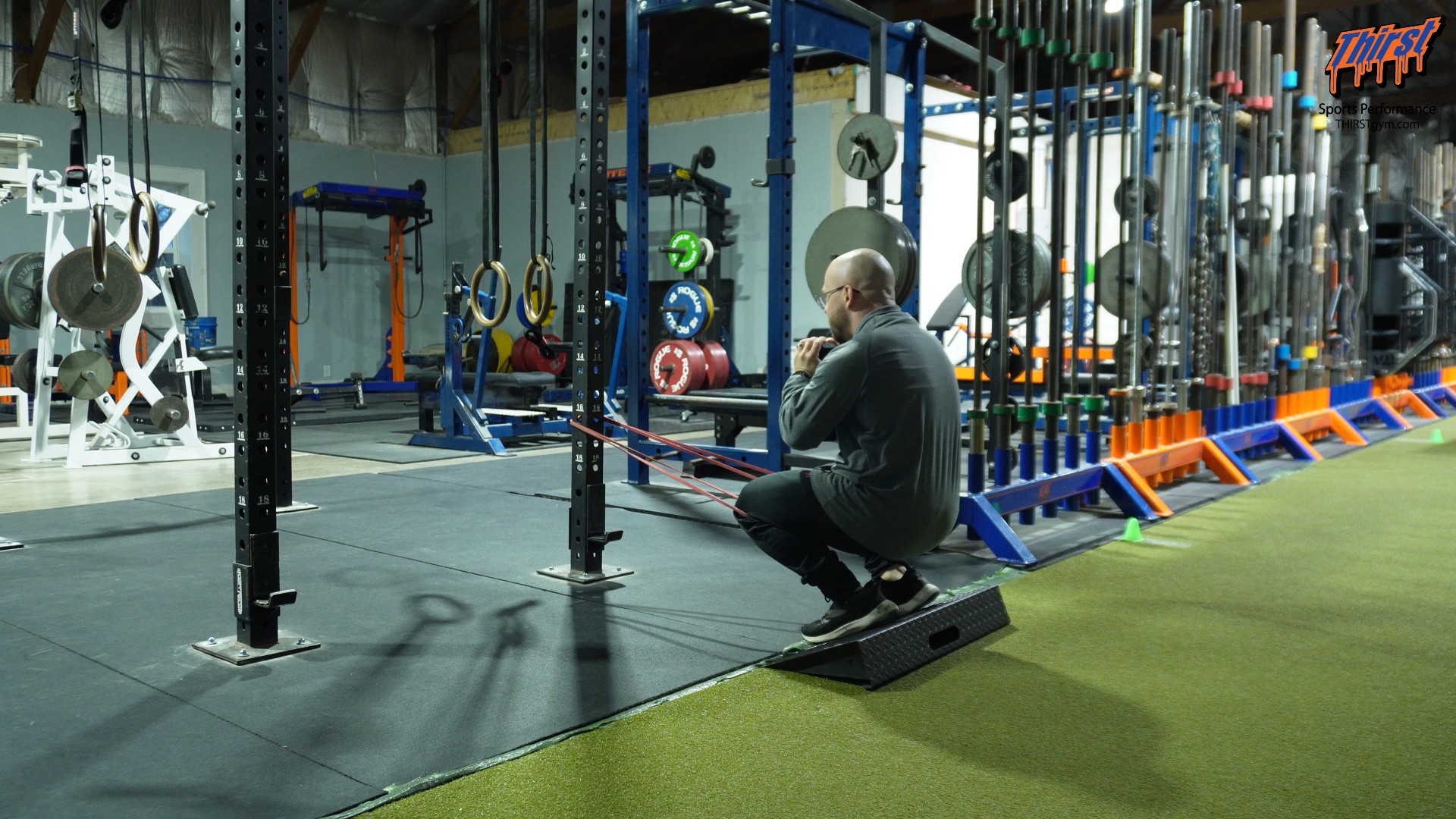
The heels elevated Spanish squat modifies the standard Spanish squat by incorporating a heel raise, typically achieved through a squat ramp, stacked weight plates, or wooden blocks. This adjustment fundamentally changes the exercise’s biomechanical demands by allowing greater ankle dorsiflexion range of motion, enabling a more vertical torso position, and facilitating deeper knee flexion angles while maintaining stability and control throughout the movement pattern.
The resistance band component, positioned behind the knees and anchored to a stable structure, provides continuous anterior tibial translation force that your quadriceps must resist eccentrically during the descent and overcome concentrically during the ascent. This constant tension keeps the quadriceps under mechanical load throughout the entire range of motion, unlike traditional squatting movements where tension can decrease at certain joint angles. The combination of heel elevation and band resistance creates a uniquely challenging stimulus that targets the vastus medialis, vastus lateralis, vastus intermedius, and rectus femoris with exceptional efficiency.
Equipment Setup and Configuration Options
Executing the heels elevated Spanish squat requires several specific pieces of equipment, though creative substitutions allow most training facilities to accommodate this movement. Your primary anchoring point should be a power rack upright, sturdy pole, or similar immovable structure capable of supporting significant band tension without shifting position. The resistance band itself should provide moderate to heavy resistance—light bands won’t create sufficient loading to challenge the quadriceps effectively, while excessively heavy bands can compromise form and positioning.
For heel elevation, purpose-built squat ramps offer the ideal solution by providing a stable, angled surface that accommodates the entire foot while promoting optimal ankle positioning. However, stacked weight plates work equally well for most athletes. A common approach involves stacking five-pound or ten-pound plates to create approximately two to four inches of elevation, though individual anthropometry and mobility limitations may require adjustments to this height. Some lifters successfully use a single forty-five-pound plate laid flat, wooden blocks, or specialized heel elevation wedges designed specifically for this purpose.
The band configuration allows two distinct setup methods, each with particular advantages depending on your equipment and preferences. The first method involves threading the band through itself around the rack upright to create a secure loop, then positioning both legs simultaneously inside the resulting circle. This approach works exceptionally well with continuous loop bands and ensures symmetrical tension distribution across both knees. The alternative method leaves the band unlooped, wrapping it around the anchoring structure and placing each leg individually into the band ends. Both techniques position the band behind the knees where it can apply the necessary anterior shear force that defines the Spanish squat’s unique loading pattern.
Proper Execution Technique and Movement Mechanics
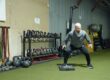
Begin the heels elevated Spanish squat by stepping backward from your anchoring point until you feel substantial tension in the resistance band pulling your knees forward. Your entire foot—or at minimum, the vast majority of your foot—should rest securely on your elevated surface, with your heels firmly planted rather than hanging off the back edge. The band tension at this starting position should actively work to bend your knees, creating a slight forward pull that you must resist to maintain your standing posture.
Hold a dumbbell, kettlebell, or other loading implement in the goblet position at chest height, keeping your elbows tucked and your torso vertical throughout the movement. This anterior loading helps counterbalance the band’s posterior pull while encouraging the upright torso positioning that maximizes quadriceps engagement. From this loaded starting position, descend into the squat by allowing your knees to bend and travel forward, maintaining active control against the band’s pull rather than simply collapsing into the bottom position.
As you reach your lowest comfortable depth—ideally approaching or exceeding parallel if your mobility and structure permit—you should experience significant quadriceps stretch while maintaining a completely flat foot position on your elevated surface. This bottom position represents peak mechanical tension on the quadriceps, particularly the vastus medialis and vastus lateralis fibers responsible for knee stability and the distinctive “teardrop” quad development many lifters pursue.
The ascent phase requires actively driving your knees backward into the resistance band while extending your legs to return to the starting position. This dual action—both extending the knee joint and pushing horizontally against the band—creates exceptional quadriceps activation that continues through lockout rather than diminishing as you approach full extension like many traditional squatting movements. Concentrate on squeezing your quadriceps forcefully at the top of each repetition, achieving complete knee extension while maintaining tension against the band’s forward pull.
Biomechanical Benefits and Training Applications
The heels elevated Spanish squat addresses multiple training objectives simultaneously, making it valuable across diverse training contexts from injury rehabilitation to high-level powerlifting preparation. The heel elevation component allows athletes with limited ankle mobility to achieve deeper squat depths without compensatory movement patterns like excessive forward lean or heel lift. This mechanical advantage proves particularly beneficial for powerlifters working to improve squat depth or athletes recovering from ankle injuries that temporarily restrict dorsiflexion range of motion.
The constant band tension fundamentally alters the exercise’s resistance curve compared to traditional barbell squatting, where peak tension typically occurs in the bottom position and decreases as you approach lockout. By maintaining continuous quadriceps loading throughout the full range of motion, the heels elevated Spanish squat better mimics the sustained tension of machine-based leg exercises while retaining the functional benefits of free-weight movement patterns. This makes the exercise exceptionally effective for hypertrophy-focused training phases where maximizing time under tension drives muscular adaptation.
From a knee health perspective, the band’s anterior tibial force strengthens the posterior cruciate ligament and surrounding connective tissues while teaching your nervous system to control and resist anterior knee translation under load. Many athletes report improved knee comfort during subsequent squatting and jumping activities after consistently incorporating Spanish squat variations into their programming. The exercise also provides valuable proprioceptive feedback through the band contact behind the knees, helping you develop superior kinesthetic awareness of proper knee tracking patterns.
Programming Recommendations and Training Integration
Incorporate the heels elevated Spanish squat as an accessory movement following your primary lower body strength work rather than as a main lift replacement. The exercise works exceptionally well programmed for two to four sets of ten to twenty repetitions, with higher repetition ranges proving particularly effective for hypertrophy and knee rehabilitation objectives while lower ranges suit strength-focused mesocycles better. Allow approximately sixty to ninety seconds of rest between sets to facilitate adequate recovery while maintaining the metabolic stress that contributes to muscular adaptation.
For powerlifters, position this exercise after competition squats and supplemental squatting variations but before isolation movements like leg extensions or leg curls. Athletes training for explosive performance can use the heels elevated Spanish squat as a quad-strengthening complement to plyometric and sprint work, typically scheduling it on strength-emphasis days rather than immediately before high-velocity training sessions. Those pursuing general fitness or physique development goals may program this movement earlier in their lower body training when fatigue levels remain manageable and technique maintenance proves easier.
The heels elevated Spanish squat’s unique combination of joint-friendly mechanics, continuous quadriceps tension, and accessible equipment requirements makes it an invaluable addition to any comprehensive lower body training program focused on sustainable quad development and long-term knee health.