
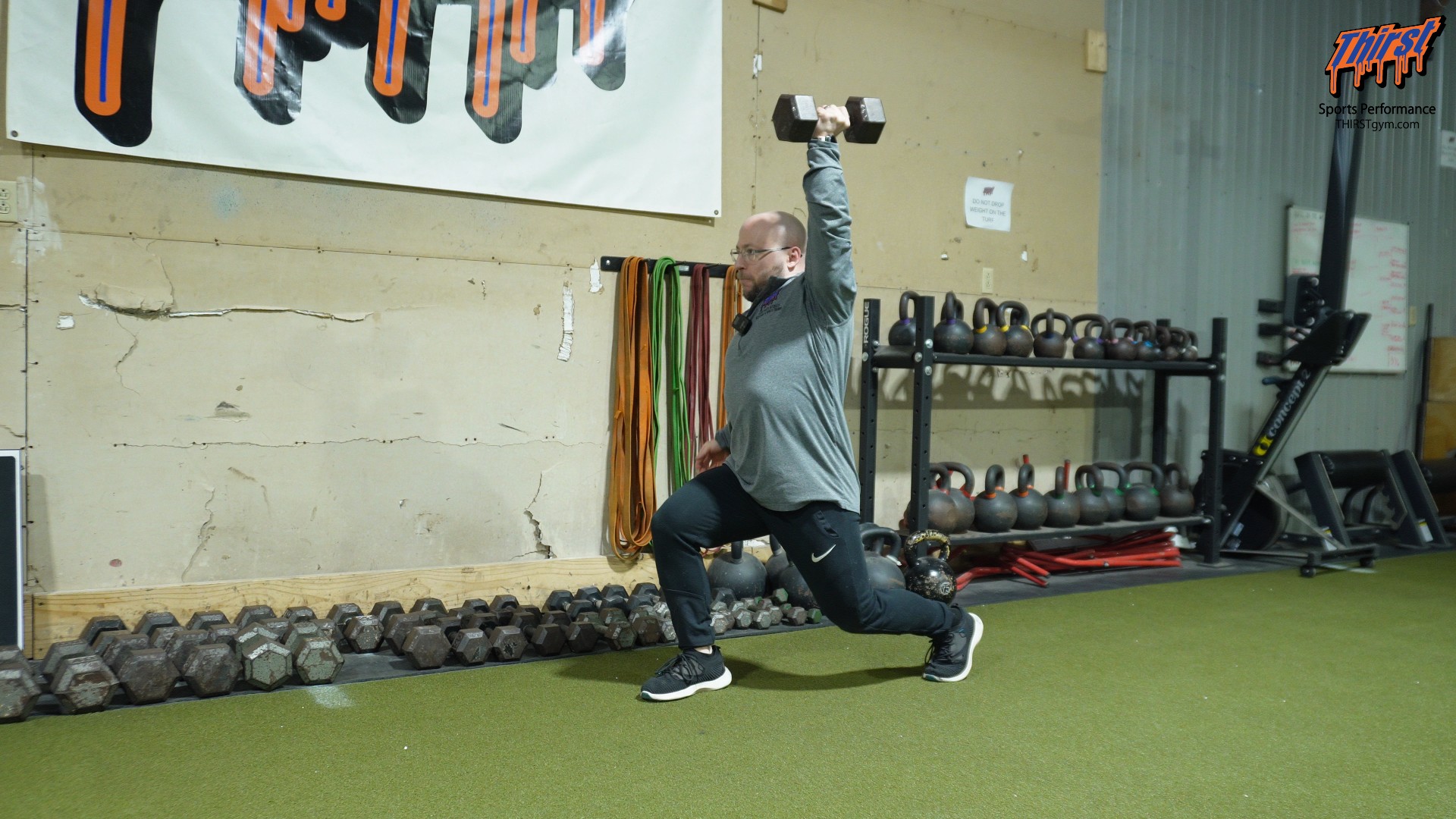
Single Arm Dumbbell Split Jerk: Build Upper Body Power and Explosive Strength
The single arm dumbbell split jerk is one of those exercises that quietly delivers far more than it looks like on the surface. At first glance, it’s a pressing movement. But when you break it down, it’s a full-body power developer that trains explosive hip extension, overhead stability, unilateral coordination, and split stance athleticism — all with nothing more than a single dumbbell and a little space.
Watch the video below on how to maximize this exercise.
Why the Single Arm Dumbbell Split Jerk Belongs in Your Program
The traditional barbell split jerk is a cornerstone of Olympic weightlifting and athletic power development, but getting a barbell into the hands of every athlete in a team setting isn’t always realistic. Whether you’re working with a large group, operating in a limited facility, or simply don’t have access to multiple barbells, the single arm dumbbell split jerk solves that logistical problem without sacrificing the training quality that makes the jerk so valuable in the first place.
Beyond the equipment advantage, this variation introduces a meaningful unilateral component. Because you’re pressing one arm at a time while landing in a split stance, your body has to manage asymmetrical loading through the catch — which is exactly the kind of coordination and stability demand that transfers well to athletic movements like sprinting, cutting, throwing, and combat sports.
How to Set Up and Execute the Movement
Start by holding the dumbbell at shoulder height, the same position you’d use for a push press or push jerk. Your grip should be secure, your elbow angled slightly forward, and the dumbbell resting comfortably at the rack position. Begin with your feet in a jump stance — roughly hip width or slightly wider — so you have a solid base from which to generate power.
The key pairing to remember for this exercise is that the pressing arm and the rear leg move together. If the right hand is pressing, the right leg drops back into the split. The opposite leg drives forward. This cross-body coordination is natural once you feel it, but it’s worth drilling slowly before adding load.
From your starting position, initiate the dip by sending your hips back slightly and bending the knees just enough to load the lower body. This is your power position — don’t rush through it. Then drive your hips upward explosively and violently, using that hip extension to transfer force into the dumbbell press. The dumbbell should accelerate upward, and as it does, you’re simultaneously dropping your body into the split stance below it.
The goal is to move fast underneath the weight, not just push it slowly overhead. Speed of descent into the split is what makes this a true jerk variation rather than a heavy push press. Think: dip, drive, split — each phase is distinct and deliberate.
The Railroad Track Cue
One of the most important coaching cues for the split jerk catch position is the railroad track concept. When you land in your split, your feet should be on two separate tracks, not stacked on a single line. A narrow base creates instability and limits your ability to absorb the weight safely. A proper split stance with your feet on parallel tracks gives you a wide, balanced platform to receive the dumbbell overhead and hold the position with control.
Recovery and Footwork
After catching the dumbbell in the split position, your recovery back to standing matters. With a barbell, the standard technique is to drive the front foot back to return to the starting position. With a dumbbell, stepping the front foot forward is slightly more practical and acceptable, especially for lighter loads and introductory coaching. That said, if your athletes are working with heavier dumbbells, encourage them to practice the standard recovery — front foot steps back first — as it more closely mirrors proper weightlifting mechanics and builds better habits long term.
Programming Recommendations
Because this is a power and explosive strength movement, it should be treated accordingly in your programming. Load selection matters, but speed of execution matters more. If the movement starts to look like a slow, grinding overhead press, the weight is too heavy. You want to see explosive hip drive, a fast drop into the split, and a solid lockout overhead with the dumbbell directly above the shoulder.
For sets and reps, three to five sets of three to five reps per side is a reliable starting point. This keeps the total volume manageable while allowing you to push the intensity and focus on quality mechanics each rep. The single arm dumbbell split jerk fits well early in a training session as a primary power movement, or it can serve as a complementary lift alongside heavier barbell work on upper body or full-body training days.
This is a versatile, equipment-friendly exercise with a high ceiling for athletic development. Whether you’re coaching a youth sports team, working with combat athletes, or simply looking to add explosive overhead work to your own training without a barbell, the single arm dumbbell split jerk earns its place.