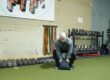


Front Foot Elevated Split Stance Cable Row with Opposite Reach: A Complete Guide
The front foot elevated split stance cable row with opposite reach represents an intelligent fusion of upper body strength training and postural correction that addresses multiple training objectives simultaneously. This sophisticated rowing variation goes beyond simple back development by incorporating lower body positioning, rotational control, and deliberate pelvic management that makes it particularly valuable for athletes struggling with stiffness, postural dysfunction, or anterior pelvic tilt patterns.
Watch the video below on how to maximize this exercise.
Equipment and Setup Requirements
Setting up this exercise requires an adjustable cable machine with a D-handle attachment positioned approximately at belly button height. The precise cable height matters less than ensuring you can achieve proper body positioning throughout the movement. You’ll also need an elevation platform measuring roughly 2 to 3 inches in height for your front foot. A DC block works perfectly for this purpose, though you have considerable flexibility in your equipment choices. Standard 45-pound weight plates, stacked yoga mats, or sturdy wooden blocks all serve equally well as elevation platforms, giving you options whether you’re training in a commercial gym or working with limited home equipment.
Movement Execution and Body Positioning
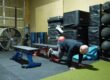
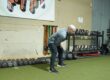
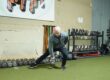
The setup process begins by grasping the D-handle with one hand and walking backward toward your elevation platform while maintaining tension on the cable. Your foot placement follows a specific pattern: the foot opposite to your rowing hand elevates onto the platform. If you’re holding the cable in your left hand, your right foot goes on the elevated surface. Your back leg extends behind you in a true split stance position, remaining on the toe rather than the entire foot. This creates the foundation for everything that follows.
The front leg’s knee bends slightly while your hips drop straight downward into what you might think of as a controlled sink position. Your pelvis positions itself directly over your midsection rather than tilting forward or shifting backward, creating a vertical stacking of your ribcage and pelvis. The rowing arm extends long, allowing the cable to pull you forward slightly, while your opposite arm prepares for its reaching component. From this loaded position, you initiate the row by pulling the cable toward your body while simultaneously reaching your free arm across your torso. The cable then controls your return to the starting position before you repeat the pattern.
Critical Positioning Details for Maximum Effectiveness
The front leg’s positioning deserves particular attention because it determines whether this exercise delivers its intended benefits. Your front knee should track relatively back behind your body, creating what we call a vertical shin position rather than allowing the knee to drift forward over the toes. This shin angle works in conjunction with the elevated front foot to encourage your hips to drop straight down into the sink position. While you remain well above 90 degrees of knee flexion, your legs work isometrically to hold this position throughout the rowing movement, creating unexpected lower body engagement despite this being classified as an upper body exercise.
Maintaining proper spinal positioning requires conscious attention to your ribcage and pelvic relationship. You want these structures stacked vertically rather than allowing your lower back to arch excessively. Many people instinctively arch through their lumbar spine when performing rowing variations, but this exercise’s specific setup helps you avoid that compensation pattern by encouraging better positional awareness.
Why This Exercise Works So Effectively
The front foot elevated positioning creates a mechanical advantage that allows you to push yourself backward, making it considerably easier to adjust your body position and maintain your pelvis underneath your center of mass. This proves particularly valuable for individuals dealing with anterior pelvic orientation or anterior pelvic tilt, common postural patterns that can interfere with both exercise performance and daily function. By getting these individuals out of their typical compensatory position, you can deliver high-quality upper body training without reinforcing problematic movement patterns.
The rotational component created by reaching your opposite arm across your body serves a purpose beyond simple coordination challenge. This reaching pattern keeps your ribcage moving fluidly rather than becoming locked and rigid during the rowing motion. For athletes who tend toward excessive stiffness or feel bound up in their trunk, this fluidity becomes crucial for maintaining healthy movement patterns. The exercise essentially allows you to accomplish two objectives simultaneously: building upper body strength through the rowing component while preserving or improving trunk mobility through the reaching pattern.
The combination of getting an athlete’s center of mass positioned back behind them while still loading their upper body musculature creates what strength coaches call a “money exercise”—something that delivers multiple training benefits from a single movement pattern. You’re developing back strength, improving postural control, working on rotational movement quality, and addressing common compensation patterns all within one exercise selection.
Programming Recommendations and Training Applications
This exercise responds best to moderate volume and moderate repetition ranges, typically programmed for 2 to 4 sets of 8 to 12 repetitions per side. The emphasis should remain on movement quality rather than maximal loading. You want each repetition to stay fluid and controlled rather than becoming grindy or forced. Think of this as being as much about movement quality as it is about progressive overload on the cable stack. The weight should challenge you without causing you to lose position, break form, or sacrifice the rotational component.
This makes the front foot elevated split stance cable row with opposite reach particularly appropriate for athletes dealing with excessive stiffness, postural dysfunction, or those needing to build upper body strength while simultaneously addressing movement quality concerns. The exercise fits well into corrective exercise programs, general strength training, and athletic development protocols where maintaining mobility alongside strength development matters.