
Half Kneeling Single Arm Kettlebell Bottoms Up Overhead Press: The Ultimate Shoulder Stability Exercise
The half kneeling single arm kettlebell bottoms up overhead press represents one of the most effective exercises for developing true shoulder stability and control. This sophisticated kettlebell variation combines the postural demands of the half kneeling position with the intense stabilization requirements of bottoms up pressing, creating a movement that challenges your shoulder complex in ways that traditional overhead pressing simply cannot match.
Watch the video below on how to maximize this exercise.
Understanding the Half Kneeling Bottoms Up Press
Unlike conventional overhead pressing movements where maximum load is the primary goal, the half kneeling bottoms up kettlebell press is fundamentally a shoulder stability exercise disguised as a strength movement. The unique challenge comes from holding the kettlebell upside down—with the heavy bell portion facing the ceiling—while pressing it overhead from a half kneeling position. This inverted grip position creates an unstable load that wants to tip and rotate in your hand, forcing the smaller stabilizer muscles throughout your shoulder girdle, rotator cuff, and scapular complex to work overtime to maintain control.
The half kneeling position adds another layer of complexity by reducing your base of support and eliminating your ability to compensate through your lower body. This stance creates an environment where your core must remain fully engaged to prevent rotation or extension through your lumbar spine, while simultaneously allowing you to focus purely on shoulder mechanics without the stability advantages that standing or seated positions provide.
Proper Setup and Execution Technique
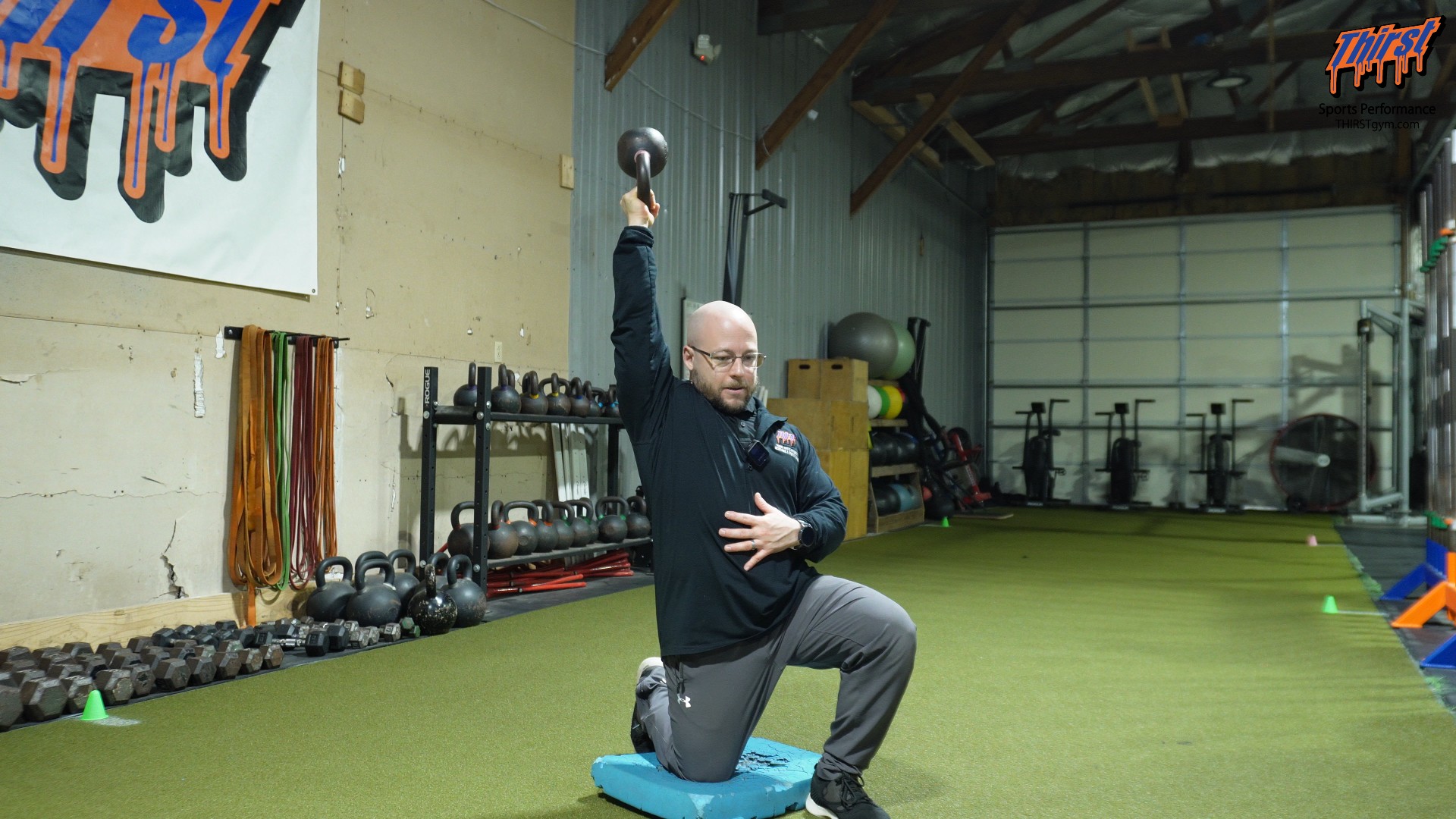
Setting up the half kneeling position correctly is essential for getting maximum benefit from this exercise. Begin by placing one knee on the ground with your other leg positioned forward, creating a 90-degree angle at both the hip and knee joint of your front leg. Your back leg should be relatively straight down from your hip, with your back toes dug into the ground for additional stability. If you find kneeling on hard surfaces uncomfortable, placing a pad or cushion under your knee can help, though it’s completely optional.
The kettlebell should be held in the hand on the same side as your down knee—if your right knee is down, you’ll press with your right hand. This ipsilateral loading pattern creates specific rotational stability demands that make the exercise particularly effective for developing anti-rotation strength through your core. Grip the kettlebell so it’s inverted, with the handle pointing down and the bell portion facing toward the ceiling. Start with your palm facing toward the midline of your body in a neutral grip position, with your elbow positioned directly underneath your wrist.
Before initiating the press, establish a strong postural foundation. Keep your ribs down and pulled toward your hips rather than flaring upward, maintain a tall chest position, and brace your core as if preparing to take a punch. From this stable base, press the kettlebell straight overhead, reaching as high as possible toward the ceiling while maintaining that inverted bottoms up position. The bell will want to tip and wobble, requiring constant micro-adjustments from your shoulder stabilizers to keep it balanced. Lower the kettlebell back to the starting position with control, reset your posture if needed, and repeat for the prescribed number of repetitions before switching sides.
The Biomechanical Benefits and Why This Exercise Works
The bottoms up kettlebell press creates unique training demands that directly translate to improved shoulder health and overhead pressing performance. By forcing you to balance an unstable load, this exercise maximally recruits your rotator cuff muscles—the subscapularis, supraspinatus, infraspinatus, and teres minor—which are responsible for centering your humeral head in the shoulder socket and providing dynamic stability throughout the pressing motion. These smaller muscles often remain underactive during traditional pressing movements where larger prime movers like the deltoids and triceps dominate the work.
The half kneeling position serves multiple purposes beyond simple variation. This stance limits your ability to use leg drive or generate momentum from your lower body, ensuring that your shoulders do all the work. It also creates a longer lever arm through your torso, meaning your core must work harder to resist extension and rotation. This anti-extension and anti-rotation demand helps reinforce proper ribcage position and develops the type of core stability that directly transfers to safer, more efficient pressing mechanics in all your overhead movements.
Perhaps most importantly for those who experience discomfort with traditional overhead pressing, the enhanced stability demands of the bottoms up press often make the overhead position feel more accessible and controlled. When your stabilizer muscles are properly engaged and working to balance the unstable load, many people find they can achieve better overhead positions with less compensatory movement through their spine or shoulder girdle.
Programming Recommendations and Load Selection
The half kneeling bottoms up press should be programmed primarily as a shoulder stability and motor control exercise rather than a maximum strength builder. Appropriate programming typically includes two to four sets of eight to twelve repetitions per side, performed earlier in your training session when you’re fresh and can maintain quality movement patterns. Because the exercise demands significant concentration and control, fatigue can quickly compromise technique and reduce the training benefit.
Weight selection requires a humble approach—you’ll use significantly less load than you might expect, often starting with kettlebells that feel almost comically light compared to your regular pressing weights. This is precisely the point. The goal isn’t to move heavy weight but to develop rock-solid stability and control throughout the entire range of motion. Start with a lighter kettlebell that allows you to complete all repetitions with perfect form, then gradually progress the load as your stability improves. Once you can complete twelve clean repetitions on both sides, you’re ready to progress to the next kettlebell size.
Addressing Hand Dominance and Asymmetries
Most people will notice a significant difference in stability and control between their dominant and non-dominant sides. If you’re right-handed, you’ll likely find that your right shoulder has better inherent stability and can handle the bottoms up press more easily than your left. This makes the exercise particularly valuable for identifying and addressing shoulder asymmetries that might otherwise go unnoticed.
When training with this awareness, always begin your sets with your non-dominant arm. This allows you to assess where your weaker side is at when you’re freshest and most focused, ensuring you don’t shortchange the development of that side. Your stronger, dominant arm will typically handle the movement more easily, but over time and with consistent training, you’ll progressively bridge that gap and develop more balanced shoulder stability on both sides.
Who Should Include This Exercise in Their Training
The half kneeling bottoms up press serves multiple populations effectively. For athletes requiring robust shoulder stability—particularly overhead athletes in sports like baseball, volleyball, swimming, or combat sports—this exercise develops the precise type of stabilizer strength that protects the shoulder during dynamic, unpredictable movements. Powerlifters and strength athletes benefit from improved shoulder stability that transfers directly to better bench press lockout strength and safer overhead pressing mechanics. Those experiencing shoulder discomfort during traditional pressing movements often find that building stability through bottoms up variations allows them to return to standard overhead pressing with better mechanics and less pain. Even general fitness enthusiasts looking to develop well-rounded shoulder strength and injury resilience will find value in incorporating this challenging stability variation into their programming.