
Landmine RDL: A Versatile Hip Hinge Exercise for Building Posterior Chain Strength
The landmine RDL (Romanian deadlift) represents one of the most underutilized variations of the classic hip hinge pattern. This barbell exercise offers a unique loading angle that creates distinct training benefits compared to traditional deadlift variations, making it an excellent choice for everyone from complete beginners learning proper hip hinge mechanics to advanced lifters looking for an effective accessory movement to strengthen their glutes and hamstrings.
Watch the video below on how to maximize this exercise.
Equipment and Setup for the Landmine Romanian Deadlift
To perform the landmine RDL, you’ll need a barbell, a landmine attachment, and weight plates appropriate for your strength level. The landmine apparatus is a pivoting sleeve that anchors one end of the barbell while allowing rotational movement. If you don’t have access to a landmine attachment at your gym or home setup, there’s a simple workaround: wedge the end of your barbell securely into the corner of a wall or find another stable anchor point where the bar can rotate freely without slipping during the movement.
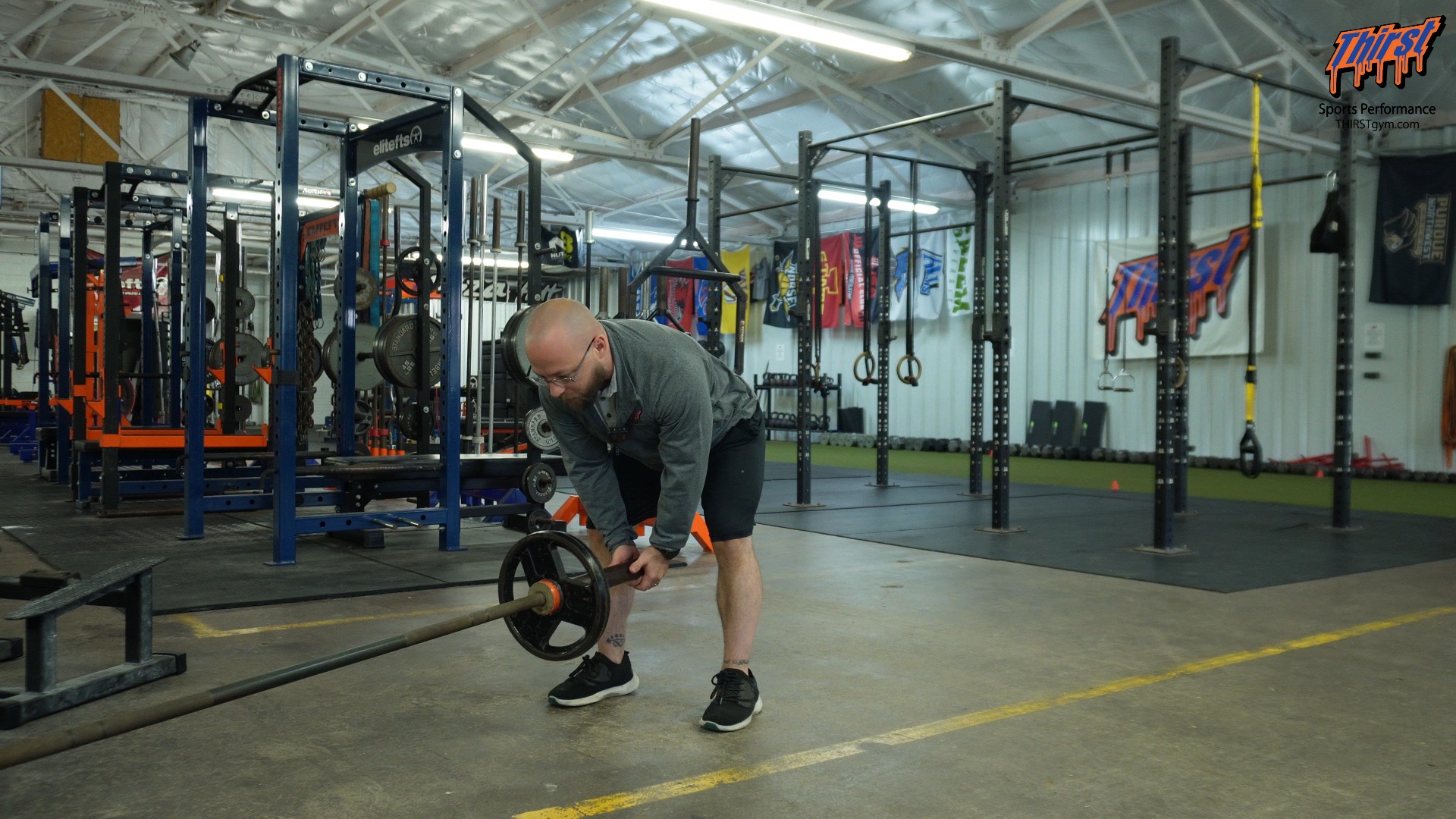
The setup begins with positioning yourself facing away from the landmine anchor point. Stand with your feet approximately hip-width apart, though you can go slightly wider if that feels more comfortable and stable for your body. Reach down and grasp the end of the barbell with both hands clasped together underneath the top plate. This hand position keeps the load centered and allows you to maintain better control throughout the movement pattern.
Proper Landmine RDL Technique and Movement Execution
The execution of the landmine RDL follows the fundamental principles of any quality hip hinge exercise, but with the added benefit of the fixed barbell path provided by the landmine setup. Begin the movement by establishing a strong starting position with your knees slightly bent—not locked straight, but not deeply flexed either. Keep your chest proud and tall, pulling your shoulder blades back slightly to create tension through your upper back.
From this position, initiate the hinge by pushing your hips backward as if you’re trying to touch a wall behind you with your glutes. This is the crucial distinction between a proper hinge and simply bending forward at the waist. As your hips travel backward, your torso will naturally incline forward while maintaining a neutral spine position. Your back should stay flat throughout the entire range of motion, avoiding any rounding through the lumbar spine or excessive arching.
Throughout the descent phase, your arms function purely as hooks connecting your body to the load. There should be no active pulling or rowing motion with your upper body—simply allow your arms to hold the weight while your hips do the work of controlling the eccentric lowering phase. The barbell will naturally stay in your body’s midline throughout the movement thanks to the fixed anchor point of the landmine, which is one of the key advantages of this variation.
You should feel the majority of your weight shifting toward your heels as you push your hips back, creating tension and loading through your posterior chain muscles. Descend until you feel a substantial stretch in your hamstrings, then reverse the movement by driving your hips forward to return to the starting position. Think about pushing the floor away with your feet and squeezing your glutes at the top to complete each repetition with full hip extension.
Why the Landmine RDL Works So Effectively
The landmine RDL offers several unique advantages that make it particularly valuable in a comprehensive training program. The angled loading pattern created by the landmine setup changes the resistance curve compared to traditional barbell RDLs, often making the exercise feel more natural and comfortable, especially for taller lifters who sometimes struggle with conventional deadlift variations.
For beginners who are still developing their hip hinge pattern, the landmine RDL provides built-in feedback that makes learning the movement significantly easier. The fixed path of the barbell creates a natural constraint that prevents you from making the common mistake of bending forward at the waist rather than hinging at the hips. If you try to lean forward incorrectly, the barbell simply won’t move properly because of the landmine anchor, essentially forcing you into better technique.
The exercise primarily targets the glutes and hamstrings, making it an excellent posterior chain builder. Because you’re using both legs simultaneously and loading a fundamental movement pattern, you can progressively overload this exercise quite heavily, especially as an accessory movement later in your workout after your primary strength work is complete.
Programming the Landmine RDL in Your Training
As an accessory exercise, the landmine RDL works best when programmed for moderate volume with controlled execution. A solid starting point is two to three sets of eight to twelve repetitions, focusing on quality movement rather than maximal loading. This rep range allows you to maintain proper form throughout each set while accumulating enough training volume to drive hypertrophy and strength adaptations in your hamstrings and glutes.
Don’t be afraid to load this exercise progressively heavier. Many lifters underestimate how much weight they can handle on landmine RDL variations, but remember that you’re working a bilateral pattern with your strongest muscle groups. As the weight increases, you can set up the loaded barbell on a box or elevated surface and step to the side of it for your setup, making it easier to get into position safely.
For those looking to really challenge their grip strength and load the movement heavily, lifting straps can be a valuable tool. Using straps allows you to focus entirely on the hip hinge pattern and posterior chain work without grip fatigue becoming the limiting factor.
Whether you’re a beginner learning fundamental movement patterns or an experienced lifter seeking effective accessory work, the landmine RDL deserves a place in your lower body training arsenal. Its unique loading angle, built-in movement constraints, and ability to effectively target the glutes and hamstrings make it a versatile exercise that can benefit lifters at every level.