
Sidelying Thoracic Rotation: The Foam Roller Exercise That Unlocks Upper Back Mobility
The sidelyin thoracic rotation is a highly effective mobility exercise that addresses one of the most common movement limitations in modern training and daily life: restricted thoracic spine rotation. Whether you’re an athlete preparing for heavy pressing movements, a desk worker struggling with upper back stiffness, or someone simply looking to improve shoulder health and posture, this foam roller-based drill provides a controlled, accessible way to restore rotational mobility through your mid-back region.
What makes the sidelying thoracic rotation particularly valuable is its self-limiting design. By using a foam roller as both a positioning tool and feedback mechanism, this exercise ensures you’re creating movement specifically through your thoracic spine rather than compensating through your lumbar spine or relying on momentum. This targeting precision makes it an intelligent choice for anyone dealing with the thoracic stiffness that develops from prolonged sitting, one-dimensional training programs, or simply the forward-focused nature of modern life.
Watch the video below on how to maximize this exercise.
Understanding Thoracic Rotation and Why It Matters
Your thoracic spine—the mid-back region consisting of twelve vertebrae—is designed for significant rotational capacity. This area should provide the majority of your upper body rotation, protecting your lower back from excessive twisting forces while enabling efficient movement patterns in everything from throwing and swinging to reaching and pressing. When thoracic rotation becomes restricted, your body compensates by seeking that movement elsewhere, typically forcing excessive rotation through your lumbar spine or creating compensatory patterns at your shoulders.
The sidelying thoracic rotation directly addresses this limitation by positioning your body in a way that isolates thoracic movement. The foam roller under your top knee serves a critical function: it provides tactile feedback that keeps your pelvis and lower back stable, ensuring the rotation happens where it should. This setup transforms a simple mobility drill into a precise corrective exercise that retrains proper movement segmentation throughout your spine.
Equipment and Setup for Sidelying Thoracic Rotation
While this exercise specifically utilizes a foam roller, the length and density matter less than you might think. A longer foam roller allows your entire leg to rest comfortably, which can be more relaxing and easier to maintain throughout the set, but a shorter roller or even a yoga block, medicine ball, or folded towel can serve the same functional purpose. The key is creating a stable surface that keeps your top knee elevated and provides clear feedback when you maintain position versus when you start compensating.
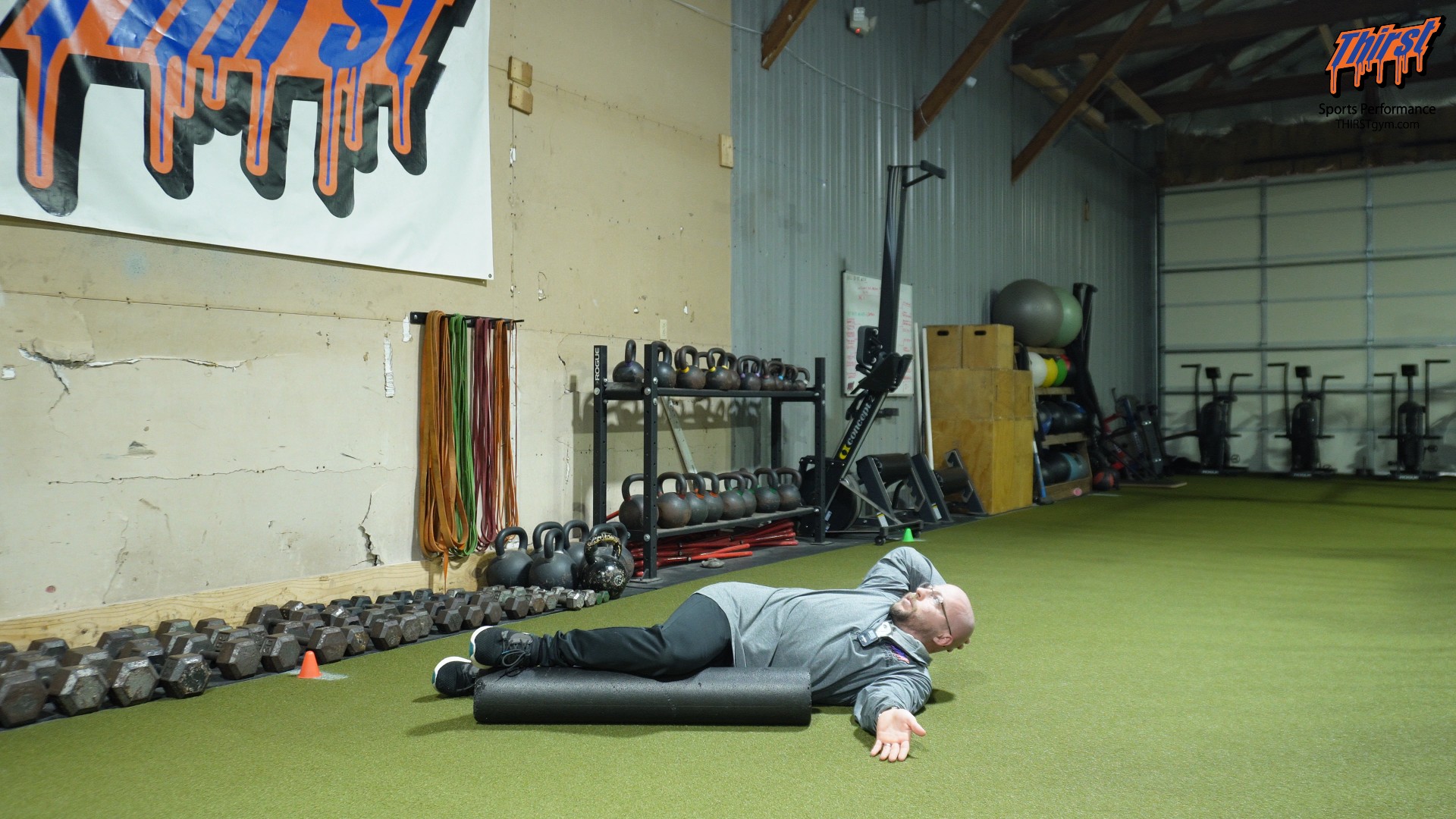
Begin by lying on your side with the foam roller positioned beside you. Your top leg—the one that will rest on the foam roller—should be bent with your knee placed directly on top of the roller. This positioning is crucial: the foam roller becomes your stability checkpoint, and maintaining contact throughout the movement ensures you’re not cheating the exercise by rotating through your hips or lower back. Your bottom leg can remain extended or slightly bent depending on what feels most stable and comfortable.
Your bottom arm extends out in front of you at roughly shoulder height, providing a base of support and reference point. Your top hand comes behind your head in a position similar to a crunch or sit-up setup. This hand placement behind your head serves multiple purposes: it adds some weight to encourage deeper rotation, it prevents you from using arm momentum to force the movement, and it keeps your shoulder blade properly positioned on your ribcage throughout the exercise.
Executing the Movement with Proper Breathing
From your setup position, begin the rotation by opening your top elbow and shoulder toward the ceiling and behind you, attempting to rotate your upper back as far as comfortable while keeping your knee firmly planted on the foam roller. This is where the exercise’s brilliance becomes apparent—the moment you try to cheat by rotating through your hips or lower back, your knee will lift off the roller, immediately providing feedback that you’ve lost proper position.
Breathing coordination significantly enhances the effectiveness of this drill. As you rotate open into thoracic extension and rotation, exhale fully and deliberately. This exhale serves several important functions: it engages your deep core musculature to stabilize your spine, it prevents you from compensating through excessive back extension, and it can actually facilitate greater range of motion by allowing your ribcage to move more freely. Many practitioners find that each exhale allows them to rotate slightly deeper as tension releases through their thoracic region.
Return to the starting position in a controlled manner, then repeat the movement for your prescribed repetitions. With each repetition, focus on moving slightly further into rotation as your tissues warm up and your nervous system becomes comfortable with the new range of motion. This progressive exploration of range is more effective than forcing maximum rotation on the first rep.
Common Mistakes and Technical Corrections
The most frequent error in the sidelying thoracic rotation is allowing excessive back extension—arching through your lower back rather than rotating through your upper back. This compensation typically occurs when someone lacks the thoracic mobility to achieve the rotation they’re attempting, so their body finds an easier alternative. The visual cue to avoid this is maintaining a relatively stacked spinal position rather than allowing your chest to thrust forward as you rotate. The exhale pattern helps prevent this compensation by maintaining core engagement throughout the movement.
Another common mistake is using the top leg actively to force rotation or allowing it to lift off the foam roller. Your top leg should remain completely relaxed, serving only as the anchor point that provides feedback about your pelvic position. If you find your knee consistently lifting off the roller, you’re likely rotating through your hips and lumbar spine rather than isolating thoracic movement. Scale back your range of motion and focus on quality rotation where it should occur.
Some individuals also rush through the repetitions, using momentum rather than control. The sidelying thoracic rotation should be performed deliberately, with 2-3 seconds spent opening into rotation, a brief pause at your end range, and a controlled return to the starting position. This tempo allows your nervous system to process the new position and can lead to more lasting improvements in mobility.
Programming and Application Strategies
The sidelying thoracic rotation functions effectively in multiple training contexts. As a warm-up drill before upper body pressing sessions—whether you’re benching, doing overhead presses, or performing push-ups—this exercise prepares your thoracic spine and shoulders for loaded movement patterns. Performing one to two sets of 8-10 repetitions per side before your pressing work can improve your positioning under the bar and reduce shoulder discomfort during your training session.
As a filler exercise between sets of compound upper body movements, the sidelying thoracic rotation provides active recovery that actually enhances subsequent performance rather than simply killing time. Between sets of bench press, weighted pull-ups, or overhead pressing, performing 5-8 rotations per side keeps your thoracic mobility fresh and can prevent the upper back tightness that accumulates during intense training sessions.
For individuals dealing with chronic desk posture issues or those following programs heavy in anterior chain work, including this exercise in dedicated mobility sessions or off-day recovery work addresses movement limitations before they become problematic. Two to three sets of 10 repetitions per side, performed with focus on breathing and progressive range exploration, can significantly improve your thoracic rotation capacity over time.
Benefits for Different Training Populations
Powerlifters and strength athletes particularly benefit from improved thoracic rotation as it enhances their ability to create upper back tightness during heavy pressing while maintaining shoulder health through balanced mobility. The sidelying position can actually facilitate greater mobility gains for compressed athletes who struggle with traditional rotation drills.
Combat sports athletes require significant rotational capacity for striking, grappling, and positional changes. The sidelying thoracic rotation provides a low-fatigue way to maintain and improve this essential movement quality without interfering with technical training demands.
General fitness enthusiasts and desk workers often discover that this simple drill provides remarkable relief from upper back tightness and improves their overall posture throughout the day. The exercise’s accessibility—requiring only a foam roller and floor space—makes it easy to perform regularly, which is exactly what creates lasting change in movement capacity.
The sidelying thoracic rotation exemplifies intelligent exercise design: simple enough for anyone to perform, specific enough to create targeted change, and self-correcting through its built-in feedback mechanism. Whether you’re preparing for a heavy training session or addressing chronic stiffness from desk work, this foam roller drill deserves a place in your movement practice.