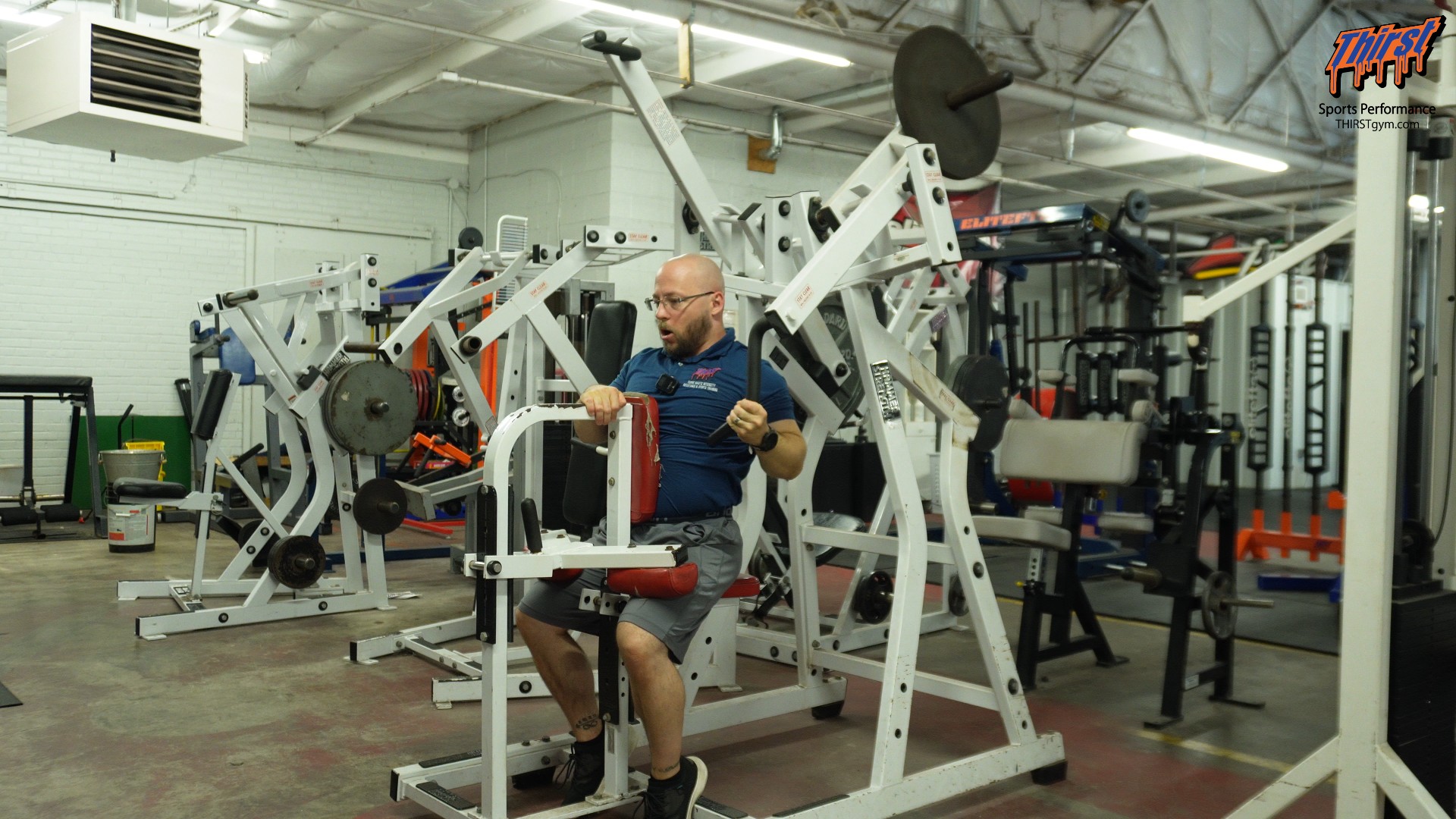
Single Arm Hammer High Row Machine: Building Back Thickness Through Unilateral Training
The single arm hammer high row machine represents one of the most effective tools for developing upper back thickness while simultaneously addressing muscular imbalances that commonly plague bilateral rowing movements. This unilateral rowing variation allows you to focus intensely on each side of your back independently, creating an environment where weaker areas cannot hide behind stronger ones and where you can typically handle significantly more load than traditional two-arm rowing patterns would allow.
Watch the video below on how to maximize this exercise.
Equipment Requirements and Setup Fundamentals
To perform this exercise properly, you’ll need access to a hammer strength high row machine or a similar piece of equipment that allows for a high pulling angle. The ideal machine will feature independent handles that permit true unilateral work, meaning each arm can move through its range of motion without being mechanically linked to the other side. If your facility doesn’t have a dedicated hammer high row, you can often substitute with certain lat pulldown machines or cable stations set at an appropriate height, though the biomechanics won’t be quite as optimal.
The setup process begins with adjusting the seat height so that when you’re seated with your chest against the pad, the handles align roughly with your shoulder height or slightly above. This positioning is crucial because it determines the angle of pull and which portions of your back musculature will be emphasized. A higher pulling angle tends to target the upper and middle trapezius fibers more aggressively, while also recruiting significant rhomboid activation. Getting yourself properly secured into the chest pad isn’t just about comfort; it’s about creating a stable platform from which you can generate maximum force without your torso shifting around and dissipating that force into unwanted movement.
Mastering the Movement Pattern and Biomechanics
The execution of the single arm hammer high row demands attention to several key technical elements that separate an effective repetition from one that simply goes through the motions. Beginning with your grip selection, you have the choice between a neutral grip where your palm faces inward or a supinated grip where your palm faces upward. The neutral grip position tends to feel more natural for most people and places the shoulder in a mechanically advantageous position, though experimenting with grip variations can help you determine what feels strongest and most comfortable for your individual anatomy.
Once you’ve secured your grip on one handle, the opposite hand should grasp something stable on the machine itself, typically a metal support beam or frame near your torso. This stabilization point serves a critical function beyond simply giving you something to hold onto. By anchoring your non-working side, you create a more rigid torso position that prevents excessive rotation and allows you to channel more force into the actual rowing movement rather than losing energy to compensatory twisting motions. This stabilization becomes increasingly important as you progress to heavier loads where the temptation to use momentum and body english becomes greater.
The actual pulling motion should emphasize driving your elbow down and back behind your body rather than simply pulling with your arm. This distinction is fundamental to understanding proper rowing mechanics. When you focus on elbow drive, you automatically engage the larger muscles of your back, specifically the latissimus dorsi, the middle and lower trapezius fibers, and the rhomboids. If instead you pull primarily with your arm and think about bringing the handle to your body, you’ll likely end up performing more of a bicep curl variation that bypasses much of the back recruitment you’re seeking.
Throughout the concentric pulling phase, maintaining an upright, tall chest position prevents you from collapsing forward, which would reduce scapular range of motion and limit how effectively you can retract your shoulder blade. As you reach the peak contraction with your elbow pulled back as far as it will comfortably go, you should feel a strong squeeze between your shoulder blade and your spine. This is the money zone where you’re maximally recruiting the muscles responsible for scapular retraction and depression.
The eccentric or lowering phase deserves equal attention to the pull itself. Rather than simply letting the weight drop back to the starting position, you should control the descent while allowing your arm to reach full extension. This complete lengthening of the working muscles serves multiple purposes. First, it ensures you’re training through a full range of motion, which research consistently shows produces superior muscle development compared to partial ranges. Second, that stretch position under load at the bottom creates significant mechanical tension in the lengthened state, a key stimulus for hypertrophy. Third, achieving full arm extension requires your shoulder blade to protract fully forward, meaning you’re training both the retraction and protraction portions of scapular movement, contributing to better overall shoulder girdle health and function.
One subtle but valuable cue involves allowing a slight rotation of your torso toward the working arm as you pull. This natural rotation enables a deeper range of motion and a more complete scapular retraction than trying to remain perfectly square to the machine. The key word here is “slight” – you’re not performing a massive twist, but rather allowing your body to move in the way it naturally wants to move during a pulling motion, which happens to follow a slight arc rather than a perfectly linear path.
Programming Strategies and Load Management
The single arm hammer high row works exceptionally well in the moderate-to-heavy loading range with controlled repetitions. A typical programming approach involves three to four sets of six to ten repetitions per arm, using a weight that challenges you within that rep range while maintaining technical proficiency. This rep and set scheme positions the exercise nicely for building both muscular size and strength, sitting in that sweet spot where you can use meaningful loads without sacrificing movement quality.
Because you’re working unilaterally, you’ll likely discover that you can handle more absolute weight per arm than you could if performing the same movement bilaterally with both arms simultaneously. This happens because your body doesn’t have to split its stabilization efforts between two sides, allowing you to generate more force through the working limb. Don’t be surprised if you find yourself loading significantly heavier than half of what you might use on a two-arm variation – this is both normal and one of the primary benefits of unilateral training.
For individuals who find that grip strength becomes the limiting factor before back fatigue, using lifting straps represents a practical solution that allows you to continue overloading the target muscles without being held back by forearm endurance. While developing grip strength has value, there’s no reason to artificially limit your back development because your hands give out first. Save the grip-specific work for dedicated grip training or exercises where grip is the primary focus.
Target Applications and Training Populations
This exercise serves multiple populations effectively, from powerlifters seeking to build a thicker, more stable upper back for better squat and deadlift positioning, to general fitness enthusiasts working to improve posture and shoulder health, to athletes requiring unilateral pulling strength for their sport. The ability to identify and address side-to-side strength imbalances makes this particularly valuable for anyone who’s noticed that one side of their back tends to dominate during bilateral movements or who experiences asymmetric muscle development.
For those dealing with postural issues related to prolonged sitting or forward shoulder positioning, the single arm hammer high row provides an excellent corrective exercise option. The movement pattern directly strengthens the muscles responsible for pulling the shoulder blades back and down, counteracting the chronic forward shoulder position that develops from desk work and device usage. The unilateral nature ensures that your stronger side cannot compensate for a weaker side, forcing both sides to develop equal capacity over time.
Understanding both the mechanics and the strategic applications of the single arm hammer high row transforms it from just another back exercise into a precision tool for building a more complete, balanced, and functional upper body. Whether your goals center on aesthetics, performance, or movement quality, this variation deserves consideration in your training rotation.