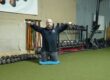


Tall Kneeling Cable Straight Arm Lat Pull Down: A Full-Body Lat Training Exercise
The tall kneeling cable straight arm lat pull down represents a sophisticated progression from traditional straight arm pulldown variations, combining targeted lat development with integrated core stability demands. This exercise variation eliminates the common compensatory patterns seen in standing or seated versions while creating a comprehensive upper body pulling movement that challenges both your lats and your ability to maintain a stable, anti-extension position throughout the range of motion.
Watch the video below on how to maximize this exercise.
Equipment Setup and Attachment Options
To properly execute the tall kneeling cable straight arm lat pull down, you’ll need an Airex pad or comfortable kneeling surface to protect your knees during the exercise. The cable machine should be set with the pulley positioned well above your head height when kneeling, creating a vertical pulling angle that maximizes lat engagement throughout the movement pattern.
The beauty of this exercise lies in its attachment versatility, allowing you to modify the movement based on your specific training goals and range of motion preferences. A straight bar attachment provides a fixed hand position that limits your pull to the front of your hip crease, creating consistent tension through a predictable movement path. Rope attachments offer significantly more freedom of movement, allowing your hands to travel all the way down to your sides and potentially incorporating a slight external rotation component at the bottom of each repetition. You can also utilize a Spud Inc. ab strap or even two individual D-handles if you want to experiment with independent arm action and address any potential strength asymmetries between sides.
The Biomechanical Advantage of Tall Kneeling Position
The tall kneeling position serves as the foundation for what makes this lat pulldown variation particularly effective for integrated training. When you establish your tall kneeling posture, both knees rest on the pad with your toes actively driven into the ground behind you. Your hips press forward into full extension, which should immediately create tension through your glutes and hamstrings even before you begin the pulling movement. This position eliminates the common compensation of hip extension and lumbar hyperextension that frequently appears in standing straight arm pulldown variations.
The primary biomechanical advantage comes from maintaining what we call a “ribs stacked over pelvis” position throughout the exercise. Many people performing standing straight arm lat pulldowns unconsciously extend through their lower back, allowing their ribcage to flare forward and their hips to drift backward as they pull the cable down. This compensation completely undermines the core stability component and often leads to the exercise becoming more of a lower back extension movement than a true lat-focused pull. The tall kneeling position makes this compensation pattern nearly impossible to execute, forcing you to maintain proper spinal alignment while your lats do the actual work of pulling the cable through space.
Exercise Execution and Movement Mechanics
Starting from your established tall kneeling position with your arms completely extended overhead, initiate the movement by engaging your lats to pull the cable attachment down toward your body. Your arms remain straight throughout the entire range of motion—this is not a rowing variation where elbow flexion contributes to the movement. Instead, you’re creating shoulder extension through pure lat engagement, pulling your straight arms from an overhead position all the way down until your hands reach your pockets or the sides of your hips, depending on which attachment you’ve selected.
The concurrent muscular demand happens as your lats pull downward while your core musculature works to prevent your torso from following the cable into extension. Your hamstrings and glutes maintain the tall kneeling hip position against the forward pull of the cable, your abdominals prevent rib flare and spinal extension, and your lats execute the actual pulling movement. This creates what we call an integrated training effect—multiple muscle groups working simultaneously to produce and control movement rather than isolating a single muscle group in a completely stable environment.
Training Applications and Programming Recommendations
The tall kneeling cable straight arm lat pull down functions best as an accessory exercise rather than a primary movement in your training program. This doesn’t diminish its value, but rather clarifies where it fits most effectively within an intelligent program design. This exercise excels at building lat strength and hypertrophy while simultaneously developing core stability and anti-extension strength, but the core fatigue component typically limits the loading you can use compared to traditional lat pulldown variations where your torso is completely supported.
Programming this movement for two to three sets of ten to twenty repetitions works exceptionally well, particularly when placed toward the middle or end of your training session. The higher repetition range allows you to accumulate significant training volume for your lats while the integrated core demand creates additional training stimulus without requiring a separate dedicated core exercise. Many athletes and coaches also find this exercise valuable as a training session finisher, using it to exhaust the lats and challenge core endurance simultaneously after the primary strength work has been completed.
The exercise works particularly well for athletes requiring coordinated upper body pulling strength combined with core stability—think combat athletes needing to maintain posture while generating upper body force, or anyone looking to develop more functional lat strength that transfers beyond isolated machine work. The tall kneeling position also makes this variation accessible for people experiencing lower back discomfort with standing lat pulldown variations, as the enforced posture prevents the compensatory extension patterns that often aggravate existing lower back issues.
Common Mistakes and Coaching Cues
The most frequent technical error involves allowing the hips to drift backward and the lower back to extend as fatigue sets in throughout the set. When this happens, the exercise transforms from an integrated lat and core movement into a lower back-dominant pattern that defeats the entire purpose of choosing the tall kneeling position. Maintaining constant tension through your glutes and hamstrings while keeping your hips pressed forward prevents this compensation, though you may need to reduce the weight slightly to preserve proper positioning throughout your target repetition range.
Another common mistake involves bending the elbows to assist the pulling movement, which shifts the training stimulus away from the lats and toward the biceps and upper back musculature. Your arms should remain completely straight from the starting position through the entire range of motion, with all movement occurring at the shoulder joint through pure shoulder extension. If you find yourself bending your elbows to complete repetitions, the weight is likely too heavy for your current lat strength in this position.
The tall kneeling cable straight arm lat pull down offers a sophisticated approach to lat training that extends beyond simple muscle isolation, creating an integrated training stimulus that develops both pulling strength and the core stability necessary to express that strength effectively. Whether you’re an athlete seeking more functional lat development or a general fitness enthusiast looking to maximize training efficiency by combining lat work with core training, this exercise variation deserves consideration in your programming rotation.