

Tall Kneeling Hip Thrust with Resistance Band: Master the Hip Hinge Pattern and Build Posterior Chain Strength
The tall kneeling hip thrust with resistance band represents one of the most effective teaching tools and posterior chain developers available to coaches and athletes. This deceptively simple exercise addresses a fundamental movement limitation that plagues countless gym-goers: the inability to properly execute a hip hinge pattern. By removing the balance and stability demands of standing exercises while simultaneously providing reactive neuromuscular feedback through band tension, this movement creates an ideal environment for learning proper hinge mechanics while delivering genuine training stimulus for the glutes and hamstrings.
Watch the video below on how to maximize this exercise.
Understanding the Exercise Mechanics and Setup
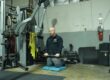
The tall kneeling banded hip thrust requires minimal equipment but delivers maximum teaching value. You’ll need a comfortable knee pad or exercise mat, a resistance band of appropriate tension, and a sturdy anchor point like a power rack or similar fixed structure. The setup process matters significantly for exercise effectiveness—loop the resistance band through itself around your anchor point to create a choked attachment that won’t slip during the movement. Position the band around your waist at hip level, then walk forward until you establish noticeable band tension that will pull your hips backward when you relax.
The starting position places you in a tall kneeling stance with toes dug into the ground for stability and hips fully extended. This setup immediately creates awareness of proper posterior chain engagement—you should feel activation through both your glutes and hamstrings before any movement occurs. The band tension provides constant posterior-directed force throughout the exercise, creating what’s known as reactive neuromuscular training that helps your body learn proper movement patterns through external feedback.
The Movement Pattern and Biomechanical Advantages
The execution emphasizes controlled eccentric lowering followed by powerful concentric hip extension. Allow the band tension to pull your hips backward while maintaining a tall chest position and neutral spine alignment. This creates a pure hip hinge where movement occurs exclusively at the hip joint rather than through spinal flexion—a critical distinction that separates effective hinging from problematic compensatory patterns. The concentric phase requires forceful glute and hamstring contraction to drive your hips forward against the band resistance, returning to that fully extended starting position where posterior chain tension remains high.
What makes this exercise particularly valuable from a biomechanical perspective is how the band creates an accommodating resistance curve that matches natural human strength curves during hip extension. The resistance increases as you approach full hip extension, exactly where your glutes and hamstrings possess their greatest force-producing capacity. This relationship between resistance profile and muscular strength creates an optimal training stimulus that challenges your posterior chain throughout the entire range of motion without the awkward resistance curves common in traditional hip thrust variations.
The tall kneeling position eliminates several common compensation patterns that plague standing hinge variations. Without the need to balance on your feet or stabilize through your ankles and knees, you can focus entirely on hip movement quality. The reduced complexity makes this an ideal pattern for beginners while still providing enough challenge for intermediate and advanced trainees when appropriate progressions are applied.
Programming Applications Across Training Levels
For beginners struggling to learn proper hip hinge mechanics, this exercise solves one of the most frustrating coaching challenges in strength training. The combination of kneeling stability and band-directed feedback creates an environment where the hip hinge pattern becomes almost intuitive. New trainees can feel what proper glute activation should be like at the top position while the band naturally guides them into correct hinge mechanics during the descent. This makes verbal coaching significantly more effective since the exercise itself provides immediate tactile feedback about movement quality.
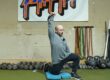
Intermediate and advanced trainees benefit from this movement as a high-quality posterior chain finisher or accessory exercise. When you lack access to specialized equipment like hip thrust machines, reverse hypers, or back extensions, the tall kneeling banded hip thrust fills that programming gap effectively. Loading the movement with a weight plate, kettlebell, or dumbbell held at chest level transforms the exercise from a teaching tool into a legitimate strength builder. The external load combines with band tension to create substantial posterior chain demand, particularly when using dumbbells in the 30-50 pound range for higher repetition sets.
The exercise works exceptionally well in preparatory or activation contexts before main strength movements. Performing two sets of 10-12 repetitions with moderate band tension and no additional load effectively wakes up your posterior chain and reinforces proper hinge mechanics before deadlifts, Romanian deadlifts, or other compound hip-dominant exercises. This priming effect can improve movement quality and potentially reduce injury risk during heavier loaded movements.
Progression Strategies and Training Variables
Progressive overload for this exercise can occur through multiple pathways beyond simply adding external resistance. Increasing band tension represents the most straightforward progression—moving from lighter to heavier bands increases the posterior-directed force throughout the movement. Adding external load through dumbbells, kettlebells, or weight plates creates a different resistance profile that emphasizes the bottom position of the hinge where the held weight is furthest from your center of mass.
Tempo manipulation offers another effective progression strategy. Slowing the eccentric lowering phase to three to five seconds increases time under tension and enhances the learning effect for beginners while creating additional training stimulus for more advanced individuals. Pausing at the bottom position for two to three seconds before the concentric drive challenges your ability to maintain proper positioning under load while increasing total work performed.
Volume recommendations remain consistent across training levels: two to four sets of 10-20 repetitions provides sufficient training stimulus without requiring excessively heavy external loads. This repetition range allows you to accumulate meaningful volume for posterior chain development while maintaining the technical focus that makes this exercise valuable. The moderate to higher repetition scheme also makes this movement particularly effective as a finisher at the end of training sessions when accumulated fatigue might compromise form on heavier compound movements.
Common Technical Considerations and Applications
The most frequent technical error involves allowing spinal flexion during the eccentric phase rather than maintaining a neutral spine throughout the hinge. Cueing “chest tall” or “proud chest” throughout the movement helps prevent this compensation. The band’s posterior pull naturally encourages proper hinge mechanics, but conscious attention to spinal position remains essential, particularly when adding external load that might encourage rounding.
This exercise serves populations beyond typical gym-goers. Combat athletes benefit from the posterior chain development and hip hinge proficiency this movement builds. Golfers can use this pattern to improve their ability to maintain posture during the golf swing. Powerlifters find value in the movement as accessory work that reinforces the hip hinge fundamental to both deadlifts and squats without adding significant systemic fatigue.
The tall kneeling banded hip thrust shouldn’t replace your fundamental hinge patterns like Romanian deadlifts and conventional deadlifts, but rather complements them by providing additional practice with the movement pattern and supplementary volume for posterior chain development. This exercise earns its place in comprehensive training programs through its unique combination of teaching effectiveness, accessibility, and genuine training value across multiple experience levels and training goals.