
Alternating Dumbbell Bench Press: A Superior Unilateral Chest Exercise for Strength and Stability
The alternating dumbbell bench press represents one of the most effective variations of traditional pressing movements for developing genuine unilateral strength, rotational stability, and improved shoulder health. While many lifters default to bilateral pressing patterns where both arms work simultaneously, this alternating approach challenges your body in fundamentally different ways that translate directly to athletic performance and functional strength development.
Watch the video below on how to maximize this exercise.
Understanding the Mechanics of Alternating Dumbbell Pressing
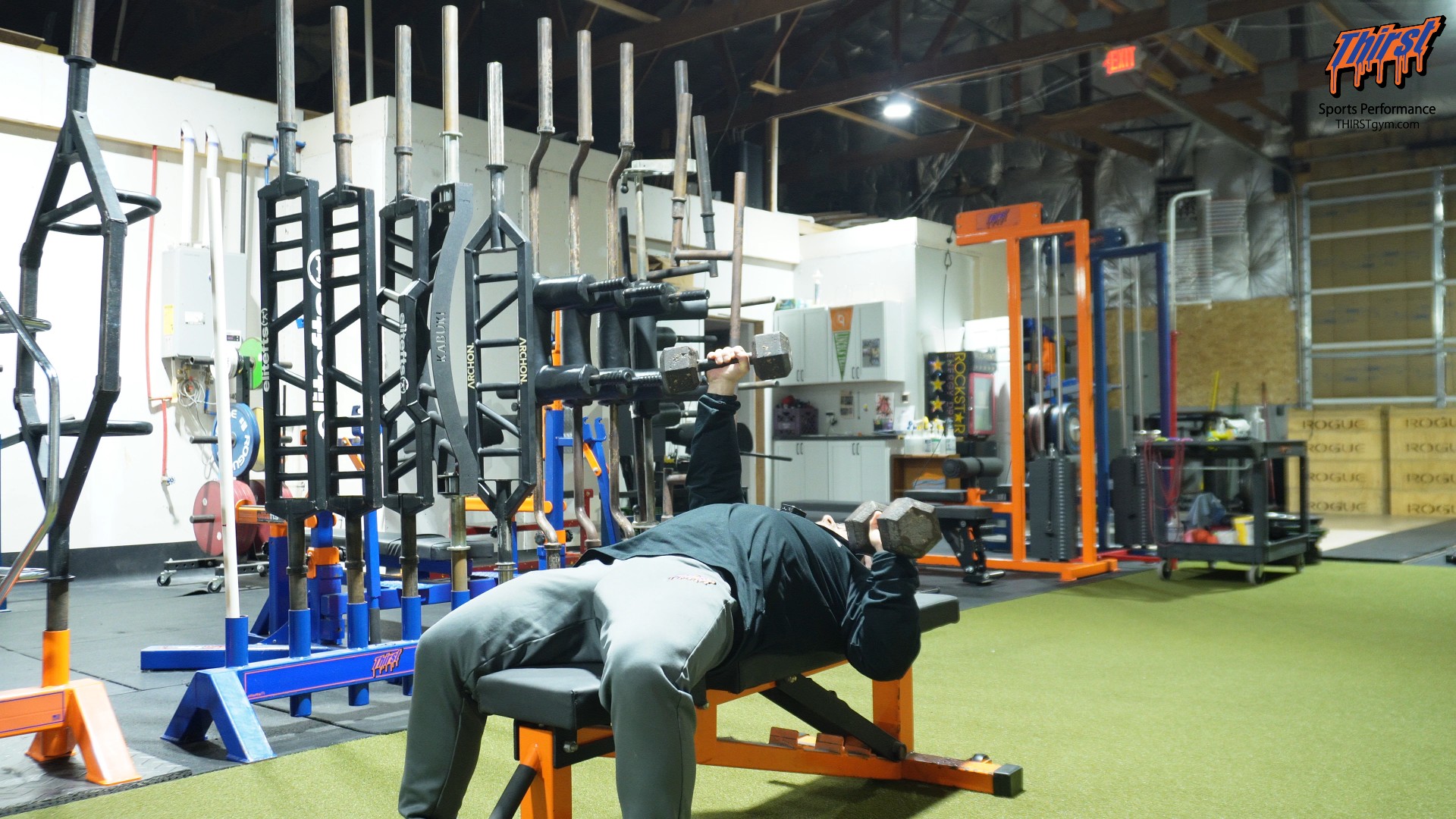
The setup for the alternating dumbbell bench press begins with selecting an appropriate pair of dumbbells and positioning yourself on a flat utility bench. You’ll grasp a dumbbell in each hand and carefully lower yourself onto the bench with your feet planted firmly on the floor. Once positioned, press both dumbbells up toward the ceiling to establish your starting position. The critical difference from standard dumbbell bench pressing begins here: rather than lowering both dumbbells simultaneously, you’ll descend with one arm while keeping the other arm fully extended overhead.
This pattern creates what exercise scientists call an “anti-rotation” demand on your torso. As one dumbbell descends toward your chest, your core musculature must resist the rotational forces trying to twist your ribcage and shoulders. This represents genuine unilateral training because even though you’re holding weight in both hands, only one side is actively producing force at any given moment while the other maintains an isometric hold against gravity and rotational torque.
The Critical Importance of Hand Position and Shoulder Angles
One of the most significant technical considerations for the alternating dumbbell bench press involves hand positioning throughout the movement. Your hands should not rotate into a fully pronated grip where your palms face directly toward your feet and your elbows flare completely perpendicular to your body. This orientation places excessive stress on the anterior shoulder capsule and can contribute to impingement issues over time, particularly in individuals with pre-existing shoulder mobility restrictions or postural imbalances.
Instead, maintain approximately a thirty to thirty-five degree angle with your hands, creating what’s often described as a neutral or semi-pronated grip. This position allows your elbows to track in a more natural path that respects the scapulohumeral rhythm of your shoulder joint. The humerus can move more freely through flexion and extension when it’s slightly internally rotated rather than forced into extreme external rotation, reducing compressive forces on sensitive structures like the subacromial bursa and rotator cuff tendons.
Why Constant Arm Extension Matters for Shoulder Health
A common mistake that compromises the effectiveness and safety of this exercise occurs when lifters allow the non-working arm to descend into a stretched position while the opposite arm presses. This creates a scenario where one shoulder remains in a vulnerable, end-range position under load for extended periods. Maintaining constant shoulder flexion on the non-working side ensures that you’re never holding weight in a mechanically disadvantaged position where passive tissues bear excessive load.
Keeping both arms actively reached throughout the entire set means your shoulder stabilizers remain engaged bilaterally even though only one arm produces concentric force at a time. This approach develops the kind of sustained stability that translates directly to athletic movements requiring overhead control and anti-rotation strength.
The Unique Training Benefits Beyond Standard Pressing
The alternating dumbbell bench press delivers several distinct advantages that make it particularly valuable for athletes, individuals recovering from shoulder issues, and lifters seeking more comprehensive upper body development. The unilateral pressing pattern forces each side of your body to stabilize independently, revealing and addressing strength asymmetries that bilateral movements can mask. Your dominant side cannot compensate for weakness on your non-dominant side when each arm must control its own load through the entire range of motion.
Beyond the obvious unilateral strength benefits, this exercise creates significant demands for shoulder girdle stability. As you press with one arm, your scapula on that side must maintain optimal position against forces trying to protract, elevate, and rotate it excessively. Meanwhile, the opposite shoulder maintains an isometric hold that challenges scapular depression and retraction. This bilateral demand for different stability patterns trains the neuromuscular coordination essential for athletic movements involving asymmetrical loading patterns.
Perhaps most interestingly, the alternating nature of this pressing variation enhances rib cage mobility and respiratory mechanics. As you lower one dumbbell, the opposite side of your ribcage can expand more freely, creating a subtle rotational component through your thoracic spine. This rib cage motion maintains the three-dimensional mobility of your thorax, preventing the rigidity that develops from purely sagittal-plane pressing movements. For athletes requiring rotational power and upper body suppleness, this quality makes the alternating dumbbell bench press superior to bilateral variations.
Optimal Programming Parameters and Load Selection
The ideal repetition range for the alternating dumbbell bench press typically falls between six to ten repetitions per side across two to four working sets. This moderate rep range provides sufficient volume for muscle growth while maintaining the quality of movement and stability that makes this exercise valuable. Unlike maximal strength work with extremely heavy loads, this exercise performs best when you can maintain pristine technique and control throughout the entire set.
The relationship between load selection and stability becomes particularly important with alternating patterns. As dumbbell weight increases substantially, the stability demands can actually interfere with your ability to generate maximal force production. You’ll find yourself fighting to maintain position rather than purely focusing on pressing strength. This doesn’t make the exercise ineffective at higher loads, but it does shift the training stimulus more toward stability and control rather than pure strength development.
Conversely, slightly higher rep ranges allow you to better manage the stability requirements while still achieving significant muscular tension and metabolic stress for hypertrophy. The controlled tempo required to maintain proper positioning throughout ten to twelve repetitions per side creates substantial time under tension that drives muscle growth without requiring loads so heavy that technique deteriorates.
Practical Implementation and Exercise Completion
When concluding your set, bring both dumbbells toward your knees in a controlled manner before using momentum to return to a seated position. This exit strategy prevents the common mistake of dropping dumbbells from the extended position, which can strain your shoulders and poses safety risks in crowded gym environments.
The alternating dumbbell bench press deserves consideration as either a primary pressing movement for athletes emphasizing stability and movement quality, or as an accessory exercise following heavier bilateral pressing work. Its unique combination of unilateral strength development, anti-rotation demands, and shoulder-friendly mechanics makes it an excellent choice for building robust, athletic upper bodies that perform as impressively as they appear.