
Mastering the Close Grip Bench Press: Technical Refinements for Maximum Tricep Development
The close grip bench press stands as one of the most valuable accessory movements for building pressing strength, yet it remains one of the most commonly misexecuted exercises in the gym. While lifters universally recognize its importance for tricep development and lockout strength in the competition bench press, the technical nuances that separate effective close grip work from wasted effort are frequently overlooked. Understanding proper hand positioning, elbow mechanics, and bar path can transform this movement from a shoulder-destroying frustration into a powerful tool for developing the kind of tricep strength that translates directly to heavier bench press numbers.
The fundamental challenge with the close grip bench press lies in the delicate balance between grip width, elbow position, and wrist alignment. Too many lifters approach this movement with either an excessively narrow grip that compromises their mechanical advantage or a grip that’s barely narrower than their regular bench press, failing to provide the tricep-specific stimulus that makes this exercise valuable. The consequences extend beyond simply missing out on training adaptations—poor execution frequently leads to wrist pain, elbow discomfort, and shoulder strain that can interrupt training consistency and force lifters to abandon an otherwise essential movement.
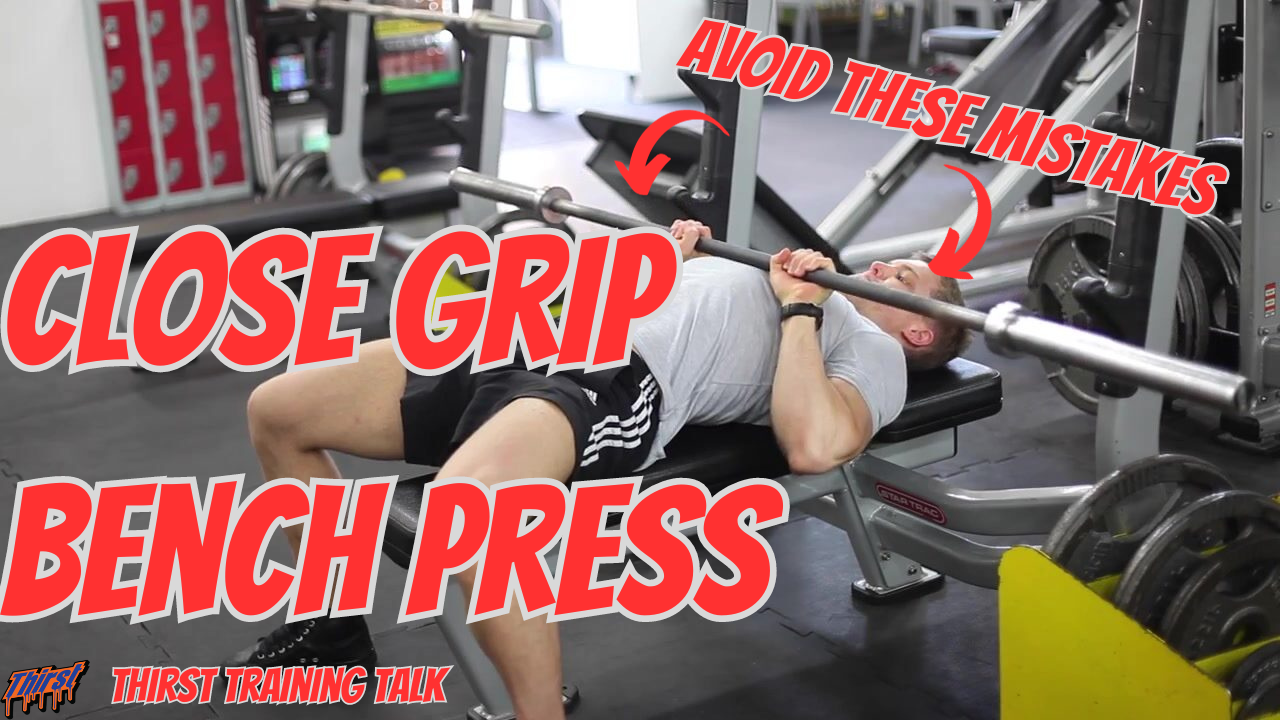
You can also watch the video below that goes along with this article.
The Critical Importance of Hand Positioning and Bar Placement
The first layer of technical proficiency in the close grip bench press begins before you even unrack the barbell. Your hand position determines everything downstream in the movement, from joint alignment to force production capabilities to injury risk. The most reliable starting point for determining appropriate grip width involves a remarkably simple assessment: stand with your arms relaxed at your sides, then raise your forearms until they’re pointing straight forward with your elbows bent at ninety degrees. The natural position of your hands in this configuration represents an excellent baseline for close grip bench press hand spacing. This position typically places your hands somewhere between shoulder-width and slightly inside shoulder-width, though individual anthropometry will create some variation.
The positioning of the barbell within your hands proves equally critical to both performance and joint health. The bar should rest in the thickest, most muscular part of your palm—the area just below where your fingers meet your hand. This placement allows you to maintain relatively straight wrists even under load, with your knuckles still pointing predominantly toward the ceiling rather than rolling back toward your body. When lifters position the bar too far back in their hands, closer to their fingers, the wrist inevitably collapses into excessive extension. This cocked-back wrist position creates a mechanical disadvantage that reduces your pressing power while simultaneously placing tremendous stress on the small ligaments and tendons of the wrist joint. The discomfort many lifters experience during close grip bench pressing often originates not from any inherent problem with the movement itself but from this single positioning error.
Understanding the False Grip Application in Accessory Work
The question of thumb position during close grip bench pressing deserves careful consideration, particularly for powerlifters who must use a full grip with the thumb wrapped around the bar during competition. Many experienced lifters adopt a false grip—sometimes called a suicide grip—during close grip bench press work, with the thumb positioned on the same side of the bar as the fingers rather than wrapped around the opposite side. This grip modification can produce substantial improvements in wrist and elbow comfort during the movement, allowing lifters to train the close grip bench press more frequently and with greater loading without accumulating the kind of repetitive stress that leads to chronic joint pain.
The biomechanical explanation for this improvement centers on wrist alignment and force transmission. When your thumb wraps fully around the bar, the natural tendency involves a slight degree of wrist extension that becomes more pronounced under load. The false grip allows the wrist to maintain a more neutral position, with the forearm and hand forming a straighter line that more efficiently transmits force from the muscles of the arm into the barbell. The reduction in angular deviation at the wrist joint decreases the shearing forces acting on the joint structures while improving the mechanical advantage of the pressing muscles.
However, this technical modification comes with an important caveat about specificity. The close grip bench press serves as an accessory movement—it exists to develop strength qualities that transfer to your competition lift rather than representing an end in itself. Since you’re not competing in the close grip bench press and won’t be judged on your thumb position during this exercise, the potential benefits for joint health and training consistency outweigh concerns about perfect specificity to competition form. If adopting a false grip allows you to train the movement more frequently, with less pain, and with greater loading over time, the strength gains you accumulate will transfer effectively to your competition bench press even though the grip differs slightly.
Good start. I’m establishing the foundational concepts and explaining the biomechanical reasoning. Now I need to expand into the most critical aspect – grip width errors and their consequences. I should cover both extremes (too narrow and too wide) with detailed biomechanical explanations.
The Grip Width Paradox: Understanding Wrist-Elbow Stacking
The single most consequential technical error in close grip bench pressing involves grip width selection, and this error manifests in two distinct forms that create opposite problems but share a common underlying cause—the loss of proper wrist-elbow alignment. Understanding this concept of wrist-elbow stacking provides the key to unlocking effective close grip bench press technique. In an optimally executed close grip bench press, when the bar touches your chest, your forearm should be essentially vertical, creating a straight line from your wrist through your elbow and down to the floor. This stacked position maximizes your mechanical advantage and ensures that the forces you generate press the bar directly upward rather than being dissipated into angular movements at the joints.
When lifters position their hands too wide on the bar—sometimes taking a grip that’s barely narrower than their competition bench press—their elbows flare outward as the bar descends. This outward elbow movement breaks the wrist-elbow stack, creating an angle between the forearm and the vertical plane. The consequences multiply beyond simple mechanical inefficiency. The flared elbow position shifts loading away from the triceps and onto the pectorals and anterior deltoids, undermining the entire purpose of choosing the close grip variation. Additionally, this position places the shoulder joint in the same compromised configuration that causes problems during wide-grip pressing, exposing the rotator cuff and anterior capsule to excessive strain while simultaneously reducing your ability to generate maximum force.
The opposite error—gripping too narrow—creates an entirely different set of problems that prove equally limiting. Some commercial gym lifters position their hands extremely close together, sometimes with their index fingers nearly touching. This excessively narrow grip forces a dramatic change in bar path and elbow mechanics as the bar descends. To touch the bar to your chest with this ultra-narrow hand spacing, your elbows must shoot forward dramatically, moving into a position similar to what you’d see during a JM press or skull crusher. While this forward elbow position does emphasize the triceps, it removes nearly all contribution from the pectorals and places your shoulder joint in a biomechanically disadvantaged position that severely limits the loads you can handle.
More critically, this excessively narrow grip creates a situation where wrist-elbow stacking becomes impossible. With your hands too close together, your elbows sit inside your wrists throughout the entire range of motion. This misalignment forces your wrists to angle outward under load, creating significant stress on the wrist joint while simultaneously reducing your mechanical advantage for pressing. Many lifters who adopt this ultra-narrow grip find they can’t even touch the bar to their chest without their elbows protruding far forward of the barbell, creating a leverage nightmare that makes the exercise feel impossibly difficult even with relatively light loads.
Optimizing Elbow Path and Touch Point for Maximum Effectiveness
Once you’ve established appropriate hand spacing using the straight-arms-forward test, the next critical element involves understanding how your elbow path and touch point differ from your competition bench press. This understanding prevents one of the most common errors—attempting to touch the bar in the exact same location on your torso during both movements. The close grip bench press requires a touch point that sits slightly lower on your torso than your regular bench press, typically by approximately half an inch. This adjustment stems directly from the differences in elbow positioning between the two movements.
During a standard bench press with your competition grip width, your elbows track at a moderate angle away from your torso—not fully flared perpendicular to your body, but not tight against your sides either. This positioning allows optimal contribution from both your pectorals and triceps while maintaining healthy shoulder mechanics. In the close grip variation, your elbows must stay notably closer to your sides throughout the descent, maintaining that crucial wrist-elbow stack we discussed earlier. This tucked elbow position naturally pulls the bar’s touch point lower on your torso because the angle of your forearms relative to your body has changed.
Understanding this touch point difference prevents a cascade of technical errors. When lifters attempt to touch the bar at their regular bench press position while using a close grip, they’re forced to choose between two undesirable options: either their elbows flare outward to allow the bar to reach that higher touch point, or they maintain tucked elbows and can’t actually touch their chest. Both scenarios compromise the training effect. The proper execution involves allowing the bar to naturally descend to a slightly lower position on your torso while keeping your elbows tracking straight down toward your feet rather than outward toward the walls.
This tucked elbow position throughout the descent serves multiple purposes beyond simply accommodating the different grip width. First, it maximizes tricep involvement by keeping the upper arm in a position where the long head of the tricep maintains optimal length-tension relationships throughout the movement. Second, it reinforces proper pressing mechanics by training your body to generate force while maintaining scapular stability and avoiding excessive shoulder internal rotation. Third, it creates a movement pattern that translates more directly to the lockout portion of your competition bench press, where the triceps assume primary responsibility for completing the lift.
The Technical Execution: From Setup Through Lockout
Proper execution of the close grip bench press begins with your setup on the bench, following many of the same principles you’d apply to your competition bench press. Establish a solid arch with your shoulder blades retracted and depressed, creating a stable platform from which to press. Your feet should remain planted firmly on the floor, allowing you to generate leg drive even though this is an accessory movement. This full-body tension serves multiple purposes—it protects your spine, enhances force production, and reinforces the movement patterns you need during maximal competition attempts.
As you unrack the barbell, focus on actively pulling it out of the hooks rather than simply pressing it up. This pulling action engages your lats and helps establish the upper back tightness that will support the bar throughout the lift. Position the bar over your shoulders with your arms fully extended, ensuring that you’ve achieved proper bar placement in your palms and that your wrists remain in that relatively straight position we discussed earlier. Take a moment in this top position to verify your grip width—your hands should feel slightly closer than your competition grip but not dramatically so, and you should be able to maintain straight forearms when viewed from the side.
The descent phase requires particular attention to elbow path. As you lower the bar under control, actively focus on keeping your elbows tracking downward rather than allowing them to drift outward. A useful internal cue involves thinking about pulling your elbows down toward your hip pockets rather than out toward the walls. Your pinky and ring fingers should maintain constant tension, actively pulling the bar apart as it descends. This tension in your outer fingers helps keep your elbows in the proper position while engaging your lats to support the bar path.
Many lifters find it helpful to think of the descent as occurring along a slight diagonal path rather than purely vertical. The bar should travel down and very slightly toward your feet, following the natural path created by your tucked elbow position. This diagonal path feels different from your competition bench press, where the bar typically travels more vertically or even slightly toward your head depending on your individual mechanics. Fighting against this natural diagonal path in an attempt to make the close grip bench press look exactly like your competition bench press will only compromise your positioning and reduce the training effect.
I’m making good progress. Now I need to cover the pressing phase, common errors during the concentric portion, and then expand into programming applications, benefits for different populations, and troubleshooting. Let me continue with flowing prose that maintains educational authority while integrating relevant keywords naturally.
As the bar touches your chest at that slightly lower position than your regular bench press, pause briefly to ensure you’ve maintained all the technical elements we’ve discussed. Your wrists should still be stacked over your elbows, your forearms should be approximately vertical, and your elbows should remain tucked close to your sides rather than flared outward. This bottom position represents the moment of maximum challenge in the movement, where the triceps must generate force from a stretched position while your stabilizing muscles work to maintain proper joint alignment.
The pressing phase demands that you maintain the same tight elbow positioning you established during the descent. The natural tendency as fatigue accumulates involves allowing the elbows to drift outward as you drive the bar upward, reverting to a wider pressing pattern that feels more familiar and mechanically advantageous. Resist this temptation aggressively. Keep thinking about driving your hands up and very slightly toward your face, maintaining that tucked elbow position throughout the entire concentric phase. The bar path on the way up should mirror the path you used on the way down—a slight diagonal that moves up and slightly toward your head as your arms extend.
As you approach lockout, your elbows should still be tracking close to your body rather than having migrated outward. This positioning ensures that the final phase of the press—where the triceps do most of their work—occurs with your arms in the configuration that maximizes tricep contribution. Complete the repetition with full elbow extension, actively contracting your triceps at the top of the movement before beginning your next repetition. This deliberate lockout reinforces the very portion of the bench press that the close grip variation exists to strengthen.
Programming Considerations for Optimal Strength Development
The close grip bench press serves multiple roles within a well-designed training program, and understanding these roles helps determine appropriate loading, volume, and frequency for the movement. For powerlifters, this exercise functions primarily as a tricep-specific accessory movement designed to address the lockout portion of the competition bench press. Lifters who struggle to complete heavy bench press attempts in the final few inches of the movement—where the triceps assume primary responsibility for extending the elbows—often find that consistent close grip bench press work directly addresses this weakness.
The loading parameters for close grip bench pressing should reflect its status as an accessory movement rather than a primary competition lift. Most lifters can handle approximately seventy to eighty-five percent of their competition bench press max on the close grip variation, though this ratio varies based on individual leverages and strength profiles. Lifters with particularly strong triceps relative to their pectorals may perform closer to ninety percent of their bench press max, while those with tricep-dominant weaknesses might only manage sixty-five to seventy percent when executing the movement with proper technique.
Volume recommendations typically involve moderate to moderately-high repetition ranges, with sets of five to twelve repetitions proving most effective for building the combination of strength and muscle mass that translates to improved bench press performance. Unlike the competition bench press where very low repetition work develops maximal strength and neural efficiency, the close grip variant benefits from slightly higher repetitions that accumulate more total time under tension for the triceps. This extended time under tension drives the hypertrophic adaptations that ultimately support long-term strength development.
Frequency considerations depend on your overall training structure and recovery capacity. Many successful powerlifting programs incorporate close grip bench pressing one to three times per week, often following heavy competition bench press work or on separate training days dedicated to accessory exercises. Performing close grip work immediately after your main bench press session allows you to accumulate tricep-specific volume while your pressing musculature is already warmed up and prepared for heavy loading. Alternatively, dedicating a separate training session to close grip pressing allows you to approach the movement with fresh muscles and potentially handle slightly heavier loads or higher volumes.
Applications Beyond Powerlifting: General Strength Development
While powerlifters represent the most obvious population who benefit from refined close grip bench press technique, the movement offers valuable training effects for general strength athletes, bodybuilders, and anyone seeking to develop upper body pressing strength and muscle mass. The triceps represent approximately sixty percent of your upper arm muscle mass, making them a critical target for anyone interested in building larger, more muscular arms. The close grip bench press allows for significantly heavier loading than isolation exercises like tricep extensions or pushdowns, creating a more potent stimulus for both strength and hypertrophy.
For bodybuilders and physique athletes, the close grip bench press addresses tricep development from a different angle than the more common isolation movements. While exercises like overhead extensions emphasize the long head of the tricep and pushdowns target the lateral head, the close grip bench press trains all three heads of the triceps simultaneously under heavy load while incorporating the anterior deltoids and upper pectorals as synergists. This multi-joint compound movement allows you to accumulate significant training volume for the triceps while handling loads that would be impossible with single-joint exercises.
Athletes from sports requiring upper body strength and power—football linemen, rugby players, combat sport athletes, and others—benefit from the close grip bench press’s emphasis on the lockout phase of pressing movements. Many athletic pressing situations, from blocking opponents to executing push-offs from the ground, require maximum force production with the arms in relatively extended positions where the triceps dominate. The close grip bench press develops precisely this quality, training the triceps to generate high forces through ranges of motion that commonly occur during athletic movements.
Troubleshooting Common Technical Breakdowns
Even with proper instruction, most lifters experience predictable technical breakdowns as fatigue accumulates during close grip bench press sets. Recognizing these patterns allows you to make real-time adjustments that maintain training quality throughout your workout. The most common breakdown involves progressive elbow flare as the set continues. Your first repetition might demonstrate perfect tucked elbow position, but by repetition six or seven, your elbows gradually drift outward with each successive rep. This drift typically indicates that you’ve either selected too heavy a load for the prescribed repetition range or that your triceps are fatiguing while your pectorals remain relatively fresh, causing your body to unconsciously shift loading toward the stronger muscle group.
Addressing elbow flare requires vigilant attention to internal cues and potentially reducing the load slightly. Before each repetition, consciously reinforce the cue about driving your elbows down toward your hip pockets rather than out toward the walls. If you find yourself unable to maintain proper elbow position despite focusing intensely on this cue, the weight is simply too heavy for quality technique. Reduce the load by five to ten percent and prioritize movement quality over absolute loading. Remember that the close grip bench press exists to develop your triceps, and loading that forces you into compensatory movement patterns defeats this purpose.
Another frequent breakdown involves wrist collapse as fatigue accumulates, with the wrists gradually extending further back toward excessive extension. This pattern often indicates that lifters have either positioned the bar too far back in their hands initially or that their grip is weakening as the set progresses. Address this issue by actively reinforcing proper bar position during your rest periods, practicing the feeling of the bar sitting in the thick part of your palm with your wrists relatively straight. During sets, maintain constant awareness of your knuckle position—they should continue pointing predominantly toward the ceiling throughout every repetition rather than gradually rotating back toward your body.
Some lifters experience a different problem where they lose the proper touch point as sets progress, gradually touching the bar higher on their chest with each successive repetition. This upward drift in touch point typically correlates with elbow flare—as your elbows move outward, the natural touch point rises. Fighting this tendency requires the same solution we discussed for elbow flare: reduce the load slightly and focus on maintaining consistent elbow position and touch point across all repetitions. The quality of each repetition matters more than the absolute load on the bar, particularly for an accessory movement designed to address specific weaknesses.
Long-Term Progression Strategies and Training Variations
Once you’ve established solid close grip bench press technique, the question becomes how to progress the movement over time to continue driving strength adaptations. The most straightforward progression involves gradually increasing the load you handle for a given repetition range, following the same progressive overload principles that govern all strength training. Track your performance over time, aiming to add small amounts of weight to the bar—typically two-and-a-half to five pounds—when you can complete all prescribed sets and repetitions with excellent technique.
However, intelligent progression involves more than simply adding weight indefinitely. Manipulating training variables like tempo, pause duration, and range of motion provides additional avenues for progressive challenge while potentially addressing specific weaknesses in your bench press. Incorporating a deliberate pause at the bottom position—holding the bar motionless on your chest for two to three seconds before pressing—eliminates any stretch reflex contribution and forces your triceps to generate force from a dead stop. This paused variation particularly benefits lifters who struggle to initiate the press from the chest position or who tend to bounce the bar to start their pressing motion.
Tempo manipulations offer another effective progression strategy. Slowing down the eccentric (lowering) phase to a three to five second descent increases time under tension and enhances the muscle-building stimulus while developing greater control throughout the movement. Alternatively, incorporating controlled eccentric phases with explosive concentric drives—lowering slowly but pressing as quickly as possible—develops rate of force development while maintaining proper positioning. These tempo variations allow you to continue challenging your muscles even if you’ve temporarily plateaued in terms of absolute load.
The close grip bench press remains one of the most valuable tools available for developing tricep strength and improving bench press lockout power, but only when executed with proper attention to hand positioning, elbow mechanics, and bar path. By establishing appropriate grip width that maintains wrist-elbow stacking, controlling elbow position throughout each repetition, and adjusting your touch point slightly lower than your competition bench press, you transform this movement from a shoulder-straining liability into a powerful driver of pressing strength. Whether you’re a competitive powerlifter working to eliminate lockout weaknesses or a general strength athlete building bigger, stronger arms, mastering these technical refinements elevates the effectiveness of your close grip bench press work while protecting your joints from unnecessary stress.
Need help improving your bench press or with your powerlifting training? Contact us to see how we can help you!