
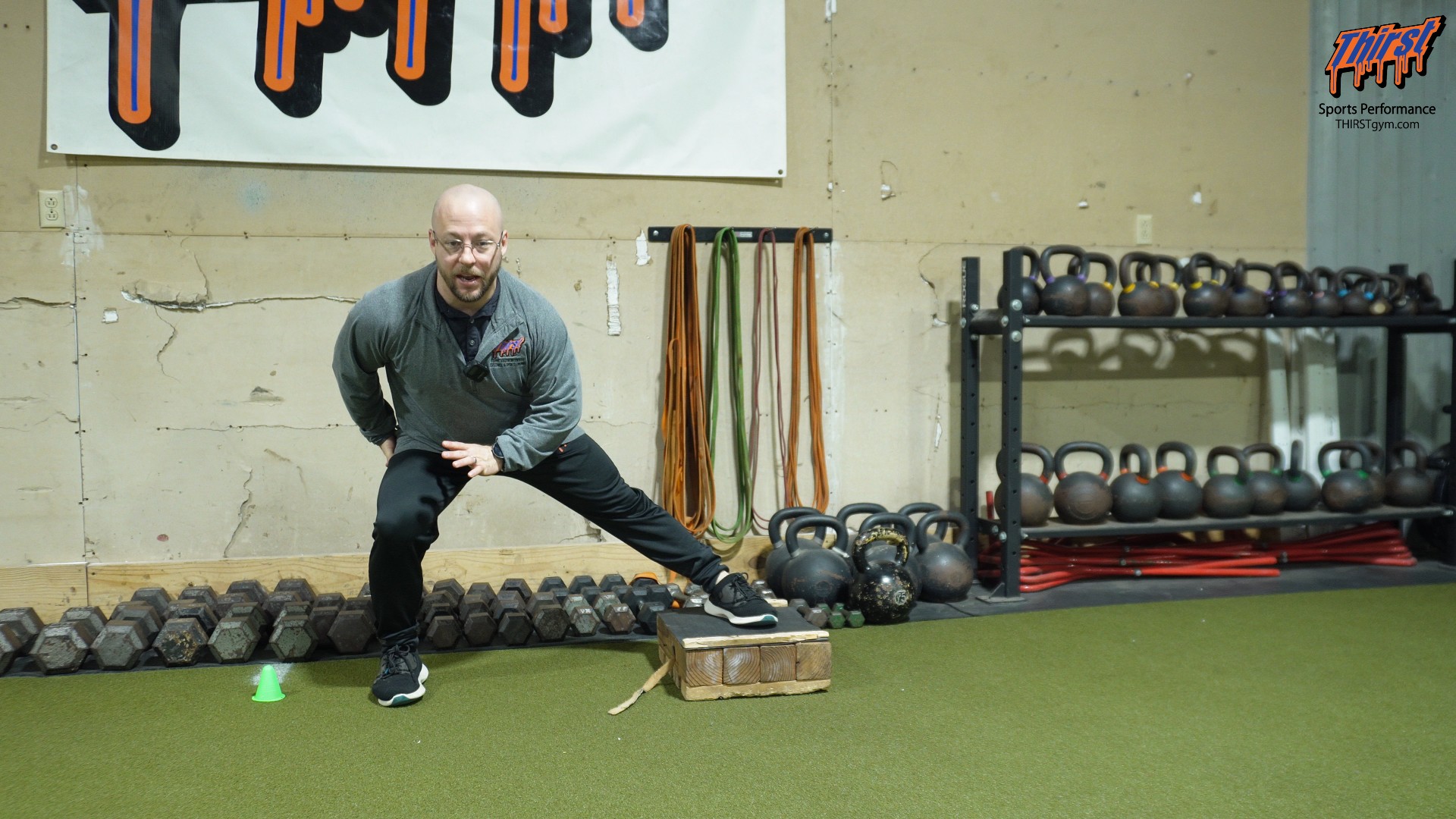
Deficit Lateral Lunge: An Advanced Frontal Plane Exercise for Explosive Lateral Movement
The deficit lateral lunge represents a sophisticated progression in lateral movement training that challenges athletes and advanced trainees through increased range of motion and enhanced force production demands. This variation elevates the standard lateral lunge by incorporating a low box or platform, creating a positional deficit that amplifies the stretch-shortening cycle in the glutes and hamstrings while developing greater explosive power for change of direction movements.
Watch the video below on how to maximize this exercise.
Understanding the Deficit Lateral Lunge Setup
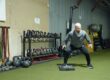
The foundation of this exercise begins with proper equipment selection and positioning. You’ll need a low box or platform ranging between two and six inches in height, with the specific height depending on your mobility capabilities and training advancement. The beauty of this exercise lies in its scalability—you can manipulate box height to precisely match your current ability level or progressively increase difficulty as your capacity improves.
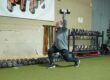
Starting position requires both feet planted on the box, creating an elevated platform from which you’ll step down into your lateral lunge. This elevated starting point fundamentally changes the exercise mechanics compared to floor-based lateral lunges. When preparing to lunge toward your right side, position yourself toward the right edge of the box to ensure adequate clearance for the stepping motion. If you’re incorporating additional resistance, holding a dumbbell or kettlebell in the goblet position provides an effective loading option that maintains proper torso positioning throughout the movement.
Proper Execution and Technique Fundamentals
The movement execution demands precise attention to several technical elements that differentiate the deficit lateral lunge from standard variations. As you step off the box toward your working side, you’re immediately creating a significant depth advantage that isn’t present in traditional lateral lunges performed on level ground. This deficit forces your body to descend deeper into the position, substantially increasing the range of motion your hip and knee joints must navigate.
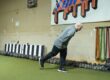
Your stepping leg—the one moving toward the side you’re lunging—should maintain a relatively forward knee position throughout the descent. This forward knee tracking ensures proper loading through the quadriceps and glutes rather than allowing excessive backward sitting that would reduce athletic carryover. Meanwhile, your non-working leg (the away leg) remains completely flat and planted, creating a long, stretched position that enhances adductor flexibility and hip mobility.
The depth of your descent should be dictated by your ability to maintain a flat foot position on your working leg. As you lower into the deficit lateral lunge, continue descending until you’ve achieved the deepest position possible while keeping your entire foot firmly planted on the ground. This maximum depth position, combined with the elevated starting point, creates substantial tension through the glutes and hamstrings that will drive the powerful concentric push phase.
Biomechanical Advantages and Training Benefits
The deficit component of this lateral lunge variation delivers several biomechanical advantages that make it particularly valuable for athletic development. By starting from an elevated position, you’re essentially pre-loading the stretch-shortening cycle more aggressively than standard lateral lunges allow. This enhanced stretch-shortening cycle occurs because the deficit creates a longer eccentric phase—the lowering portion of the movement—which stores more elastic energy in the muscle-tendon units of the glutes and hamstrings.
This stored elastic energy must then be rapidly released during the concentric push phase as you drive yourself back up onto the box. This requirement for powerful force production to overcome gravity and return to the elevated starting position makes the deficit lateral lunge exceptional for developing explosive lateral movement capacity. Athletes who compete in sports requiring rapid directional changes—basketball, soccer, tennis, football, and virtually all field and court sports—benefit tremendously from this enhanced force production demand.
The frontal plane emphasis of this exercise addresses a commonly undertrained movement pattern in many strength programs. While most training occurs in the sagittal plane (forward and backward movements), athletic competition demands significant lateral movement capacity. The deficit lateral lunge specifically targets this frontal plane strength and power development, creating more resilient and capable athletes who can generate force in multiple directions.
Programming Considerations and Set-Rep Schemes
The deficit lateral lunge should be approached as an advanced exercise variation rather than an entry-level movement pattern. Before incorporating this exercise, ensure you possess adequate lateral lunge proficiency with proper mechanics and sufficient hip mobility to achieve deep positions without compensation. Attempting deficit variations before mastering standard lateral lunges increases injury risk and reduces the training benefit you’ll receive.
For athletes and trainees who have demonstrated competency with traditional lateral lunges and possess the requisite mobility, programming this exercise depends heavily on your specific training goals. When using the deficit lateral lunge as accessory work to build overall lower body strength and frontal plane capacity, two to four sets of six to ten repetitions per side provides appropriate volume. This rep range allows sufficient time under tension to drive hypertrophy and strength adaptations while maintaining quality movement throughout each set.
If your training objective centers on developing explosive power and rapid change of direction ability, reduce the repetition range to three to six reps per side while increasing the emphasis on movement speed and force production. This lower-rep, higher-intensity approach should feature aggressive pushes back to the starting position with maximum intent on each repetition. When training for power development, the deficit lateral lunge can be positioned earlier in your training session—immediately following your warm-up and before more fatiguing strength work—to ensure optimal force production capacity.
The strategic manipulation of box height provides an additional programming variable that allows progressive overload without necessarily adding external resistance. As your mobility improves and movement proficiency increases, gradually elevating the box height creates a more challenging deficit that continues driving adaptation. This progression strategy makes the deficit lateral lunge a sustainable long-term training tool that can evolve alongside your developing capabilities.
Conclusion
The deficit lateral lunge stands as a powerful training variation for athletes and advanced trainees seeking enhanced lateral movement capacity, explosive power development, and comprehensive frontal plane strength. By thoughtfully incorporating this exercise into your programming with appropriate volume, intensity, and progression strategies, you’ll develop the robust directional change capabilities that separate good athletes from great ones.