
Foam Roller Bent Over Lat Stretch: A Complete Guide to Improving Overhead Mobility and Shoulder Health
The foam roller bent over lat stretch is a highly effective mobility drill that addresses one of the most commonly restricted muscle groups in the upper body—the latissimus dorsi. This simple yet powerful exercise uses readily available equipment to create significant improvements in overhead range of motion, thoracic extension, and overall shoulder health, making it valuable for everyone from powerlifters and Olympic weightlifters to general fitness enthusiasts working out at home.
Watch the video below on how to maximize this exercise.
Understanding the Latissimus Dorsi and Why Lat Mobility Matters
The latissimus dorsi muscles are the broad, wing-shaped muscles that span much of your mid and lower back, attaching from your upper arm down to your pelvis and lower spine. These powerful muscles are responsible for pulling your arms down and back toward your body, which makes them crucial for exercises like pull-ups, chin-ups, lat pulldowns, and rows. However, this same pulling function means that tight lats can significantly restrict your ability to reach overhead, impacting movements like overhead presses, snatches, and even everyday activities like reaching for items on high shelves.
When your lats become chronically shortened from training or prolonged sitting, they pull your shoulders into internal rotation and can limit thoracic spine extension. This restriction doesn’t just affect overhead movements—it can also compromise your positioning in bench press by preventing proper scapular retraction, reduce your pulling strength by limiting your range of motion, and contribute to shoulder impingement patterns that lead to discomfort during training.
Setting Up the Foam Roller Bent Over Lat Stretch
This exercise requires minimal equipment, making it an accessible option for both gym and home training environments. You’ll need two larger foam rollers, ideally thirty-six inches in length, which provide the necessary height and stability for the stretch. The longer rollers create a more stable platform and allow you to achieve the proper body position without the rollers shifting or rolling away during the movement.
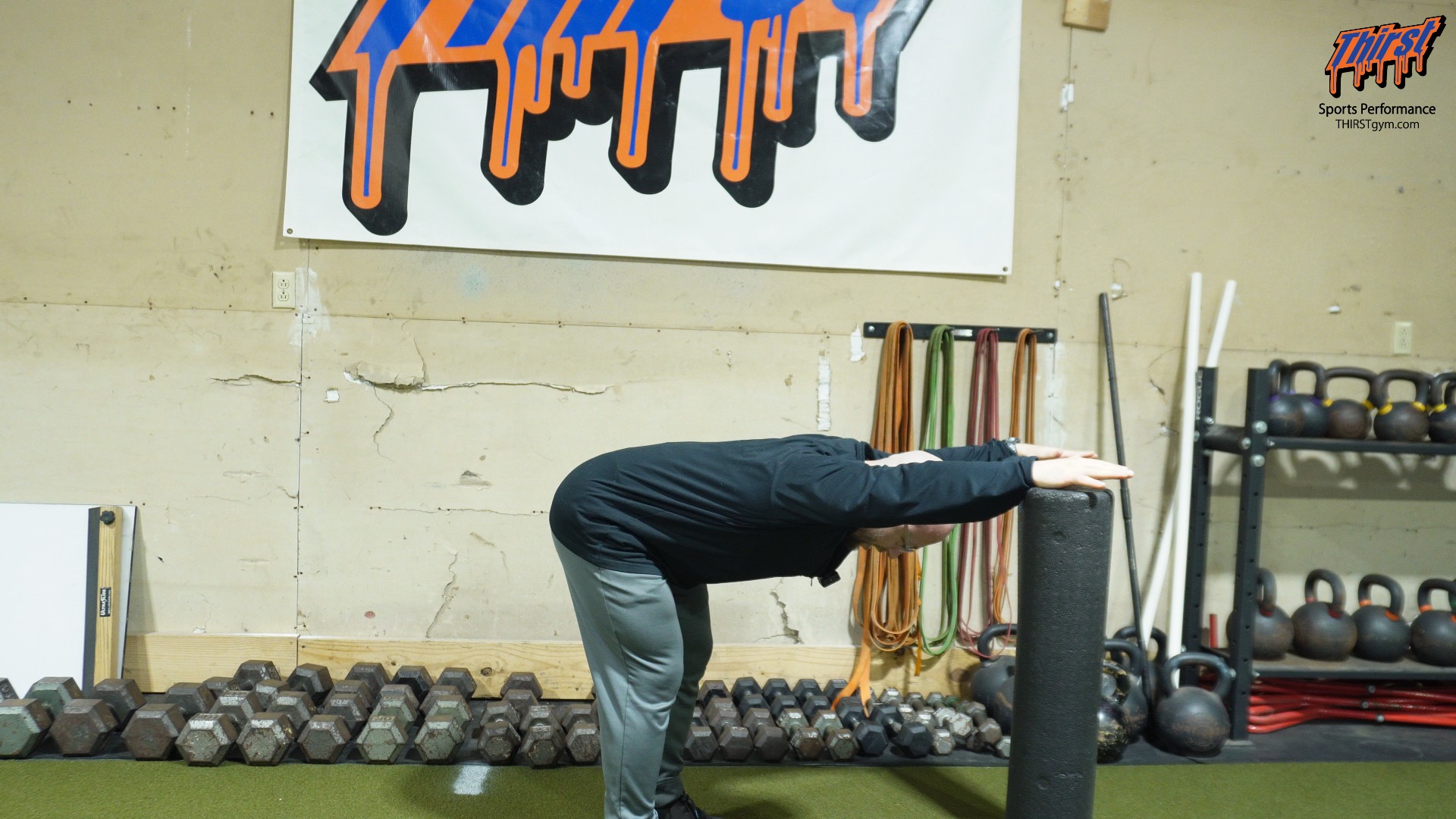
Begin by positioning the foam rollers parallel to each other on the ground, spaced slightly wider than shoulder-width apart. Place your hands on the ends of the foam rollers while standing, then walk your feet back slightly to create some distance between your body and the rollers. From this starting position, you’ll perform a hip hinge by pushing your hips backward while maintaining a neutral spine, similar to the setup for a Romanian deadlift or good morning exercise.
As you hinge at the hips, allow your chest to drop toward the floor while keeping your arms extended and your hands pressing into the foam rollers. The goal is to create a long line from your hips through your spine and out through your extended arms, allowing gravity to gently pull your shoulders and lats into a stretched position. Your body should form roughly a ninety-degree angle at the hips when you reach the bottom position of the stretch.
Technique Variations and Hand Positioning Options
One of the most valuable aspects of the foam roller bent over lat stretch is the ability to modify hand position to emphasize different aspects of the stretch or target one side more specifically. You can perform the stretch with your palms facing down in a pronated grip position, which tends to create more external rotation demand at the shoulder joint. Alternatively, positioning your thumbs upward in a neutral grip can feel more comfortable for some individuals and may allow for a deeper stretch depending on your individual anatomy and restrictions.
To address asymmetries or emphasize one lat more than the other, you can shift your body weight toward the left or right side during the stretch. This lateral weight shift allows you to spend additional time addressing the tighter side while still maintaining the stretched position. Many people find they have greater restriction on their dominant side due to training volume and daily activities, making this unilateral emphasis particularly valuable for balancing mobility between sides.
The Critical Role of Breathing in Maximizing the Stretch
The breathing pattern you employ during this lat mobility drill significantly impacts its effectiveness. Rather than simply holding your breath and waiting for time to pass, you should actively use your breath to deepen the stretch progressively throughout each hold. Begin each breath cycle by inhaling slowly through your nose, allowing your ribcage to expand in all directions. Then, as you exhale through your mouth, consciously relax your upper back and shoulders, allowing your body to sink slightly deeper into the stretched position.
This breathing strategy works because exhaling activates your parasympathetic nervous system, reducing muscular tension and allowing your tissues to relax more completely. The expansion of your ribcage during inhalation also creates gentle movement in your thoracic spine, promoting the extension that many people lack in their upper back. Performing five deliberate breath cycles during each stretch hold, or sustaining the position for thirty to sixty seconds while breathing continuously, allows sufficient time for your nervous system to recognize the stretched position as safe and release protective tension.
Programming Recommendations and Workout Integration
The foam roller bent over lat stretch is remarkably versatile in terms of when and how you can incorporate it into your training program. As a warm-up drill, performing this stretch before overhead pressing movements, Olympic lifts, or pulling exercises helps prepare your shoulders and upper back for the ranges of motion you’ll demand during your working sets. Two to three sets of thirty to sixty seconds or five breath cycles effectively opens up your lats and thoracic spine without creating fatigue.
This mobility exercise also functions exceptionally well as a filler movement between sets of compound exercises. Rather than simply resting passively between sets of squats, deadlifts, or bench press, you can use this downtime productively by performing a set of the lat stretch. This approach maximizes your training efficiency, allowing you to accumulate significant mobility work throughout your session without adding time to your overall workout duration.
For individuals with particularly restricted overhead mobility or those recovering from shoulder issues, performing this stretch daily or even multiple times per day can accelerate improvements in range of motion. The low intensity and non-fatiguing nature of the exercise makes frequent practice sustainable without interfering with your strength training recovery.
Benefits Across Different Training Populations and Goals
Powerlifters and strength athletes benefit from improved lat mobility even though their primary lifts occur in front of or beside the body rather than overhead. Better lat flexibility allows for improved thoracic extension during the squat, which helps maintain a more upright torso position and reduces lower back stress. In the bench press, mobile lats enable better scapular positioning and shoulder stability, allowing for safer and more effective pressing mechanics.
Olympic weightlifters and CrossFit athletes require exceptional overhead mobility for movements like the snatch, overhead squat, and jerk variations. Tight lats represent one of the most common limiting factors preventing these athletes from achieving the overhead positions demanded by their sport. Regular practice of the foam roller bent over lat stretch directly addresses this restriction, allowing for better positioning in the receiving position of Olympic lifts.
Combat sport athletes, baseball players, and other overhead athletes benefit from maintaining healthy shoulder function and preventing the chronic internal rotation that often develops from repetitive throwing or striking movements. General fitness enthusiasts and people training at home appreciate that this exercise requires only inexpensive foam rollers and can be performed in limited space, making it an accessible solution for improving posture and shoulder health without gym access.
The foam roller bent over lat stretch represents a simple yet powerful tool for addressing one of the most common mobility restrictions in the upper body. By combining proper positioning, breathing technique, and strategic programming, you can create significant improvements in overhead ability, shoulder health, and overall upper body function that translate directly to better performance in virtually any training goal.