
Foam Roller T-Spine Overhead Extension: Complete Guide to Improving Thoracic Mobility
The foam roller T-spine overhead extension stands as one of the most effective yet underutilized mobility drills for addressing the epidemic of poor upper back extension that plagues desk workers, lifters, and athletes alike. This deceptively simple exercise targets thoracic spine mobility—the mid-back region that becomes chronically stiff from hours of sitting, driving, and working at computers. When your thoracic spine loses its natural ability to extend, you’ll struggle with overhead pressing movements, experience compromised squat mechanics, and likely develop the forward-rounded posture that characterizes upper cross syndrome.
What makes this foam rolling technique particularly valuable is its dual function as both a mobility drill and a corrective exercise. Unlike passive stretching that simply pulls tissues into new positions, the foam roller T-spine extension actively engages your neuromuscular system through controlled breathing patterns and segmental spinal movement. This approach creates lasting improvements in thoracic extension rather than temporary flexibility gains that disappear within minutes of finishing your warm-up.
Watch the video below on how to maximize this exercise.
Setting Up the Foam Roller T-Spine Extension
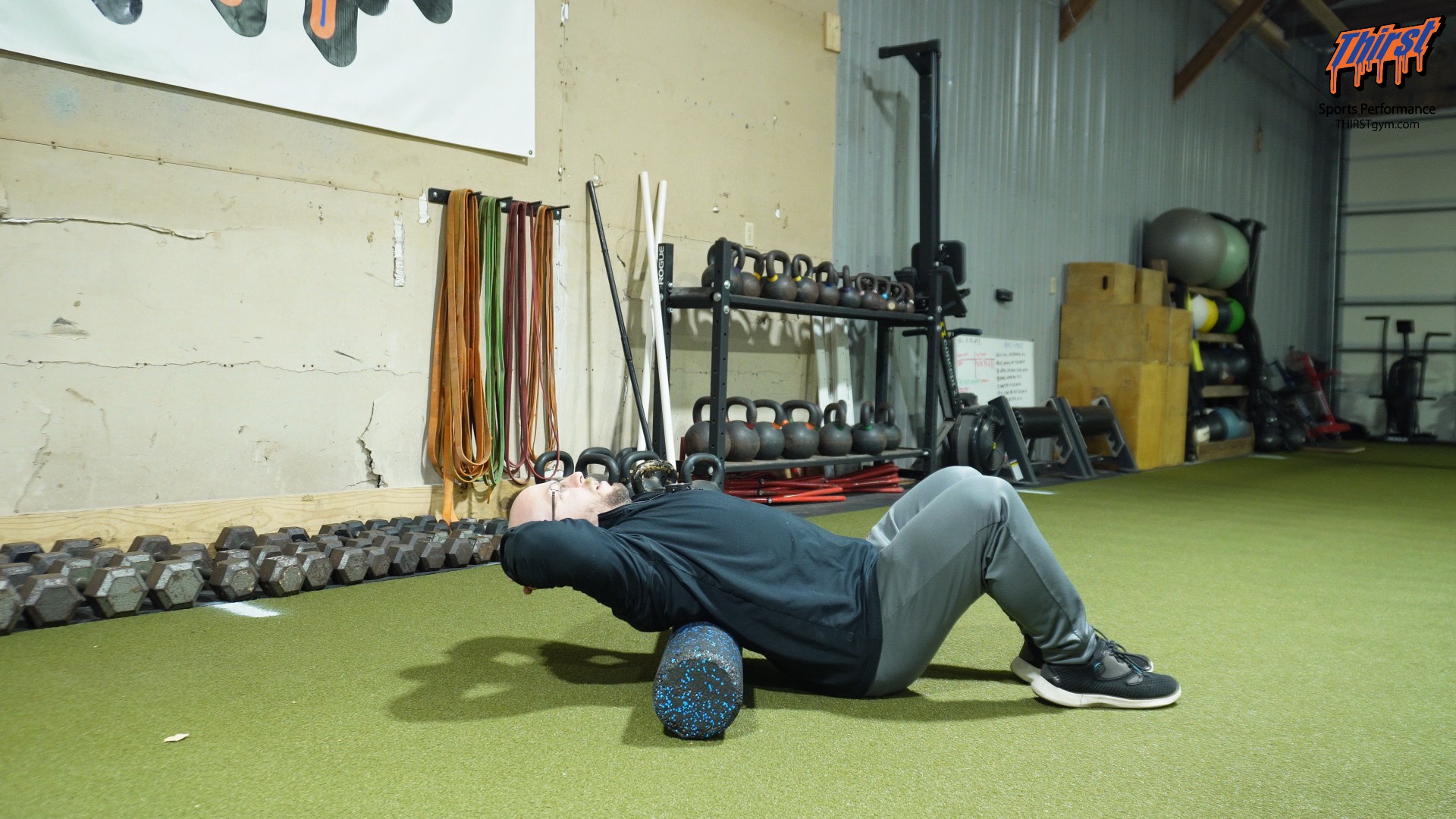
The foundation of this exercise begins with proper foam roller placement on your mid-back. You’ll position yourself on the ground with a quality foam roller placed across your back, specifically targeting the lower portion of your thoracic spine to the middle aspect of your upper back. This means the roller sits above your lumbar spine (lower back) but below your shoulder blades, right around the region where your bra strap would sit or where your mid-back naturally curves forward when you’re slouching.
Your feet should remain flat on the ground with knees bent, creating a stable base that prevents you from rolling backward uncontrollably. This foot positioning is crucial because it allows you to maintain control throughout the movement rather than simply collapsing over the roller. From this foundation, you have two hand position options, each offering distinct advantages for different body types and mobility levels.
The first option involves crossing your arms across your chest or shoulders, which works well for beginners who need less neck support. However, the preferred position places both hands behind your head with elbows pointed forward. This hand-behind-head setup serves a critical biomechanical purpose beyond simple comfort—it helps you maintain a neutral cervical spine position by preventing your head from hyperextending backward as you arch over the roller. This chin-tucked position ensures you’re actually extending through your thoracic spine rather than compensating by cranking your neck into excessive extension, a common mistake that defeats the entire purpose of the exercise.
Executing the Movement: Two Effective Variations
The foam roller T-spine extension offers two distinct execution methods, each delivering unique benefits for improving upper back mobility. The first variation employs a dynamic approach that combines thoracic extension with anterior core engagement. Beginning from your setup position, you’ll take a complete exhale to engage your core, then extend your thoracic spine backward over the foam roller, allowing your mid-back to drape over the roller as you reach overhead. From this extended position, you return to a crunch-like position by flexing your spine forward, then repeat the cycle of exhaling and extending again.
This dynamic version works exceptionally well as an activation drill because it teaches your nervous system to control movement through the full range of thoracic extension. The alternating pattern of flexion and extension helps your body recognize and access positions it may have been avoiding due to stiffness or postural habits developed from prolonged sitting.
The second variation takes a more sustained approach that leverages breathing mechanics to progressively deepen your thoracic extension. After extending backward over the foam roller into your maximum comfortable range, you maintain this position while performing complete breathing cycles. Each inhale expands your ribcage, and each exhale allows you to relax slightly deeper into extension around the roller. This breathing-focused method typically involves taking five to eight complete breath cycles, with each exhalation creating an opportunity to access slightly more range of motion as your tissues relax and your nervous system adapts to the new position.
The breathing variation proves particularly effective because it addresses one of the primary limitations in thoracic mobility—the relationship between rib positioning and spinal extension. Your thoracic vertebrae articulate directly with your ribs, meaning restricted rib mobility directly limits your ability to extend your mid-back. By incorporating deliberate breathing patterns, you’re simultaneously addressing both the spinal and ribcage components of thoracic extension.
Programming the Foam Roller T-Spine Extension Into Your Training
This thoracic mobility drill integrates seamlessly into virtually any training program, whether you’re preparing for heavy squats, improving your overhead press, or simply trying to undo the postural damage from your desk job. For most applications, performing the exercise for thirty to sixty seconds provides sufficient stimulus to improve tissue quality and joint mobility. Alternatively, the five to eight breath cycle protocol works perfectly when you’re using the sustained breathing variation.
As a warm-up tool, the foam roller T-spine extension shines before upper body pressing sessions where thoracic extension directly impacts your ability to maintain proper scapular positioning during bench press variations. It proves equally valuable before lower body training, particularly for front squats and overhead squats where maintaining an upright torso requires exceptional thoracic extension. Many lifters discover that just two minutes of focused T-spine mobility work completely transforms their squat mechanics by allowing them to stay more vertical throughout the movement.
Beyond pre-training applications, this drill functions brilliantly as a filler exercise between working sets of pressing movements. Rather than scrolling your phone during rest periods between bench press sets, spending forty-five seconds extending over the foam roller can actually improve your performance on subsequent sets by maintaining optimal thoracic positioning. The same principle applies when training overhead presses, where thoracic extension determines whether you can achieve a true vertical pressing path or whether you’re forced to press at a forward angle that increases shoulder strain.
You can also strategically move the foam roller up and down your thoracic spine to target different segments of stiffness. After completing your breath cycles at one level, roll slightly higher up your back and repeat the process, methodically addressing restriction throughout your entire mid-back region. This segmental approach ensures you’re not just mobilizing one area while leaving other regions locked up.
Who Benefits Most From This Exercise
The foam roller T-spine extension serves an incredibly diverse population spanning from competitive powerlifters to office workers battling chronic upper back pain. Desk workers dealing with kyphotic posture and rounded shoulders will find this exercise invaluable for reversing the postural adaptations created by prolonged computer work. The sustained breathing variation particularly benefits this population by teaching them to actively access extension rather than passively slumping into their habitual flexed position.
Athletes requiring overhead mobility—including Olympic weightlifters, CrossFit competitors, volleyball players, and swimmers—depend on thoracic extension for optimal performance and injury prevention. Similarly, powerlifters and strength athletes benefit from improved T-spine mobility for maintaining proper positioning during heavy squats and achieving optimal shoulder blade retraction during bench pressing. Even general fitness enthusiasts training for aesthetic goals will notice improved muscle recruitment and reduced shoulder discomfort when their thoracic spine moves properly.
For anyone experiencing the postural consequences of modern life, this simple foam rolling technique offers a practical, equipment-minimal solution that delivers measurable improvements in both how you move and how you feel throughout your training and daily activities.