

Low Box Lateral Shuffle with Stick: The Lateral Deceleration Drill Athletes Need
Most athletes spend a significant amount of time developing their ability to accelerate and produce lateral power, but the ability to decelerate and own a stopped position is what separates good movers from elite ones. The low box lateral shuffle with stick is a change-of-direction drill specifically designed to train lateral deceleration, teaching athletes how to yield, absorb force, and stop in a mechanically sound position so they are immediately ready to explode again in any direction.
Watch the video below on how to maximize this exercise.
What You Need
This exercise requires minimal equipment. You will need a small box or elevated surface approximately two to three inches off the ground. A DC block works perfectly, but a standard weight plate or any low, stable platform will accomplish the same goal. Beyond that, you just need enough space to shuffle laterally a few feet in each direction.
Starting Position and Athletic Stance
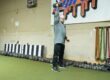
Begin with one foot on the block and the other foot on the ground beside it, establishing your athletic stance. Hips drop back into a loaded position, chest stays tall, and the knees track directly in line with the feet rather than collapsing inward or driving excessively forward. This is the same power position you would see in a defensive athletic stance across virtually every field and court sport. The hips are back, weight is distributed through the foot, and the body is coiled and ready to move. This setup is not incidental to the drill — it is the entire point. The goal is to land in this exact position on the other side.
How to Perform the Low Box Lateral Shuffle with Stick
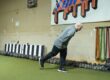
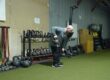
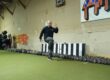
From your starting position, drive laterally off the foot that is not on the block, shuffling over the box as quickly as possible before sticking the landing on the opposite side. The stick is the critical component here. Upon landing, you hold that stopped position for a full two to three seconds before returning. The emphasis is not on how fast you can cycle back and forth. The emphasis is on how cleanly and completely you can decelerate, own the landing, and demonstrate full control of that position before moving again.
This is where athletes often misunderstand drills like this one. The natural instinct is to try to move as fast as possible across the box, minimizing the pause and turning the exercise into a speed drill. That misses the point entirely. The effort going across should be maximal, but the stick is what you are training. Holding that position for two to three seconds forces the neuromuscular system to fully experience and reinforce the deceleration pattern rather than rushing past it.
Why This Drill Works
Lateral deceleration is one of the most undertrained qualities in sport-specific and general athletic development. When an athlete cannot stop cleanly in a lateral direction, they either have to round off their change of direction — losing time and position — or they stop in a mechanically compromised posture that puts stress on the knees and ankles while also leaving them out of position to immediately react and reapply force.
The low box lateral shuffle with stick addresses this directly by creating repeated, deliberate exposure to the landing position itself. Notice that the position you land in — hips back, knee stacked over foot, chest tall — is the same position you want to push from when changing direction. The drill is essentially teaching your body that stopping and re-accelerating are not two separate events. They are one fluid sequence, and owning that stopped position is where the next explosive movement begins.
For athletes who look like they have to rotate their entire body just to change direction, or who struggle to decelerate without their knees caving or their weight shifting to their toes, this drill provides a low-complexity, high-feedback environment to build better movement patterns from the ground up.
Programming the Low Box Lateral Shuffle with Stick
This drill fits best alongside plyometric, speed, and lateral power work rather than as a standalone accessory movement. Three to five sets of three to five reps per side is the target range, keeping the total volume manageable enough to maintain quality on every single repetition. Because this is a movement quality drill rather than a conditioning drill, every rep should look the same — deliberate, controlled, and fully owned at the stick position. It pairs naturally with other lateral-based movements such as lateral bounds, broad jumps, and change-of-direction speed work, making it an efficient addition to any athletic performance block.