
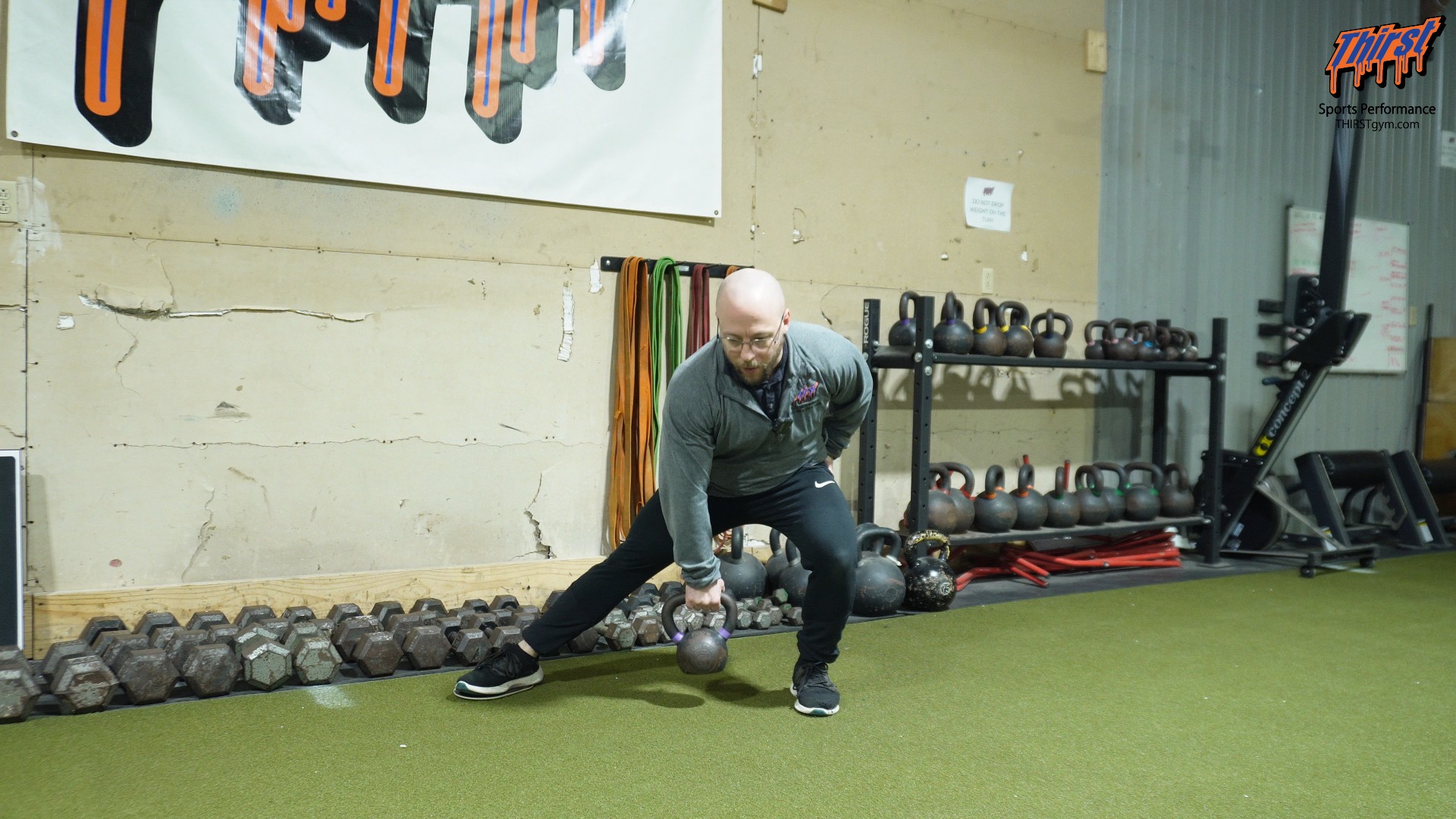
Offset Kettlebell Lateral Lunge with Slider: Build Stronger Adductors and Healthier Hips
The offset kettlebell lateral lunge with slider is a highly effective frontal plane exercise that targets adductor strength, glute and hamstring development, and overall hip health. Whether you’re working with athletes in a performance setting or coaching personal training clients who need better lateral movement patterns, this variation deserves a place in your programming toolkit.
Watch the video below on how to maximize this exercise.
What You Need
All this exercise requires is a sandbag. The type of sandbag doesn’t particularly matter — use what you have access to. In general, heavier is better as long as you can execute the movement with sound mechanics. The unpredictable, shifting weight of a sandbag is actually a feature, not a bug, as it forces your stabilizers to work overtime in a way that a barbell or dumbbell simply cannot replicate.
How to Perform the Sandbag Ground to Shoulder
Start by straddling the sandbag with your feet on either side of it. From there, hinge at the hips, keep your chest tall, and drive your arms underneath the bag as much as possible before initiating the lift. The goal is to use your legs to generate power and throw the sandbag up onto one shoulder in one fluid motion.
For lighter sandbags, you can go straight from the ground to the shoulder in a single movement. For heavier loads, you’ll want to use the lapping technique. To lap the sandbag, squat down, pick it up off the ground, and bring it into your lap by driving your knees forward to create a shelf. Once the bag is stable and resting on your thighs, use your upper body and remaining leg drive to shoulder it to whichever side you prefer. From there, drop the bag back to the ground under control and repeat on the same or opposite side.
The lapping variation is a critical skill for anyone working with truly heavy sandbags or training in a strongman context. Learning to break the lift into two distinct phases — ground to lap, lap to shoulder — allows you to handle much greater loads and is more reflective of how heavy awkward objects get moved in real-world situations.
Muscles Worked
The sandbag ground to shoulder is a true full-body exercise. The legs and hip extensors drive the initial pull from the floor and power the bag up onto the shoulder. The entire posterior chain — glutes, hamstrings, and spinal erectors — works hard throughout the movement. Your core and abdominals are heavily engaged, particularly during the lapping phase when the load is held out in front of the body. The upper back, traps, and arms all contribute to controlling and placing the bag on the shoulder. Few exercises demand this level of total-body coordination and effort simultaneously.
Programming the Sandbag Ground to Shoulder
From a conditioning standpoint, two to five reps per side works well when this movement is paired in a mixed modality circuit with other exercises. Because the movement is so demanding, even low rep ranges accumulate significant fatigue across the entire body. For strength-focused work with heavier sandbags, staying in the two to five rep range with full recovery between sets is appropriate.
One programming note worth emphasizing: unless you’re competing in strongman and need to optimize your dominant side, train both sides equally. Alternating shoulders each rep or each set helps identify and address any strength or coordination imbalances that might otherwise go unnoticed. This is standard practice at THIRST Gym for all combat sports athletes, where unilateral strength and body control matter enormously in competition.
Why Combat Athletes Should Use This Exercise
Wrestlers, grapplers, and fighters benefit enormously from exercises that mimic the demands of controlling and moving a resisting, unpredictable opponent. The sandbag ground to shoulder checks every box — it requires hip extension power, grip strength, upper back engagement, and whole-body coordination under fatigue. The odd object nature of the sandbag also builds the kind of grip and bracing strength that translates directly to the mat or the cage in ways that traditional barbell work cannot fully replicate.
Final Thoughts
If you’re looking to elevate your conditioning, add a practical strength element to your training, or simply want an exercise that challenges you in a completely different way than traditional barbell movements, the sandbag ground to shoulder belongs in your program. It’s accessible, scalable, and brutally effective. Give it a try and let us know how it goes in the comments.