
Alternating Bent Over Kettlebell Row: How to Do It, Muscles Worked, and Programming Tips
The alternating bent over kettlebell row is a full-body integrated pulling exercise that challenges your posterior chain, upper back musculature, and grip simultaneously. While it looks like a straightforward rowing variation, the demands it places on positional stability and unilateral coordination make it a more advanced movement that rewards athletes who have already built a solid foundation in hinging and horizontal pulling.
Watch the video below on how to maximize this exercise.
Setup and Starting Position
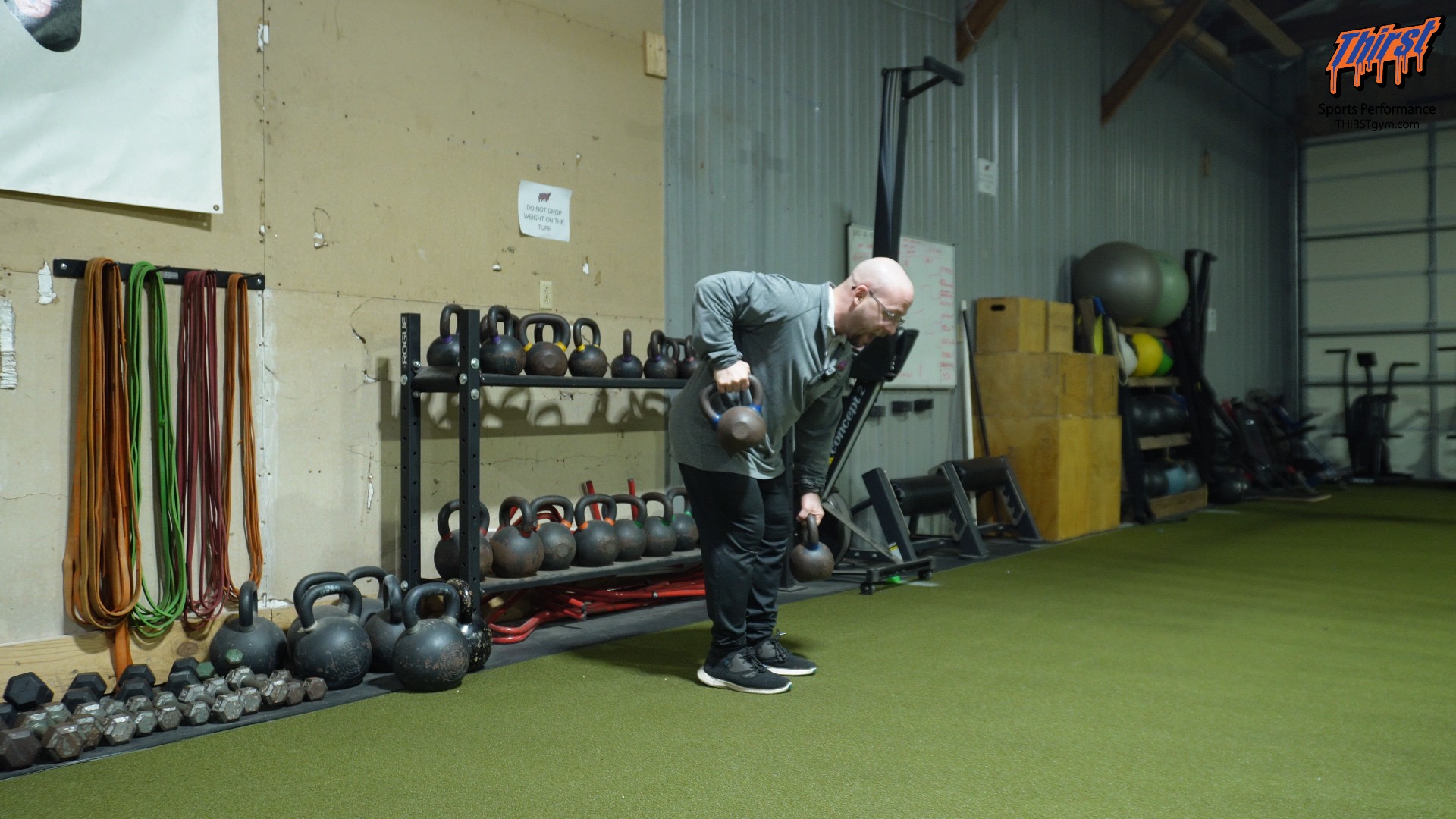
To perform this exercise, you will need a pair of kettlebells and enough space to hinge freely. Start with your feet directly beneath your hips, knees slightly unlocked, and arms hanging long below your shoulders. From there, push your hips back as far as possible while maintaining a flat, neutral spine and a tall, proud chest. Think of this as a kettlebell Romanian deadlift position — your goal is to feel a stretch through the hamstrings while your lower back stays strong and supported. A common error is either rounding through the upper back, creating a Hunchback of Notre Dame posture, or not hinging far enough and staying too upright. You want to be genuinely loaded into that hinge position, not hovering somewhere in between.
Executing the Row
From your hinged base, drive one elbow back in a controlled arc, allowing it to travel at roughly a 30-degree angle relative to your torso. Avoid the instinct to flare the elbow wide or pull it straight up — as long as you are properly bent over, your elbow will naturally track where it needs to go. The key coaching cue here is to focus on driving the elbow back rather than lifting the hand up. Maintain a completely stable torso throughout the pull, resisting any rotation or shifting as you alternate from side to side.
Why Kettlebells Make This Exercise Unique
The kettlebell handle changes the dynamics of this rowing variation in a meaningful way. With a dumbbell, the weight is centered around your hand, making it relatively easy to control the path of the movement. With a kettlebell, the load hangs below the handle, meaning the bell constantly wants to pull straight toward the floor. This demands more grip activation and forces you to actively control the kettlebell’s position throughout the entire range of motion. That added instability also creates a stronger mind-muscle connection to the lats, traps, and rhomboids, as you feel the back working harder to manage and pull the load.
Muscles Trained
This exercise functions as a full-body integration movement. Your glutes and hamstrings are working isometrically to maintain the hinge throughout every rep. Your abdominals and spinal erectors are bracing to keep the torso rigid and neutral. The row itself directly targets the upper back, including the traps, rhomboids, and rear deltoids, while your forearms and hands are under consistent grip demand from the kettlebell’s offset load.
Programming Considerations
Because this is a bent-over exercise, it requires some thought when placing it within a training session. Avoid pairing it directly with other hinging movements like a dumbbell RDL or exercises that are already grip-intensive, as you will be doubling down on the same muscular demands and compromising the quality of both exercises. A smarter pairing is to superset it with an upper-body push movement, which creates a balanced agonist-antagonist structure without accumulating unnecessary fatigue in the same positions and grip patterns.
For athletes and general clients who move well in a hinge and understand proper horizontal rowing mechanics, two to four sets of six to ten reps per side is an effective starting prescription. The alternating nature of the movement extends the time spent in the hinge position per set, which adds to the total stability demand and makes this a more metabolically challenging variation than a standard bilateral row.
This exercise is not appropriate for individuals who have difficulty hinging, struggle with low back pain, or have not yet developed a baseline of rowing strength and body control. Master the hinge and the basic bent-over row first, then progress to this variation when those patterns are solid.