
The Broad Jump with Medicine Ball Throw: A Complete Guide to This Explosive Plyometric Exercise
When it comes to developing raw athletic power and explosiveness, few exercises combine the benefits of jumping and throwing quite like the broad jump with medicine ball throw. This dynamic plyometric movement has become a cornerstone exercise for athletes across multiple sports, from football players seeking enhanced acceleration to swimmers looking to improve their explosive starts.
Watch the video below on how to maximize this exercise.
What Is the Broad Jump with Medicine Ball Throw?
The broad jump with medicine ball throw is a compound plyometric exercise that challenges your body’s ability to generate maximum force through what’s known as triple extension – the simultaneous extension of your ankles, knees, and hips. Unlike a standard broad jump where you focus solely on distance, this variation adds the complexity of transferring that generated force into an external object, creating a more sport-specific movement pattern.
This exercise essentially trains your nervous system to coordinate power production through your entire kinetic chain, from the ground contact through your legs and core, ultimately expressing that force through your upper body as you release the medicine ball.
Key Benefits for Athletic Performance
Enhanced Triple Extension Power
The primary benefit of this exercise lies in its ability to develop triple extension power, which forms the foundation of virtually every explosive athletic movement. Whether you’re sprinting off the line in football, launching into a swimming dive, or executing a wrestling takedown, triple extension is the biomechanical pattern that generates maximum force production.
Force Transfer Training
What sets this exercise apart from traditional plyometrics is the force transfer component. Athletes must learn to efficiently channel the power generated from their lower body through their core and into their upper extremities. This transfer of energy is crucial in sports where you need to apply force to external objects or opponents.
Improved Coordination and Timing
The coordination required to execute both the jump and throw simultaneously challenges your nervous system in ways that single-plane movements cannot. This improved neuromuscular coordination translates directly to better athletic performance in complex, multi-directional sports movements.
Proper Exercise Technique
Understanding the correct form is essential for maximizing benefits while minimizing injury risk. Here’s how to execute the broad jump with medicine ball throw properly:
Starting Position
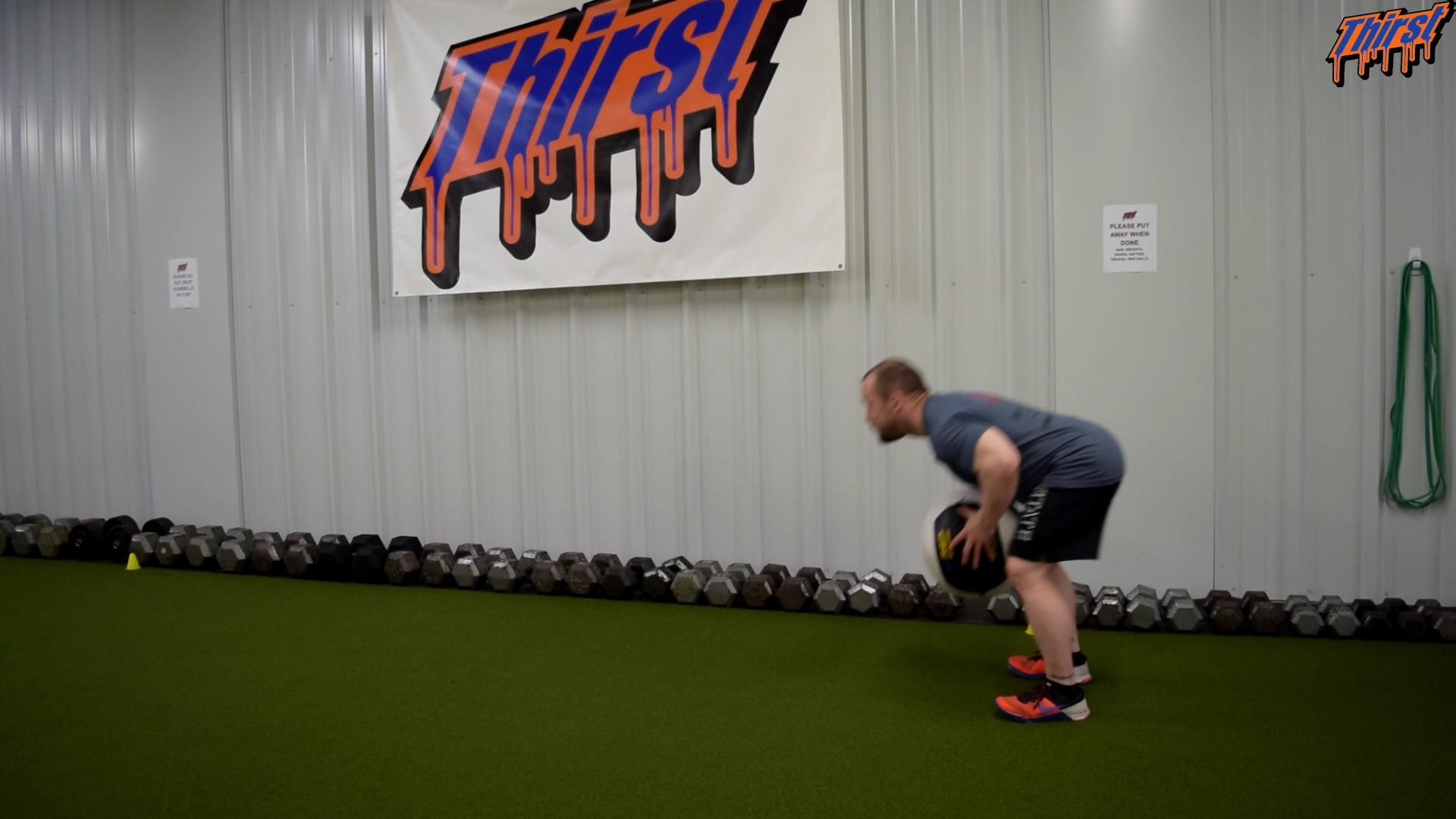
Begin by holding the medicine ball at chest level with both hands, maintaining a firm grip. Position yourself in a quarter-squat stance with your feet shoulder-width apart. Your weight should be evenly distributed, with a slight forward lean to prepare for the explosive movement.
The Execution Phase
Initiate the movement by driving through your heels and explosively extending through your ankles, knees, and hips simultaneously. As you leave the ground, bring the medicine ball back slightly before driving it forward with maximum force. The goal is to achieve both maximum jump distance and maximum throwing distance.
Landing and Follow-Through
Focus on sticking the landing with proper mechanics – land with your feet shoulder-width apart and absorb the impact through your legs. Maintain balance and control throughout the deceleration phase.
Programming Recommendations for Maximum Results
Sets and Repetitions
For optimal power development, structure your training around 3-6 sets of 3-6 repetitions. This low-repetition, high-intensity approach ensures you’re training in the power zone rather than transitioning into muscular endurance work.
Medicine Ball Weight Selection
Choosing the appropriate medicine ball weight is crucial for success. The ball should be challenging enough to provide resistance but light enough to allow for explosive movement. A good benchmark is achieving a 10-yard total distance (jump plus throw combined). If athletes consistently exceed this distance, consider increasing the weight slightly. If they fall short, the ball may be too heavy.
Rest Periods
Allow adequate rest between sets – typically 2-3 minutes – to ensure full neurological recovery. Power training requires your nervous system to be fresh for each repetition.
Equipment and Space Requirements
The beauty of this exercise lies in its simplicity. You’ll need:
- A medicine ball of appropriate weight (typically 6-12 pounds for most athletes)
- Adequate space for both jumping and throwing (minimum 15-20 yards)
- Ideally, a training partner to retrieve the ball, or a large wall for ball return
Common Mistakes and How to Avoid Them
Asymmetrical Throwing Patterns
Many athletes, particularly those with dominant throwing arms, tend to favor one side during the throw phase. This can create imbalances and reduce the effectiveness of the triple extension. Focus on maintaining symmetrical arm action and even force application through both sides of the body.
Inadequate Landing Mechanics
Rushing through the landing phase diminishes both safety and training effect. Emphasize proper deceleration and balance upon landing, treating it as an integral part of the exercise rather than simply the end point.
Ball Weight Progression Too Aggressive
Progressing to heavier medicine balls too quickly can compromise movement quality and reduce power output. Always prioritize movement speed and distance over absolute weight moved.
Who Benefits Most from This Exercise
This exercise is particularly valuable for athletes in sports requiring explosive starts, rapid direction changes, or the ability to generate force against external resistance. Football players benefit from improved acceleration and blocking power, swimmers develop better start explosiveness, and wrestlers enhance their takedown power and overall explosive strength.
The broad jump with medicine ball throw also serves as an excellent alternative for athletes who may not have access to Olympic lifting platforms or for those seeking to add variety to their plyometric training programs.
Conclusion
The broad jump with medicine ball throw represents a perfect fusion of lower body power development and upper body force expression. By challenging your body’s ability to generate and transfer force efficiently, this exercise builds the type of explosive power that translates directly to improved athletic performance. When programmed correctly with appropriate loads, volumes, and rest periods, it becomes an invaluable tool in any serious athlete’s training arsenal.
Remember to start conservatively with ball weight selection, focus on movement quality over quantity, and always emphasize proper landing mechanics. With consistent practice and progressive overload, this exercise will help develop the explosive power that separates good athletes from great ones.