
Dumbbell Bench Floor Press: The Elevated Setup for Solo Training and Heavy Loads
The dumbbell bench floor press has long been a staple exercise for building pressing strength and developing lockout power, but traditional floor press variations present a significant practical challenge. Getting heavy dumbbells into position while lying on the ground becomes increasingly difficult as your strength improves, particularly when training alone. The elevated dumbbell bench floor press solves this problem elegantly by combining the benefits of floor pressing with the accessibility and setup convenience of traditional bench work.
This exercise variation uses an elevated platform setup that allows you to maintain all the mechanical advantages of floor pressing while eliminating the awkward transitions and positioning difficulties that typically limit your ability to work with challenging loads. For serious lifters training without a spotter or anyone looking to maximize their floor press work, this setup represents a practical solution that doesn’t compromise on training quality.
Watch the video below on how to maximize this exercise.
Equipment Setup and Configuration
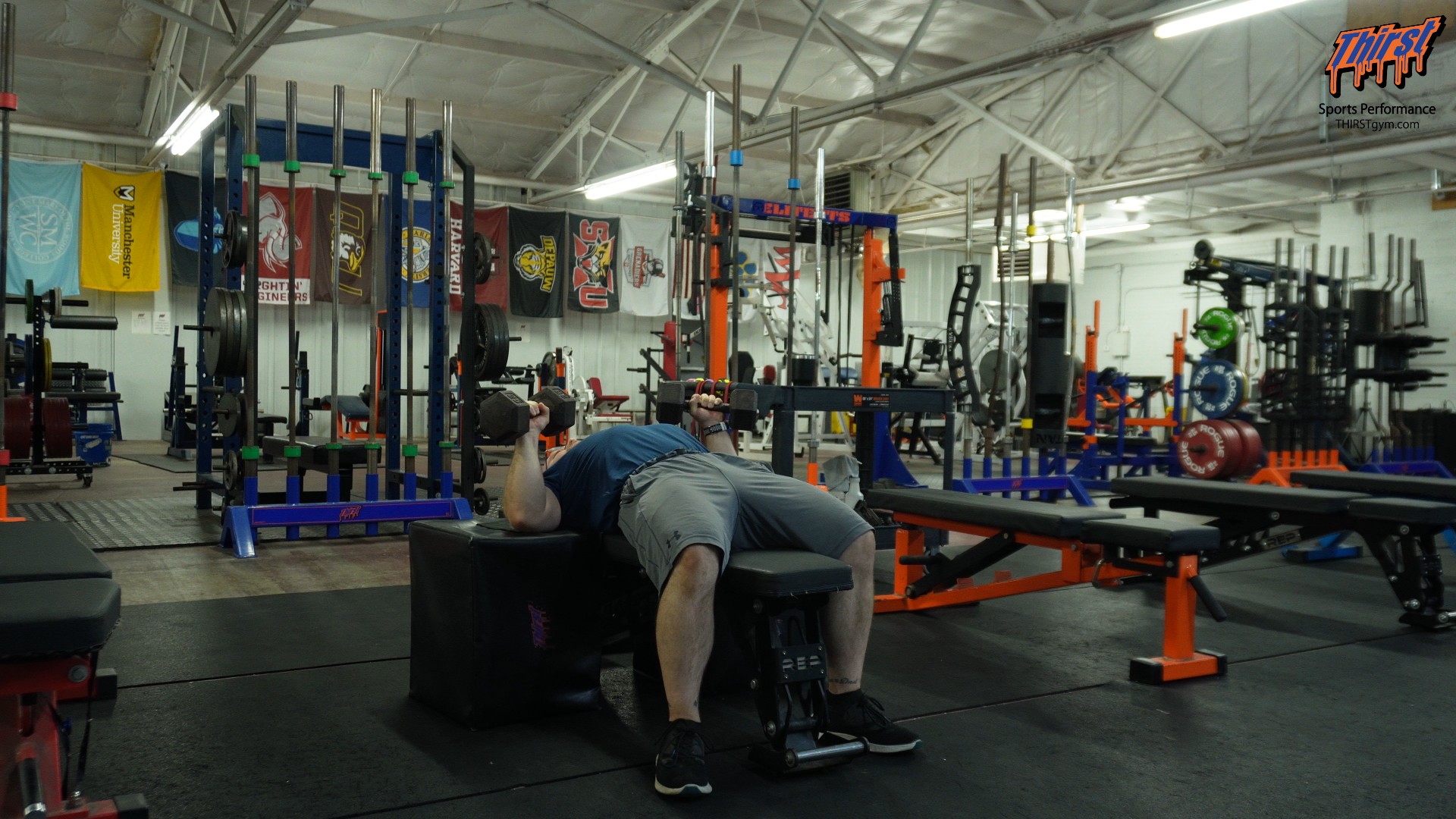
The beauty of this variation lies in its straightforward equipment requirements. You’ll need a standard utility bench, a pair of dumbbells appropriate for your strength level, and two plyo boxes set at eighteen inches in height. This specific height matters because it matches the standard elevation of most utility benches, creating a level pressing surface that mimics your regular bench press position.
The plyo boxes can be any sturdy eighteen-inch platform. Elite FTS makes excellent flippable boxes that work perfectly for this purpose, but any solid boxes at the correct height will serve you well. The key is ensuring they’re stable and positioned to support your arms throughout the movement without shifting or wobbling during the press.
Position the boxes on either side of the bench at a distance that allows your elbows to rest comfortably on them when you’re in your normal bench press setup. This spacing should mirror where your elbows would naturally track during a regular dumbbell bench press, typically creating that twenty to thirty degree angle from your torso rather than flaring straight out to the sides.
Movement Execution and Technical Details
Getting into position follows the same protocol you’d use for standard dumbbell bench pressing. Place the dumbbells on the bench, sit down, and position them on your thighs. Lean back into your pressing position just as you normally would, using the momentum of the dumbbells to help guide them into the starting position. This familiar setup process is precisely why this variation works so well for solo training with heavy loads.
From the starting position, your arms rest on the plyo boxes with the dumbbells held at chest level. This creates the fundamental floor press position where your upper arms are supported, limiting the range of motion and eliminating the stretch reflex you’d get from a full bench press. The supported position also reduces shoulder stress by preventing excessive horizontal extension of the shoulder joint, making this variation particularly valuable for lifters managing shoulder issues or those looking to overload the lockout portion of the pressing movement.
Throughout the press, maintain active tension even when your arms contact the boxes. This is crucial and represents a common mistake in floor press variations. Your arms shouldn’t simply collapse or relax onto the platform. Instead, stay tight and controlled, actively pressing into the boxes as if you’re trying to meet the dumbbells at the top of a regular bench press. This continuous tension maximizes muscle engagement and maintains the training stimulus throughout the entire set.
The pressing motion itself should follow sound bench press mechanics. Press the dumbbells up and slightly together, avoiding the tendency to let your elbows flare excessively outward. That twenty to thirty degree angle from your torso provides optimal shoulder positioning while still allowing for maximum force production. Your feet should remain flat on the floor, creating a stable base that keeps your body anchored to the bench without the extreme leg drive you might use in competition bench pressing.
Why This Variation Delivers Results
Floor presses offer distinct advantages over traditional bench pressing, and this elevated setup preserves all those benefits while adding its own unique value. The limited range of motion inherent to floor pressing allows you to overload the lockout portion of the press, which is often the weakest point for many lifters. By removing the bottom portion of the movement, you can typically handle more weight than you could through a full range bench press, creating a powerful overload stimulus for building pressing strength.
The reduced shoulder extension also makes this variation exceptionally joint-friendly. For lifters with shoulder impingement issues or those who experience discomfort in the bottom position of traditional bench pressing, floor presses provide a way to continue building pressing strength without aggravating existing problems. The boxes naturally limit how far your elbows can descend, creating a built-in safety mechanism that protects your shoulders while still delivering an effective training stimulus.
From a practical standpoint, this elevated setup eliminates the most frustrating aspect of traditional floor pressing with heavy dumbbells. Anyone who’s tried to get a pair of one hundred pound dumbbells into position while lying on the ground understands the struggle. The elevated variation lets you use your normal bench press setup technique, making it feasible to train with challenging loads even when working alone. This accessibility means you can actually push the intensity on floor press work rather than being limited by logistics.
Programming Applications and Training Recommendations
Incorporate this exercise using the same set and rep schemes you’d apply to regular dumbbell bench press work or traditional floor presses. Three to four sets of six to twelve repetitions represents an ideal starting point for most lifters, falling squarely within effective hypertrophy ranges while still providing sufficient mechanical tension for strength development.
The exercise works exceptionally well as a primary pressing movement on days when you want to emphasize lockout strength or reduce shoulder stress. It also functions effectively as an accessory movement following heavier barbell bench work, allowing you to accumulate additional pressing volume without excessive fatigue or joint stress. The reduced range of motion means you can often push higher volumes than you might with full range pressing variations.
For warming up or extended set work, you can certainly push repetitions higher than the standard hypertrophy range. Sets of fifteen to twenty repetitions can serve as excellent activation work before heavier pressing or as metabolic stress training to finish a session. The supported position makes higher rep sets more manageable than they would be with full range bench pressing, where maintaining optimal positioning becomes increasingly challenging as fatigue accumulates.
This variation particularly benefits powerlifters working on lockout strength, solo trainers who need a practical solution for heavy dumbbell work, and anyone managing shoulder issues who still wants to maintain pressing volume. The combination of accessibility, effectiveness, and joint-friendliness makes it a valuable addition to nearly any upper body training program.