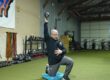


Dumbbell Bench Press on Plyo Box: The Solo Trainer’s Solution to Floor Press Limitations
The dumbbell bench press on plyo box represents an intelligent training hack that solves one of the most frustrating problems facing lifters who train alone: how to execute heavy dumbbell floor presses without assistance for setup and dismount. This accessory variation combines the shoulder-stabilizing benefits of floor press work with the practical advantages of bench press positioning, all while maintaining competition-specific height standards that directly transfer to your main pressing movements.
Watch the video below on how to maximize this exercise.
Understanding the Exercise and Its Purpose
At its core, the dumbbell bench press on plyo box functions as a hybrid movement that bridges the gap between traditional dumbbell floor pressing and standard bench press work. The exercise positions you on an 18-inch plyo box—the exact height of competition powerlifting benches and standard utility benches—allowing you to perform dumbbell pressing with your elbows making contact with the elevated surface rather than the floor. This specific height standardization ensures that your range of motion, shoulder positioning, and pressing mechanics remain consistent with your competition setup, making this variation far more than just a convenient substitute for floor work.
The primary advantage this exercise offers over conventional dumbbell floor presses becomes immediately apparent when you’re training without a spotter or training partner. Anyone who has attempted heavy dumbbell floor presses knows the awkward challenge of getting into position with substantial weight, maintaining proper setup throughout the movement, and then safely dismounting after reaching muscular fatigue. The elevated plyo box position eliminates these logistical nightmares by allowing you to simply bring the dumbbells forward and sit up when you’ve completed your set, exactly as you would from a standard bench.
Equipment Setup and Height Specifications
The 18-inch plyo box height proves critical for maximizing transfer to your competition bench press. This measurement isn’t arbitrary—it represents the standardized height used in powerlifting competitions and matches the dimensions of most commercial utility benches. By training at this exact height, you maintain consistent shoulder mechanics, elbow positioning, and pressing angles that directly reinforce the motor patterns you’re developing in your main pressing work.
While taller plyo boxes at 21 or 24 inches can certainly be used, particularly for larger individuals who might find the surface area of standard boxes restrictive, the 18-inch height offers the most specific carryover to actual bench press performance. Since this exercise functions primarily as accessory work rather than a main movement, some variation in height won’t undermine its effectiveness, but competition-focused lifters benefit most from maintaining that precise 18-inch standard.
The surface area of your plyo box requires consideration based on your body size. Positioning yourself lengthwise on the box typically provides the most stable setup, though smaller athletes may find standard box dimensions adequate. Larger lifters can stack two boxes together or position a single box adjacent to a utility bench to create an extended pressing surface that accommodates broader backs and shoulders while maintaining the target height.
Technical Execution and Setup Fundamentals
Proper execution begins with positioning your glutes at the edge of the plyo box, creating a sensation of almost falling backward that ensures you’re maximally utilizing the available surface area. From this position, you assume your standard bench press setup: shoulder blades pulled together, back, and down, creating the same upper back tightness you would establish on a competition bench. Your feet remain actively pressed into the floor with light to moderate pressure, maintaining leg drive without creating excessive spinal hyperextension or lifting your hips off the box.
The pressing motion itself mirrors traditional dumbbell bench press technique, lowering the dumbbells until your elbows make contact with the plyo box surface. This contact point serves the same function as the floor in conventional floor presses, establishing a consistent depth while preventing excessive shoulder extension that could compromise joint integrity. The critical technical element here involves maintaining total body tension through this bottom position rather than relaxing and allowing the dumbbells to drift. Your shoulder positioning should remain locked throughout the touch, preserving the retracted and depressed scapular position that protects your shoulders and maximizes pressing strength.
The pressing phase requires the same technical focus you would apply to competition bench pressing. Drive through your feet, maintain core bracing, and press the dumbbells along their optimal path while keeping your shoulders stable. The goal extends beyond simply moving the weight—you’re reinforcing proper bench press motor patterns while building pressing strength through a controlled range of motion that emphasizes shoulder health and stability.
Programming Applications and Training Context
This variation fits optimally into accessory programming blocks as a supplementary pressing movement that builds strength without the recovery demands of maximum-range bench pressing. Three to four sets of six to twelve repetitions provides an effective dosage for most training applications, allowing sufficient volume to stimulate hypertrophy and strength adaptation while maintaining the exercise’s accessory role. The moderate rep range ensures you’re working with meaningful loads that challenge your pressing capacity without requiring the maximal weights that would necessitate spotters or create excessive setup difficulties.
Higher repetition work certainly has its place within this exercise framework, particularly when you’re targeting increased training volume, incorporating extra accessory work, or using the movement as specific warm-up preparation before transitioning into heavier bench press or floor press training. The controlled range of motion and stable setup make this variation especially suitable for accumulating quality pressing volume without the shoulder stress that can accompany high-repetition full-range dumbbell work.
For powerlifters and strength athletes, this exercise serves as an excellent option during deload weeks or recovery-focused training phases when you need to maintain pressing frequency and technique practice while reducing absolute loading and range of motion stress. The abbreviated range naturally limits the loads you can handle compared to full-range pressing, creating a built-in intensity reduction that facilitates recovery while preserving movement quality and neuromuscular efficiency.
Who Benefits Most From This Variation
Solo trainers represent the primary demographic that gains maximum advantage from this exercise implementation. If you regularly train alone and have struggled with the practical challenges of heavy dumbbell floor pressing, the plyo box setup transforms a logistically difficult movement into a practical, executable variation that you can perform safely and effectively without assistance.
Athletes and lifters focusing on shoulder health and longevity also benefit significantly from incorporating this controlled-range pressing variation. The defined bottom position prevents excessive shoulder extension while the elevated surface allows superior scapular positioning compared to lying directly on the floor, where ground contact can restrict shoulder blade movement and compromise optimal mechanics.
Home gym owners with limited equipment often find this variation particularly valuable, as it provides quality pressing stimulus without requiring a full bench setup while utilizing equipment—plyo boxes and dumbbells—that commonly appears in minimalist training spaces focused on functional strength development.