

Feet Up Alternating Dumbbell Bench Press: A Lower Back-Friendly Chest Training Variation
The feet up alternating dumbbell bench press represents a sophisticated training variation that addresses one of the most common complaints during traditional bench pressing: lower back discomfort. By elevating the feet onto boxes or platforms during the pressing movement, this exercise fundamentally changes the biomechanical demands of the exercise while simultaneously increasing the training stimulus for the chest, shoulders, and core stability systems.
Understanding why lifters experience lower back issues during standard bench pressing provides important context for this variation’s effectiveness. During conventional bench press execution, many athletes unconsciously hyperextend their lumbar spine in an attempt to reduce the range of motion or create a more mechanically advantageous pressing position. This excessive spinal extension places significant compressive forces on the facet joints of the lower back and can create considerable discomfort, particularly during higher volume training phases or for individuals with pre-existing lower back sensitivity.
Watch the video below on how to maximize this exercise.
Equipment Setup and Exercise Execution
Implementing the feet up alternating dumbbell bench press requires minimal specialized equipment. You’ll need a pair of dumbbells appropriate for your strength level, a standard utility bench, and elevated platforms for foot placement. Box squat boxes from manufacturers like Elite FTS work exceptionally well for this purpose, though plyometric boxes or even sturdy aerobic steps can serve as effective alternatives. The key consideration is ensuring the platforms are stable enough to support your foot pressure throughout the movement without shifting or sliding.
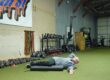
The setup process begins by positioning your boxes at the appropriate distance from the bench head. After selecting your dumbbells, approach the bench and assume your standard bench press starting position. Once your torso is properly positioned on the bench with your shoulder blades retracted and depressed, bring your feet up onto the elevated platforms. Your feet don’t necessarily need to be completely flat on the boxes—a slightly extended ankle position often feels more natural for many lifters. The critical factor is achieving a neutral spine position where your lower back maintains contact with the bench surface rather than arching excessively.
With your feet secured on the platforms and your lower back flat against the bench, press the dumbbells to the starting position with both arms extended toward the ceiling. From this position, you’ll execute the alternating pressing pattern. Lower one dumbbell toward your chest while keeping the opposite arm extended and locked out. As you press the first dumbbell back to the starting position, simultaneously begin lowering the second dumbbell, creating a smooth alternating rhythm throughout the set.
Biomechanical Advantages and Movement Quality
The biomechanical benefits of the feet up position extend beyond simple lower back relief. By placing your feet on elevated platforms, you effectively posteriorly tilt your pelvis, which naturally flattens your lumbar spine against the bench. This pelvic positioning prevents the hyperextension compensation pattern that commonly occurs during traditional bench pressing, particularly as fatigue accumulates or when lifters attempt to handle loads near their maximum capacity.
The feet up position also increases the range of motion demands throughout your upper body. Without the ability to generate leg drive or create spinal extension, your chest and shoulders must travel through a greater excursion distance during each repetition. This increased range of motion translates to greater muscle fiber recruitment and improved muscular development over time, particularly in the stretched positions of the movement where muscle damage and subsequent hypertrophy signals are maximized.
Perhaps most significantly, the alternating pressing pattern combined with the feet up position creates exceptional demands for thoracic spine rotation and anti-rotation stability. As you press one dumbbell while holding the other stationary, your rib cage experiences rotational forces that your core musculature must control and stabilize against. This rotational demand enhances your ability to resist unwanted movement in your midsection while simultaneously improving the mobility and motor control of your thoracic spine—a region that commonly becomes stiff and restricted in individuals who spend significant time in seated positions.
Proper Technique and Common Execution Mistakes
Maintaining proper dumbbell positioning throughout the movement is essential for both safety and effectiveness. As you lower each dumbbell, keep your hands and the weights positioned forward over your chest rather than allowing them to drift out to the sides. Your elbows should track at approximately a thirty to thirty-five degree angle relative to your torso rather than flaring out to ninety degrees. This elbow positioning reduces unnecessary stress on the shoulder joint while maintaining optimal loading angles for the pectoral muscles.
The alternating nature of the exercise requires careful attention to tempo and control. Rather than rushing through the movement, focus on maintaining tension in the stationary arm while smoothly lowering and pressing the working side. This constant tension approach maximizes the training stimulus while improving your neuromuscular coordination and unilateral control.
When completing your set, bring both dumbbells back to the vertical starting position, then draw them down to your knees before using your abdominal muscles to sit up. This exit strategy prevents unnecessary strain on your shoulders and lower back while safely transitioning out of the exercise position.
Programming Recommendations and Application
The feet up alternating dumbbell bench press works exceptionally well within a moderate repetition range that balances mechanical tension with metabolic stress. Programming two to four sets of six to ten repetitions per side provides sufficient volume to drive adaptation while allowing you to maintain quality movement execution throughout each set. This rep range also allows for appropriate load selection—heavy enough to challenge your pressing strength but manageable enough to control the alternating pattern and maintain proper positioning.
This variation serves multiple training populations particularly well. Athletes dealing with chronic lower back discomfort during traditional bench pressing often find immediate relief with the feet up position, allowing them to continue developing upper body pressing strength without aggravating existing issues. Individuals focusing on hypertrophy and muscle development benefit from the increased range of motion and constant tension demands. The exercise also provides valuable training for improving thoracic spine mobility and rotational control, making it applicable for athletes in rotational sports or individuals working to address postural dysfunction.
The feet up alternating dumbbell bench press represents more than just another pressing variation—it’s a strategic solution that addresses common biomechanical limitations while providing unique training stimulus for upper body development and core stability. Whether you’re managing lower back sensitivity, seeking to increase your pressing range of motion, or simply looking to add variety and challenge to your training program, this exercise delivers meaningful results across multiple performance domains.