
Tall Kneeling Band Pull Apart: Technique, Setup, and Programming
The tall kneeling band pull apart is a deceptively simple exercise that delivers serious upper back development when performed with intention. All you need is a light to moderate resistance band and enough floor space to kneel comfortably, making it one of the most accessible and versatile movements you can add to your training program. Whether you’re warming up for a bench press session, finishing off an upper body day, or looking for a way to accumulate quality horizontal pulling volume, this variation has a place in your programming.
Watch the video below on how to maximize this exercise.
Setting Up the Tall Kneeling Position
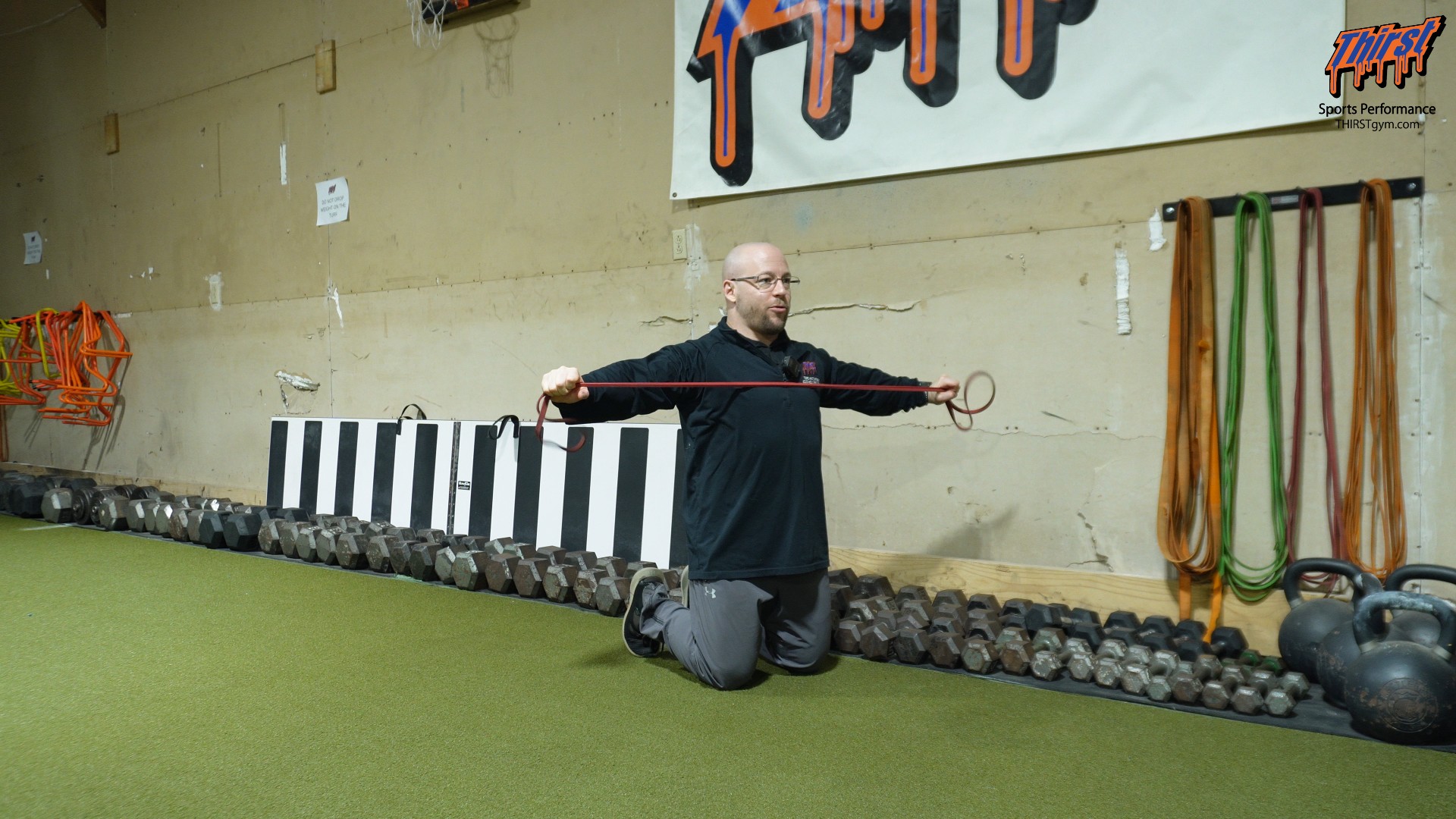
Before you even touch the band, the setup matters. Get both knees on the ground with your toes dug into the floor behind you. Your hips should be pressed slightly forward so that you can feel a mild activation in your glutes and hamstrings. This is not passive kneeling. You want your pelvis stacked directly under your rib cage, creating a neutral, braced position from your hips through your torso. Avoid hinging your hips back or compensating by arching through your lower or upper back. Ribs stay down, everything stays stacked.
This positional discipline is the whole point of performing the pull apart from tall kneeling rather than standing. When athletes stand and do band pull aparts, it becomes far too easy to let the upper back round forward, arch the lumbar spine, or shift into a lazy postural pattern that reduces the work the target muscles are actually doing. The tall kneeling position removes a lot of that slack and forces you to stay honest with your alignment throughout each rep.
Performing the Movement
Double up your resistance band and grip it with palms facing down, arms extended straight out in front of you at approximately chest or nipple height. From there, pull the band apart by driving your hands out to each side while keeping your arms straight. Squeeze your shoulder blades together at the end range and hold briefly before returning to the start position. The arms stay straight throughout the entire movement. This is a shoulder blade retraction drill, not an elbow-driven row.
To make the exercise more challenging, bring your hands closer together on the band or grab a band with heavier resistance. To make it easier, widen your grip or use a lighter band. What you want to avoid is starting with your hands so wide that your range of motion becomes negligible. Beginning with your arms extended straight out in front of you gives you the best combination of resistance and range of motion to actually feel your upper back doing the work.
Why the Tall Kneeling Variation Works
The biggest problem with traditional standing band pull aparts is a lack of body awareness and positional control. Many athletes crank out rep after rep by arching their spine and shifting their body position to compensate rather than demanding that their rear deltoids, rhomboids, and mid-traps do the work. Tall kneeling eliminates those compensation patterns by locking your lower body into a position that demands stability. When your glutes and hamstrings are engaged below and your ribs are stacked above, the upper back has nowhere to hide. The reps become more intentional, more effective, and more honest.
Programming Applications
The tall kneeling band pull apart is a flexible tool that fits well in multiple programming slots. As a warm-up before bench press or any overhead pressing work, a set or two primes the posterior shoulder and upper back musculature and helps establish the postural habits you want to carry into your heavier sets. Because it trains the opposing muscle groups to pressing movements, it can also be paired directly with bench press or overhead press as a superset without compromising your performance on those lifts. You get the benefit of free upper back work between pressing sets without accumulating fatigue that bleeds into your main movement.
At the end of a training session, this exercise works well as a finisher. Try accumulating 100 to 150 total reps in as little time as possible, or work in straight sets of 10 to 30 reps for one to five sets depending on where it sits in your session. The options are genuinely wide open here. Let your goal, your training phase, and your individual needs dictate how you apply it, but know that almost any implementation will give you a return on your investment.