
The Mental Shift That Could Add Pounds to Your Bench Press Instantly
Most lifters approach the bench press with an obsessive focus on the technical details: hand placement, foot position, upper back tightness, and bar path. While these elements matter tremendously, there’s a fundamental mental framework that nearly 90% of bench pressers completely miss. This single shift in how you think about the movement can unlock immediate strength gains and set the foundation for long-term progress. The change isn’t about what you’re doing with your body—it’s about how you’re thinking about the movement itself.
You can also watch the video below that goes along with this article.
Understanding the Problem with Traditional Bench Press Thinking
When most people approach the bench press, their mental focus centers entirely on pushing the barbell away from their chest. This seems logical on the surface—after all, the objective is to move the weight upward until your arms reach full extension. You unrack the bar, lower it to your chest, and then think about driving that weight back up toward the ceiling. This push-focused mentality feels natural and intuitive, which is precisely why it’s so pervasive among lifters at every level.
The issue with this approach reveals itself most clearly under maximum loads. When you’re attempting a personal record or working with weights that challenge your absolute strength capacity, thinking about pushing the bar up creates a mechanical and neurological disadvantage. Your focus becomes externalized on an object you’re trying to move rather than on the platform you’re generating force from. This subtle distinction might seem insignificant with lighter weights, but it becomes the difference between success and failure when the stakes are highest.
The Framework That Changes Everything
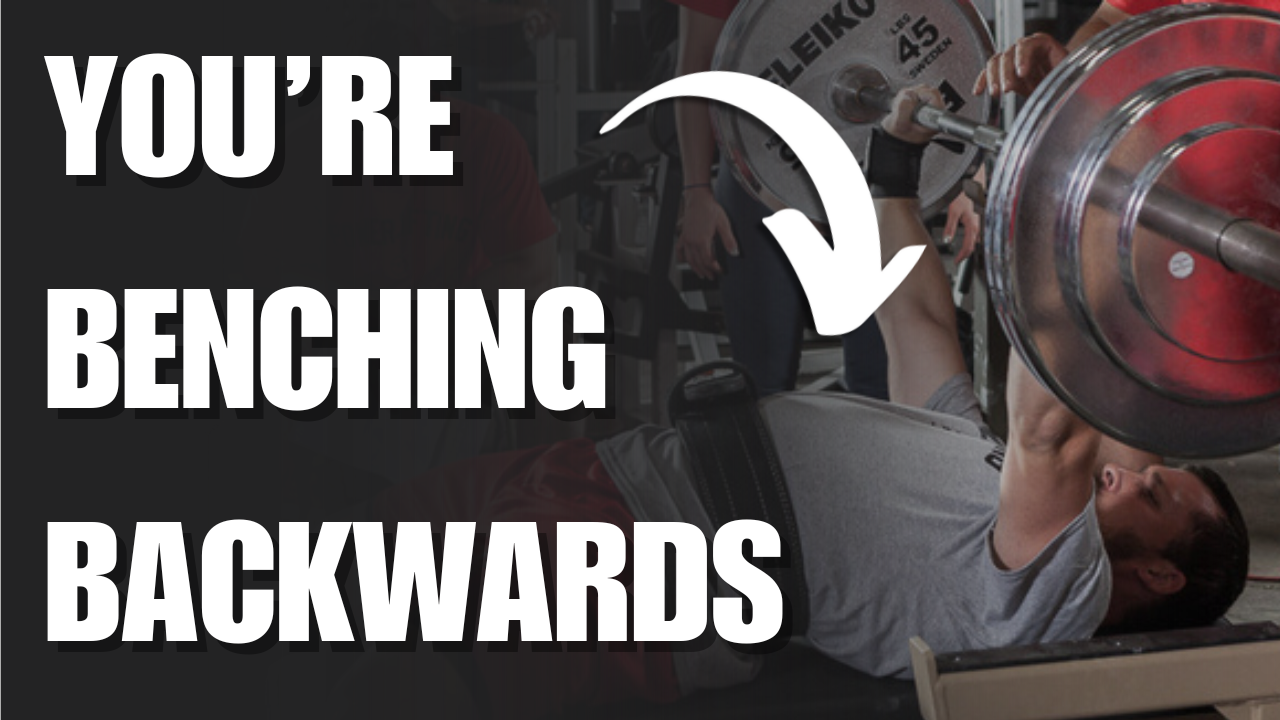
The mental shift that can transform your bench press performance is deceptively simple: instead of thinking about pushing the barbell away from your chest, focus on pushing yourself away from the barbell. This reframe fundamentally changes how your nervous system recruits muscles, maintains tension, and generates force throughout the entire range of motion.
When you concentrate on pushing your body away from a fixed point (the barbell), you automatically engage your entire kinetic chain more effectively. Your upper back maintains tighter contact with the bench, your leg drive integrates more seamlessly with your upper body pressing mechanics, and your core stabilization improves dramatically. The barbell becomes an anchor point that you’re driving yourself away from rather than an object you’re trying to move. This mental model creates superior mechanical advantage and allows you to express your strength more fully.
The Biomechanical Rationale Behind This Approach
Understanding why this mental shift works requires examining the biomechanics of force production during the bench press. When you think about pushing the bar up, your focus tends to migrate toward your hands and arms—the points of contact with the barbell. This creates a tendency to press primarily with your chest and triceps while your larger muscle groups and structural support systems become secondary contributors.
In contrast, when you think about pushing yourself away from the bar, you naturally emphasize driving force through your entire back into the bench. This engages your lats more effectively as stabilizers, maintains the natural arch in your thoracic spine, and allows you to transmit force from your lower body through leg drive more efficiently. Your scapulae remain retracted and depressed throughout the movement, creating a stable platform from which your prime movers can generate maximum force.
The physics also favor this approach. By maintaining rigid tension through your posterior chain and thinking about moving your body rather than the bar, you create what’s essentially a more efficient lever system. Your upper back becomes a fulcrum that doesn’t shift or lose position during the press, which means all the force you generate translates directly into moving the weight rather than being lost to postural adjustments or compensatory movements.
Implementing the Mental Shift: A Step-by-Step Process
Integrating this new mental framework into your bench press technique requires deliberate practice, starting with your lightest warm-up sets and progressing systematically through your working weights. The key is making this thought process automatic before you ever attempt a challenging load.
Begin with your standard setup routine, establishing the technical foundation that supports this mental approach. Set your upper back by retracting and depressing your scapulae, creating a shelf of muscle and connective tissue that will remain stable throughout the lift. Position your hands appropriately for your individual anatomy and goals—typically somewhere between 1.5 to 2 times shoulder width for most lifters. Ensure your grip places the bar in the meat of your palm rather than back in your fingers, which allows you to squeeze the bar with maximum intensity and creates irradiation that tightens your entire upper body.
Your lower body setup matters just as much for this mental framework to work optimally. Plant your feet flat on the floor in a position that allows you to generate leg drive without your hips lifting off the bench. Some lifters prefer a tucked foot position closer to their glutes, while others find more stability with feet further forward—experiment to find what allows you to create maximum tension while maintaining five points of contact with the bench and floor.
Once your setup is established, approach the unrack with intention. Rather than rushing to get the bar out of the rack and start your set, take deliberate control of the barbell while it’s still supported. Create tension in your hands, your back, and your legs before the weight ever moves. When you unrack, think about pulling the bar out horizontally over your chest rather than pressing it up and out. This maintains the tension you’ve created and positions the bar correctly for your descent.
As you lower the weight to your chest, maintain your focus on staying tight against the bench rather than thinking about the bar moving toward you. Touch the bar at the appropriate point on your chest—typically somewhere between your sternum and lower pecs, depending on your arm length and pressing style—and without bouncing, immediately think about driving yourself into the bench and away from the bar. Your mental cue should be “push myself down” rather than “push the bar up.”
Programming This Mental Framework Into Your Training
The most effective way to make this mental shift automatic is treating every single repetition, from your first warm-up with the empty bar through your final working set, as practice for perfect execution. This means approaching a 45-pound barbell with the same mental intensity and technical precision you’d use for a maximum attempt.
Many lifters make the mistake of only “turning on” their focus when the weight gets heavy. They’ll rush through warm-ups with sloppy form and inconsistent setup, then try to suddenly execute perfect technique when they load the bar to their working weight. This approach creates neurological inconsistency—your nervous system never learns the pattern well enough to execute it automatically under stress.
Instead, use this protocol for every set: establish your full setup routine with every technical detail in place, create maximum tension before unracking, control the descent, and then focus entirely on pushing yourself away from the bar during the concentric phase. On warm-up sets, this builds the motor pattern. On working sets, it allows you to execute without thinking because you’ve already practiced the pattern dozens of times that session.
Consider incorporating specific practice sessions focused exclusively on ingraining this mental framework. Drop your working weight by 20 to 30 pounds and perform sets of 1-3 repetitions where your only objective is executing the mental cue perfectly. These technique-focused sessions shouldn’t leave you fatigued—they’re neurological practice, not muscular training. You’re teaching your nervous system a new pattern, and that happens most effectively with fresh muscles and complete focus.
Integrating Supplemental Movements That Reinforce the Pattern
Certain assistance exercises can help you feel and understand the pushing-yourself-away concept more clearly. Floor presses offer particularly valuable feedback because you have significantly more surface area in contact with the ground compared to a bench. This increased contact makes it easier to feel what it means to generate force by driving into a surface rather than pushing an object away.
Set up for floor presses by lying flat on the ground with a barbell in a rack positioned appropriately for your arm length, or have a training partner hand you the weight. With your entire back, hips, and legs on the floor, you’ll immediately notice how much easier it becomes to feel yourself pushing into the ground as you press. Your leg drive is removed from the equation, which actually helps isolate the sensation of generating force through your upper back. Perform floor presses for sets of 3-5 repetitions with moderate weight, focusing entirely on the sensation of driving yourself into the floor rather than pressing the bar toward the ceiling.
Pin presses and board presses also reinforce this mental framework by giving you a fixed reference point. When you press from pins or boards, you’re starting from a dead stop against an immovable object, which makes it very clear that you need to generate force by driving away from that object rather than trying to accelerate the bar from zero. These movements teach you to create maximum tension instantaneously and to think about pushing your body rather than moving the weight.
Common Mistakes and How to Avoid Them
The most frequent error lifters make when implementing this mental shift is only applying it during the heaviest sets. They’ll use the cue successfully with lighter weights, then abandon it under maximum loads because it feels unfamiliar when they’re nervous or fatigued. This defeats the entire purpose—the mental framework needs to be automatic precisely when you’re under the most stress.
To prevent this, make the cue non-negotiable for every single repetition you perform. If you complete a warm-up set and realize you weren’t thinking about pushing yourself away from the bar, repeat that set with the proper mental focus. This might seem excessive, but developing automaticity requires consistent reinforcement, especially in the early stages of pattern learning.
Another common mistake is confusing this mental cue with actual changes in bar path or technique. The mental shift of pushing yourself away from the bar should not cause you to press the bar backward toward your head or to change your descent pattern. The bar path itself remains essentially identical to what you were doing before—the difference is entirely in how you’re thinking about generating force and where you’re directing your focus during the concentric portion of the lift.
Some lifters also misunderstand the cue and begin relaxing their upper body tension while overemphasizing leg drive. Remember that pushing yourself away from the bar doesn’t mean you stop pressing with your chest, shoulders, and triceps. Those muscles still do the primary work of moving the weight. The mental shift simply ensures you’re maintaining optimal positioning and utilizing your entire body as an integrated system rather than relying solely on your pressing muscles.
Why This Works for All Training Levels
Beginning lifters benefit from this mental framework because it teaches proper tension and positioning from the start. Rather than developing the common bad habit of thinking about pressing the bar up and losing tightness through the back, novices can build the correct motor pattern from their very first session. This creates a technical foundation that supports years of productive training.
Intermediate lifters often find this cue breaks through frustrating plateaus. If you’ve been stuck at the same bench press numbers for months despite consistent training, the issue frequently isn’t strength—it’s technical efficiency. The mental shift to pushing yourself away from the bar often reveals that you’ve been losing force through positional breakdown rather than lacking the muscular capacity to move the weight. Cleaning up this one aspect of your technique can immediately add 10-20 pounds to your bench press without any actual increase in muscle mass or maximum force production capacity.
Advanced lifters and competitors discover that this mental framework becomes increasingly important as weights approach true one-rep maximums. When you’re attempting to bench press three times your bodyweight or more, every small technical detail magnifies in importance. The difference between maintaining perfect upper back tightness and losing even a few degrees of scapular positioning can mean the difference between success and failure. Thinking about pushing yourself away from the bar provides the mental anchor that keeps everything locked in place even when your nervous system is firing at maximum capacity under extreme loads.
Integration with Other Technical Elements
This mental shift doesn’t replace other critical bench press technique points—it enhances them. Your grip still needs to be positioned correctly, with knuckles pointed toward the ceiling and the bar sitting in the meat of your palm. You still need to create and maintain upper back tightness through scapular retraction and depression. Leg drive still contributes significantly to your total force production. The mental framework of pushing yourself away from the bar simply ties all these elements together into a cohesive whole.
Think of it this way: all the individual technical points of the bench press setup—grip width, hand position, back arch, foot placement, breathing strategy—are ingredients in a recipe. The mental cue of pushing yourself away from the bar is the cooking method that transforms those ingredients into a finished dish. Without proper ingredients, even perfect cooking won’t save the meal. But even with quality ingredients, poor cooking ruins the result. You need both the technical fundamentals and the mental framework working together.
Your breathing strategy particularly benefits from this mental approach. When you focus on pushing yourself away from the bar, it becomes natural to maintain your breath and core tension throughout the press. You’re not thinking about the bar moving away from you, which would create an impulse to exhale as the weight rises. Instead, you’re braced and tight, driving into the bench, which reinforces holding your breath and maintaining intra-abdominal pressure until lockout.
The Long-Term Impact on Strength Development
Beyond immediate performance improvements, training with this mental framework creates better long-term adaptations. When you consistently execute the bench press with proper positioning maintained through the entire range of motion, you create more productive training stress. Your muscles receive optimal loading patterns, your connective tissues adapt along proper lines of force, and your nervous system learns efficient motor patterns that transfer to maximum strength expression.
Over months and years, this compounds significantly. A lifter who maintains perfect technique through superior mental cueing accumulates thousands of high-quality repetitions that build robust strength and resilient structures. Compare this to a lifter who performs thousands of repetitions with inconsistent positioning and technical breakdown—even if they’re working just as hard, the adaptations will be inferior because the training stimulus itself is less optimal.
This mental framework also reduces injury risk substantially. When you push yourself away from the bar while maintaining tightness through your entire posterior chain, you distribute forces more evenly across your shoulder girdle, spine, and ribcage. This prevents the concentration of stress on vulnerable structures that often occurs when lifters lose position during heavy pressing. Your shoulders stay healthier, your back stays safer, and you can train productively for decades rather than dealing with chronic pain and setbacks from accumulated microtrauma.
Practical Application: Your Next Bench Press Session
When you walk into the gym for your next bench press workout, approach it as a learning session rather than just another training day. Begin with the empty barbell and establish your complete setup routine: upper back set with scapulae retracted and depressed, hands positioned correctly on the bar, feet planted firmly on the floor, core braced and ready to create tension.
Unrack the empty bar with deliberate control, focusing on the sensation of creating tension throughout your entire body even though the weight is minimal. Lower the bar to your chest with control, touch lightly, and then think exclusively about pushing yourself away from the bar as you press back to lockout. Notice how this feels different from simply pushing the bar up. You should feel more connected to the bench, more stable through your entire body, and more in control of the movement.
Perform several sets with just the bar, ingraining this sensation. Then as you add weight for your warm-up sets, maintain exactly the same mental focus and technical execution. Don’t allow the pattern to degrade just because the weight is still light—this is where you’re building the automaticity that will serve you when the loads get heavy.
As you progress through your working sets, check in with yourself after each repetition: Were you thinking about pushing yourself away from the bar, or did you default back to thinking about pressing the bar up? If you caught yourself reverting to the old pattern, make that adjustment before your next set. It takes time and repetition to overwrite deeply ingrained motor patterns, so be patient with the process while remaining committed to consistent execution.
Conclusion: A Simple Change with Profound Results
The most powerful training interventions are often the simplest. Changing your mental focus from pushing the bar up to pushing yourself away from the bar requires no special equipment, no complex programming, and no significant time investment. Yet this one shift in how you think about the bench press can unlock strength you already possess but weren’t able to express fully due to technical inefficiency.
This mental framework works because it aligns your focus with optimal biomechanics. By thinking about pushing yourself away from the bar, you automatically engage your musculature more effectively, maintain superior positioning throughout the lift, and generate force more efficiently. The result is immediate performance improvements that compound over time into substantial long-term strength gains.
Remember that this mental shift complements rather than replaces other aspects of intelligent bench press training. You still need appropriate programming that addresses your individual weak points, progressive overload to drive adaptation, and proper recovery to allow those adaptations to occur. But within the context of well-designed training, this single mental cue can be the difference between frustrating plateaus and consistent progress toward your strength goals.
The next time you set up under the barbell, take a moment to reset your mental approach. Establish your position, create tension throughout your entire body, unrack with control, and then focus entirely on pushing yourself away from the bar. Notice the difference in how the weight moves, how your body feels, and how much more control you have over the entire lift. This simple shift might just be the breakthrough you’ve been searching for in your bench press training.
Need help improving your bench press? Contact us to see how we can help you!