
The Ultimate Deadlift Assistance Exercise Tier List: Ranking the Best Movements to Build Your Pull
When it comes to building a massive deadlift, the supplemental exercises you choose can make the difference between plateauing at mediocre numbers and consistently adding weight to the bar. The sheer number of assistance movements available can be overwhelming, which is exactly why organizing these exercises into a tier list helps clarify which movements deserve prime real estate in your training program and which ones are better left on the sidelines.
Understanding how to evaluate deadlift assistance exercises requires looking beyond surface-level similarities to the competition lift. The most effective supplemental movements address specific weaknesses in the deadlift chain, whether that’s developing explosive power off the floor, building lockout strength, or reinforcing proper positional mechanics throughout the pull. This comprehensive ranking breaks down the most common deadlift assistance exercises into clear categories based on their transfer to actual deadlift performance, helping you make informed decisions about your training priorities.
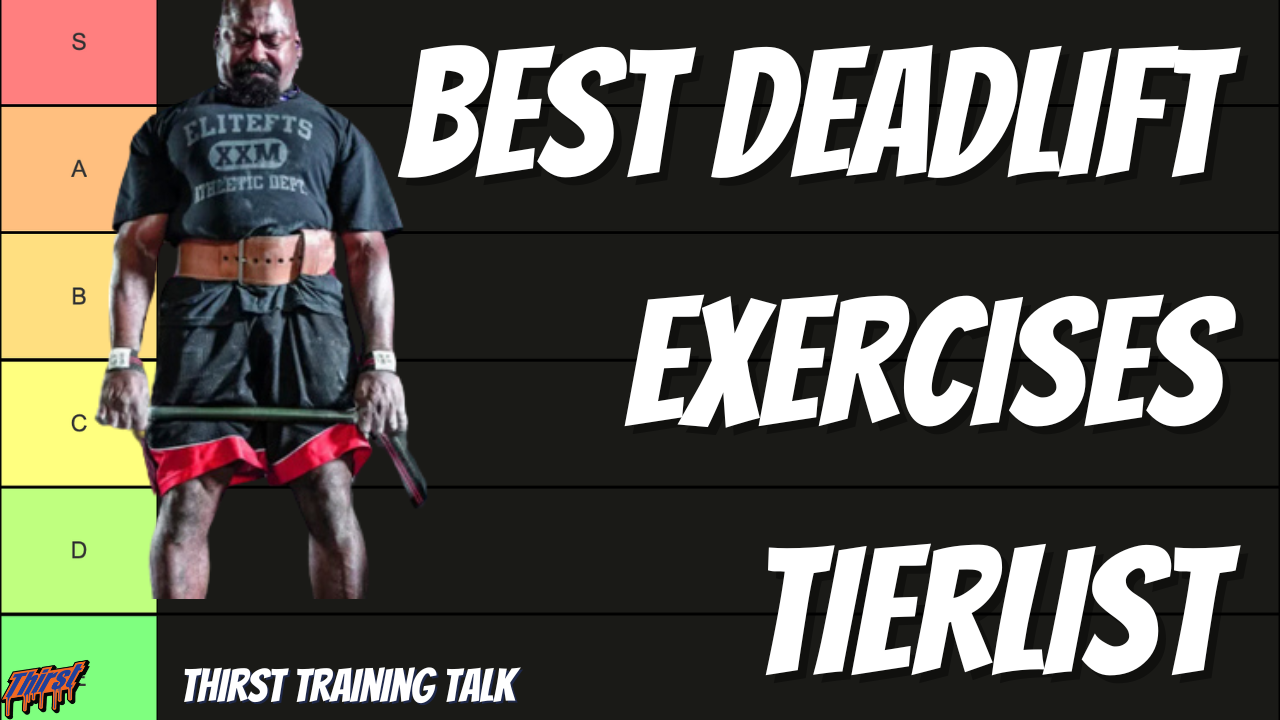
You can also watch the video below that goes along with this article.
Understanding the Tier System for Deadlift Training
Before diving into individual exercise rankings, it’s important to understand the tier system framework. The best tier represents exercises with the highest degree of specificity and transfer to the deadlift itself. These movements closely mirror the deadlift’s mechanics, train the same muscle groups through similar ranges of motion, and typically address common sticking points that lifters encounter in competition. Exercises in this category should form the foundation of your deadlift-focused programming.
The decent tier includes movements that provide significant benefits to deadlift development but may lack the direct specificity of top-tier exercises. These are still highly valuable additions to a well-rounded program and often address specific aspects of the pull, such as posterior chain development or positional strength. The not great tier consists of exercises that have some carryover to deadlift performance but are several steps removed from the actual movement pattern. These can still serve a purpose in your overall strength development but shouldn’t be prioritized if deadlift improvement is your primary goal.
Best Tier: The Elite Deadlift Builders
Sumo Deadlift
Perhaps the most obvious inclusion in the best tier is the sumo deadlift itself, which earns top placement due to pure movement specificity. Even for conventional pullers, incorporating sumo deadlifts into your training rotation provides tremendous benefits that many lifters overlook. The sumo stance forces you to develop hip strength that conventional pulling alone may never fully develop, particularly the external rotators and adductors that play crucial stabilizing roles.
For conventional deadlifters who struggle with utilizing leg drive effectively, sumo deadlifts serve as a powerful teaching tool. The wider stance and more upright torso position make it nearly impossible to muscle the weight up without proper leg engagement. This neuromuscular pattern can then transfer back to your conventional pull, helping you understand what it truly feels like to push through the floor rather than simply yanking the bar upward. The movement also builds tremendous positional strength in the hips, which becomes invaluable when fatigue sets in during heavy conventional pulls and your form starts to drift.
Sumo pullers obviously benefit even more directly, as this is their competition movement. However, the programming consideration here involves manipulating variables like deficit work, pause variations, and different loading parameters to continue driving adaptation. The key is recognizing that even the competition movement itself can be modified to address specific weaknesses within the lift.
Deadlifts Against Bands
Banded deadlifts secure a high ranking in the best tier because they address two critical aspects of deadlift performance simultaneously. First, they develop explosive speed off the floor by reducing the load at the bottom position while maintaining or increasing resistance as you approach lockout. This accommodating resistance teaches you to accelerate through the entire range of motion rather than decelerating as you approach the top, which is a common technical flaw that limits maximum strength expression.
Second, and perhaps more importantly, banded deadlifts force you to understand what it truly means to drive through the floor with maximum force production. Many lifters, even experienced ones, never fully grasp the concept of leg drive in the deadlift. They understand it intellectually but fail to execute it under heavy loads. The band tension increases throughout the movement, which means you cannot coast through any portion of the lift. You must generate force explosively from the start and maintain that aggression all the way through lockout.
The practical implementation of banded deadlifts involves attaching resistance bands to the barbell and anchoring them to a stable base, creating tension that increases as the bar rises. Programming these movements earlier in your training cycle can help develop rate of force development, while using them closer to competition can serve as a powerful lockout strengthener. The versatility of band resistance makes this exercise valuable for addressing multiple weaknesses depending on how you program it.
Deficit Deadlifts
Deficit deadlifts earn their place in the best tier by creating one of the most specific overload patterns for the conventional deadlift. By standing on a platform that elevates you one to four inches above the floor, you increase the range of motion at the start of the pull, which is precisely where most conventional pullers struggle. This extended range forces your legs to work harder and teaches proper positional mechanics that prevent the common fault of shooting the hips up too early.
The beauty of deficit work lies in its ability to expose technical flaws that might be masked during regular deadlifts. When you add those extra inches to the bottom of the movement, any tendency to round your back, shift your weight onto your toes, or fail to engage your lats properly becomes immediately apparent. The deficit essentially functions as a technique amplifier, making good positions feel better and bad positions feel impossible to execute.
For conventional pullers specifically, deficit deadlifts address the critical skill of pushing through the floor rather than pulling the weight up. The lower starting position naturally encourages more knee bend and a more favorable shin angle, which allows for greater quadriceps involvement. This leg drive component is what separates efficient conventional pullers from those who struggle despite having a strong back and posterior chain. Programming deficit work typically involves using weights in the seventy to eighty-five percent range for multiple sets of three to five repetitions, focusing on maintaining perfect positions throughout the extended range of motion.
Decent Tier: High-Value Supplemental Movements
45-Degree Back Extensions with Barbell (Pete Rubish Style)
The barbell-loaded back extension performed on a 45-degree bench deserves recognition as a brutally effective exercise for posterior chain development. While this movement presents setup challenges and requires some equipment creativity, its ability to simultaneously crush your glutes, hamstrings, lower back, and even grip strength makes it a valuable inclusion in deadlift-focused programming. The specific variation popularized by Pete Rubish involves holding a barbell across your shoulders while performing the back extension movement, creating a compound loading pattern that closely mimics the demands placed on your posterior chain during heavy deadlifts.
The exercise excels at building muscular endurance in the exact muscle groups that must work isometrically to maintain spinal position during the deadlift. Your erectors must fire continuously to control the eccentric lowering phase and then concentrically extend your torso back to the starting position, all while managing the additional load from the barbell. This time under tension creates significant hypertrophy stimulus in the lower back musculature, which translates to greater stability and force transmission during actual deadlifts.
Programming considerations for this movement involve managing fatigue carefully, as the lower back can become a limiting factor in subsequent deadlift training if you overdo the volume. Sets of eight to fifteen repetitions work well for building the muscular endurance that transfers to maintaining position during heavy pulls, while lower rep ranges with heavier loads can develop more pure strength. The grip challenge created by holding the barbell throughout the set provides an additional benefit, as grip endurance often becomes a limiting factor during high-volume deadlift training.
Nordic Hamstring Curls
Nordic curls earn their decent tier ranking through their exceptional ability to develop eccentric hamstring strength, which plays a crucial role in controlling the descent phase of the deadlift and maintaining proper hip hinge mechanics. However, the exercise receives a slight edge over glute ham raises primarily due to the stricter execution standards it enforces. When performed correctly, nordics eliminate the ability to cheat through the movement, forcing your hamstrings to control the entire eccentric lowering phase.
The key phrase here is “when performed correctly,” because sloppy nordic execution where you simply flop to the ground provides minimal training benefit. Proper nordics involve a controlled eccentric lowering that can take three to five seconds, followed by an explosive push back to the starting position using minimal upper body assistance. This movement pattern builds tremendous eccentric strength capacity in the hamstrings, which becomes valuable during the setup and initial pull phases of the deadlift when your hamstrings must eccentrically control your hip position while isometrically maintaining knee angle.
For deadlift application specifically, the hamstring strength developed through nordics helps maintain optimal back angle throughout the pull. Weak hamstrings often result in hips shooting up prematurely because the hamstrings cannot maintain tension while the quads extend the knees. By building robust hamstring strength through nordics, you create a more stable foundation for force production throughout the entire range of motion. Programming these movements two to three times per week with progressive overload, starting from assisted variations if needed, creates significant hamstring development over time.
Glute Ham Raises
Glute ham raises occupy a similar space to nordic curls but receive a slightly lower ranking primarily due to the execution variability that many lifters demonstrate. A properly performed glute ham raise absolutely destroys your hamstrings and posterior chain, creating significant training stimulus that carries over beautifully to deadlift performance. The challenge lies in the fact that an alarming number of lifters cannot execute the movement with proper form, often turning it into a glorified back extension rather than a true hamstring and glute dominant exercise.
When executed correctly, the glute ham raise involves both knee flexion and hip extension components, making it more comprehensive than the pure knee flexion emphasis of nordic curls. This combined movement pattern more closely mirrors the demands placed on your posterior chain during deadlifts, where your glutes and hamstrings must work synergistically to extend the hips while your hamstrings simultaneously maintain knee position. The movement builds the kind of functional strength that transfers directly to lockout power.
The practical consideration with glute ham raises involves ensuring you have access to proper equipment and understanding the technical nuances of the exercise. Many commercial gyms lack glute ham raise machines, and improvising with alternative setups often compromises form. Additionally, the learning curve for proper execution can be steep, with many lifters needing considerable practice before they can perform the movement in a way that maximally loads the target muscles. High-repetition work in the ten to twenty rep range builds the muscular endurance needed for maintaining position during heavy deadlift sets.
Not Great Tier: Limited but Potentially Useful Options
Squats
The squat lands in the not great tier for deadlift development, which might surprise some lifters who assume that any lower body strength work automatically translates to better pulling. While squats certainly build lower body strength and can contribute to overall athletic development, their specificity to the deadlift is limited enough that they shouldn’t be prioritized if deadlift improvement is your primary goal. The movement pattern, joint angles, and muscular demands differ significantly enough from deadlifting that the transfer remains moderate at best.
However, context matters tremendously when evaluating squat variations for deadlift carryover. A conventional deadlifter performing narrow stance box squats with an emphasis on explosive hip drive will see more transfer than someone doing wide stance high bar squats. Similarly, a sumo puller who incorporates wide stance box squats can develop the specific hip and adductor strength needed for their pulling style. The key is matching the squat variation to your deadlift style rather than simply including generic squat work and hoping for transfer.
The primary value of squats in a deadlift-focused program comes from their ability to build general lower body strength and add training volume without the specific fatigue that comes from deadlift variations. You can typically handle higher squat volume than deadlift volume, which allows for greater overall loading of the legs while managing systemic recovery. Free weight squats earn a nod over belt squats due to the additional stability demands and free weight loading patterns, though belt squats can serve a purpose for adding volume when recovery is limited.
Belt Squats
Belt squats occupy a lower position than free weight squats primarily due to the reduced specificity and stability demands. The exercise certainly develops lower body strength and can provide valuable training volume, but the supported torso position and fixed movement path limit its transfer to actual deadlift performance. The one exception worth noting involves belt squat marching, which would actually move up to the decent tier due to its ability to develop unilateral leg strength and stability in a way that more closely mimics the alternating force production demands of actual pulling.
The practical application of belt squats in deadlift training typically involves using them as a lower fatigue option for accumulating leg volume. Unlike free weight squats and especially deadlifts, belt squats create minimal spinal loading and systemic fatigue, which allows you to push higher volumes without compromising recovery for your primary deadlift work. This makes them valuable during accumulation phases when you need to build muscle and work capacity without accumulating excessive fatigue.
Programming belt squats might involve moderate to high rep work in the eight to fifteen rep range, using them as supplemental volume after your main deadlift work. The reduced technical demands also make them safer to push closer to failure compared to free weight variations, which can be valuable for driving hypertrophy adaptations in the quads and glutes. However, they remain several steps removed from actual deadlift specificity and shouldn’t displace more specific exercise options.
C Tier: Minimal Direct Transfer
Leg Press
The leg press receives a C tier ranking because its value for deadlift development depends almost entirely on how you implement it. Standard leg press work with full range of motion and continuous tension provides moderate lower body development but offers minimal specific carryover to pulling strength. The fixed movement path, supported back position, and lack of free weight stabilization requirements make it quite removed from the demands of actual deadlifting.
However, the leg press can move up toward the not great or even decent tier when programmed more specifically. Performing dead stop leg presses where you pause at the bottom position and explode upward can develop the kind of concentric power that transfers to driving through the floor during deadlifts. This variation eliminates the stretch reflex and forces pure concentric force production, which more closely mirrors the demands of breaking the bar off the floor. Similarly, manipulating foot positions to emphasize different muscle groups can make the exercise more valuable for addressing specific weaknesses.
For conventional pullers who need additional quad development without the spinal loading of squats, leg press work can serve a purpose in the broader training program. The exercise allows for high volume leg training with minimal systemic fatigue, which can be valuable during phases when you’re prioritizing deadlift-specific work and need supplemental volume that doesn’t interfere with recovery. Sets of ten to twenty repetitions can build significant muscular endurance in the quads and glutes, contributing to overall lower body development even if the specific transfer remains limited.
Bent Over Rows
Bent over rows land in C tier for deadlift development despite being a staple in many powerlifting programs. The exercise certainly builds upper back strength and can contribute to the general back development that supports heavy pulling, but the movement pattern and muscular demands differ enough from deadlifting that the specific transfer remains questionable. The horizontal pulling pattern emphasizes different portions of the lats and rear delts compared to the vertical pull of the deadlift, and the dynamic hip hinge position doesn’t closely mirror the static positions required during actual pulls.
The one modification that could move rows higher on the list involves using a cambered bar, which increases the range of motion and allows for a deeper stretch of the lats and rhomboids. This enhanced range of motion creates a more comprehensive training stimulus that might offer slightly better transfer to deadlift performance. However, even with improved execution, bent over rows remain primarily a back development exercise rather than a deadlift-specific movement.
If you’re going to include rowing variations for deadlift purposes, pin pulls or rack pulls would likely provide more specific transfer since they more closely mirror the actual deadlift movement pattern while allowing you to overload the top portion of the lift. The static starting position of pin pulls also better replicates the demands of initiating each deadlift rep from a dead stop, which is obviously a critical component of the competition movement. Programming rowing work makes sense for overall back development, but it shouldn’t be prioritized over more specific exercises if deadlift improvement is the goal.
D Tier: Not Recommended for Deadlift Focus
Lat Pulldowns
Lat pulldowns receive the lowest ranking on this tier list because their contribution to deadlift performance is minimal at best. While the exercise can develop lat width and general back musculature, the vertical pulling pattern and seated position bear little resemblance to the demands placed on your lats during actual deadlifts. During deadlifts, your lats work primarily isometrically to maintain spinal position and keep the bar close to your body, which is completely different from the concentric pulling motion of a lat pulldown.
From a pure back development standpoint, lat pulldowns might have value, though even here the research suggests that neutral grip variations provide better range of motion and muscle contraction compared to traditional wide grip pulldowns. However, developing lat width isn’t necessarily the same as developing the kind of lat strength and tension required for heavy deadlifts. The isometric strength and ability to maintain tension under load matters more than pure size when it comes to deadlift performance.
If you absolutely must include vertical pulling for lat development, chin-ups and pull-ups represent superior options compared to lat pulldowns. The free weight stability demands and full body tension requirements of bodyweight pulling variations create more transfer to the kind of total body tension needed during maximal deadlifts. However, even chin-ups remain far down the priority list when program design focuses specifically on deadlift improvement. Direct deadlift variations and posterior chain exercises should consume the majority of your supplemental work before dedicating significant time to vertical pulling movements.
Practical Application: Building Your Deadlift Program
Understanding how to rank deadlift assistance exercises provides the foundation for intelligent program design, but the real value comes from knowing how to apply these rankings to your actual training. The exercises in the best and decent tiers should form the core of your deadlift-focused programming, with the specific selection depending on your individual weaknesses and training phase. A conventional puller who struggles off the floor might prioritize deficit deadlifts and banded work, while someone with lockout issues might emphasize the band work and top-end variations.
The not great tier exercises can still find a place in well-rounded programming, but they should be viewed as supporting actors rather than stars. Squat variations build general lower body strength and provide training variety, but they shouldn’t displace deficit deadlifts or other high-specificity movements from your program. Similarly, the C and D tier exercises might serve specific purposes in certain contexts but should never be prioritized over more valuable options when deadlift improvement is the goal.
The key to effective program design involves matching exercise selection to your current needs while maintaining enough specificity to drive continued adaptation in the deadlift itself. This means regularly performing actual deadlifts or close variations, supplemented with the highest value assistance work that addresses your specific weaknesses. Over time, as your needs change and different weaknesses emerge, you can adjust your exercise selection while maintaining this principle of prioritizing specificity and direct transfer.
Need help improving your deadlift? Contact us to see how we can help you!