
Lateral Lunge with Pushoff: Explosive Power for Change of Direction
The lateral lunge with pushoff represents a critical progression in lower body power development and multi-directional athletic training. While standard lateral lunges build fundamental lateral movement patterns and strengthen the hips, adductors, and glutes through controlled motion, adding an explosive pushoff component transforms this exercise into a dynamic power movement that directly translates to sports performance and change of direction ability.
Watch the video below on how to maximize this exercise.
Understanding the Lateral Lunge with Pushoff
This exercise builds upon the foundational lateral lunge by emphasizing aggressive, explosive movement in both the descent and the return phase. Unlike traditional lateral lunges where you step out and controllably step back, the lateral lunge with pushoff requires you to forcefully drive out of the bottom position, creating a reactive, springy quality that develops the neuromuscular patterns essential for cutting, decelerating, and reaccelerating in lateral directions.
The exercise primarily requires just your bodyweight and sufficient space to step laterally without restriction. As you progress and the movement becomes more controlled and powerful, you can add external load using a dumbbell, kettlebell, or sandbag held in a goblet position (at chest height) or zercher position (in the crooks of your elbows). However, maintaining the explosive, reactive quality of the movement should always take priority over adding resistance. If the pushoff begins to feel slow or labored, you’ve added too much weight and need to reduce the load.
Proper Execution and Technique
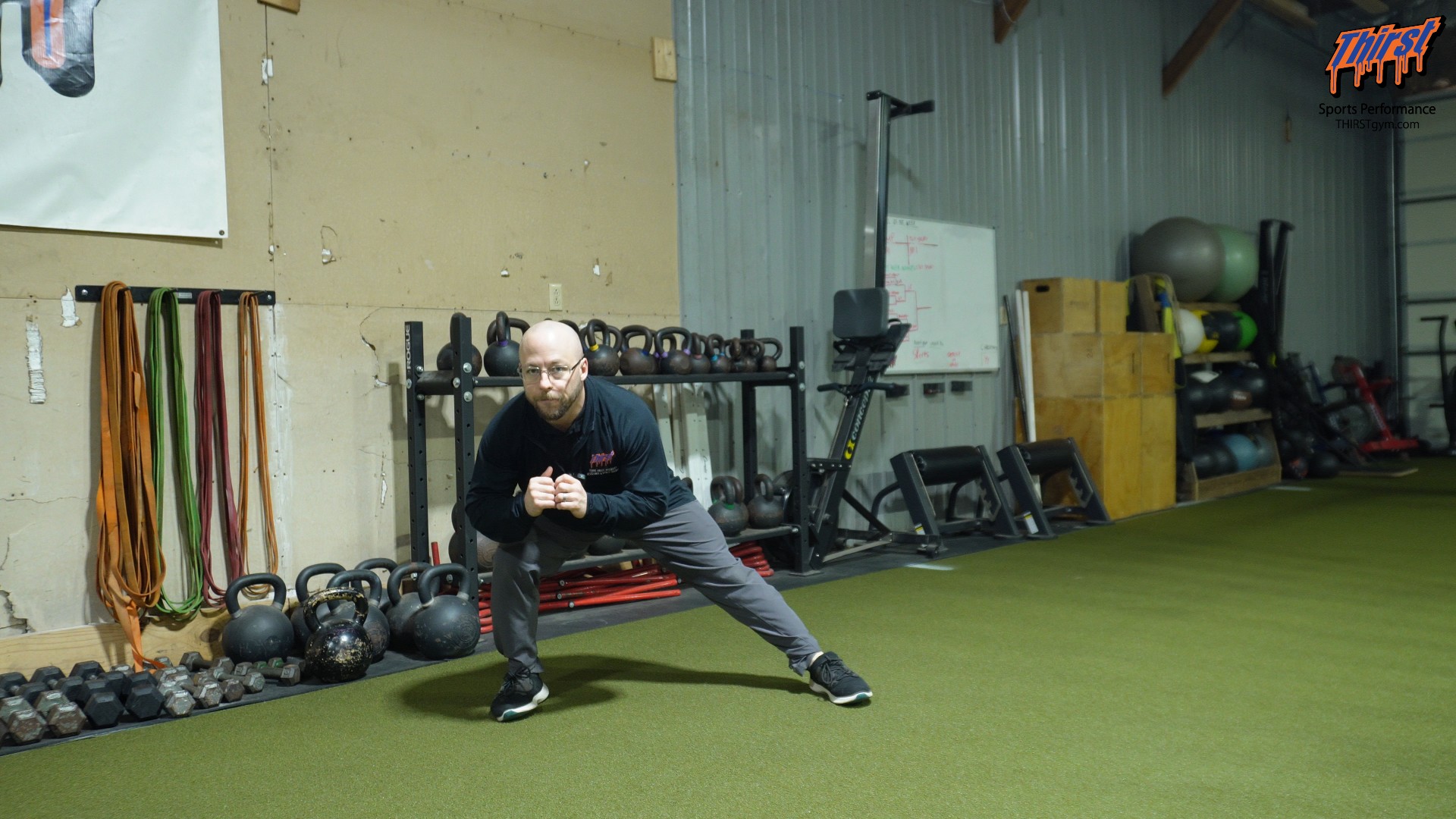
Begin by taking an aggressive lateral step to one side, dropping into a deep lateral lunge position where your stance leg bends significantly while your opposite leg remains relatively straight. The key distinction from a standard lateral lunge comes in what happens next. Rather than simply stepping back to your starting position, you’ll explosively push off the ground with your stance leg, driving yourself laterally back toward center with power and speed.
A critical coaching point involves keeping your non-stance leg elevated rather than placing it back on the ground between repetitions. This creates a continuous cycle where you fall into the lateral lunge position and immediately push out, fall and push, fall and push. This technique keeps you constantly loading and unloading the working leg, minimizing ground contact time and maximizing the stretch-shortening cycle effect that develops reactive strength and change of direction power.
When you add external load, the weight naturally makes your descent more aggressive and controlled, forcing your muscles and connective tissues to absorb force more dramatically before the explosive pushoff. This additional eccentric loading enhances the power development stimulus and better simulates the forces athletes experience when cutting or changing direction during competition.
Biomechanical Benefits and Training Applications
The lateral lunge with pushoff specifically targets lateral power output and change of direction mechanics that are fundamental to virtually all field and court sports. When athletes cut, they must decelerate their bodyweight traveling in one direction, stabilize through their hip and knee, and then explosively reaccelerate in a new direction. This exercise trains that exact sequence in a controlled, repeatable format.
By emphasizing the aggressive pushoff and minimizing ground contact, you’re developing rate of force development in the lateral plane—the ability to generate significant force very quickly. This quality directly determines how fast an athlete can change direction, how sharply they can cut, and how effectively they can defend or evade opponents in game situations.
The exercise also reinforces proper mechanics for getting into and out of the back hip during lateral movements. When you load into that lateral lunge position, you’re training hip hinge mechanics in the frontal plane, strengthening the posterior chain muscles that control deceleration and stabilization. The explosive pushoff then develops the coordinated muscle firing patterns needed to transition from eccentric to concentric action rapidly.
Programming Recommendations and Progression
The lateral lunge with pushoff functions as a power-based exercise rather than a strength or hypertrophy movement. As such, you’ll want to program it using lower repetitions with emphasis on maximal intent and explosive execution. Generally, three to five sets of five to six repetitions per side provides sufficient volume to develop power without inducing excessive fatigue that would compromise movement quality.
This exercise works best as a progression after athletes have mastered standard lateral lunge mechanics. You need to establish proper frontal plane control, hip stability, and basic lateral strength before adding the explosive, reactive component. Once those foundations exist, the lateral lunge with pushoff becomes an excellent tool for bridging the gap between basic strength exercises and true sport-specific change of direction movements.
Consider placing this exercise early in your training session when you’re fresh and can execute each repetition with maximum power and precision. It pairs well with other lateral power movements, agility drills, or multi-directional speed work in an athletic development program. The explosive nature and relatively low fatigue cost make it suitable for in-season training when you need to maintain power qualities without excessive training stress.
Key Coaching Cues and Common Mistakes
The most important technical element is ensuring the movement remains springy, fast, and reactive throughout all repetitions. If you find yourself slowly grinding out of the bottom position, you’ve either added too much external load or accumulated too much fatigue to maintain the power output necessary for this exercise to achieve its intended training effect.
Focus on making both the descent and the pushoff aggressive and controlled. The eccentric phase should be quick but controlled enough to maintain proper positions, while the concentric pushoff should be maximally explosive. This creates the reactive, elastic quality that distinguishes power development from simple strength work.
Maintaining an elevated non-stance leg between reps requires balance and coordination but serves an important purpose. It forces continuous engagement of your stabilizing muscles and prevents you from resetting completely between repetitions, which better simulates the continuous nature of athletic movement and maintains the stretch-shortening cycle benefit.
The lateral lunge with pushoff represents an essential progression for athletes and fitness enthusiasts looking to develop explosive lateral power and improve change of direction ability. By emphasizing aggressive execution in both phases of the movement and maintaining that critical explosive quality, you’ll build the reactive strength and neuromuscular coordination that translates directly to improved athletic performance and movement competency in the frontal plane.