
Barbell Floor Press Off Plyo Box: A Smarter Pressing Variation for Strength and Shoulder Health
The barbell floor press off a plyo box is one of those exercises that looks simple on the surface but delivers a surprising number of training benefits depending on who is using it and why. It bridges the gap between a traditional floor press and a standard bench press, giving athletes and lifters a unique tool that preserves the mechanics of the bench press while intentionally limiting range of motion. Whether you are a competitive powerlifter, a strength athlete managing shoulder discomfort, or simply someone looking for a productive pressing variation, this movement deserves a place in your training rotation.
Watch the video below on how to maximize this exercise.
What You Need to Set Up
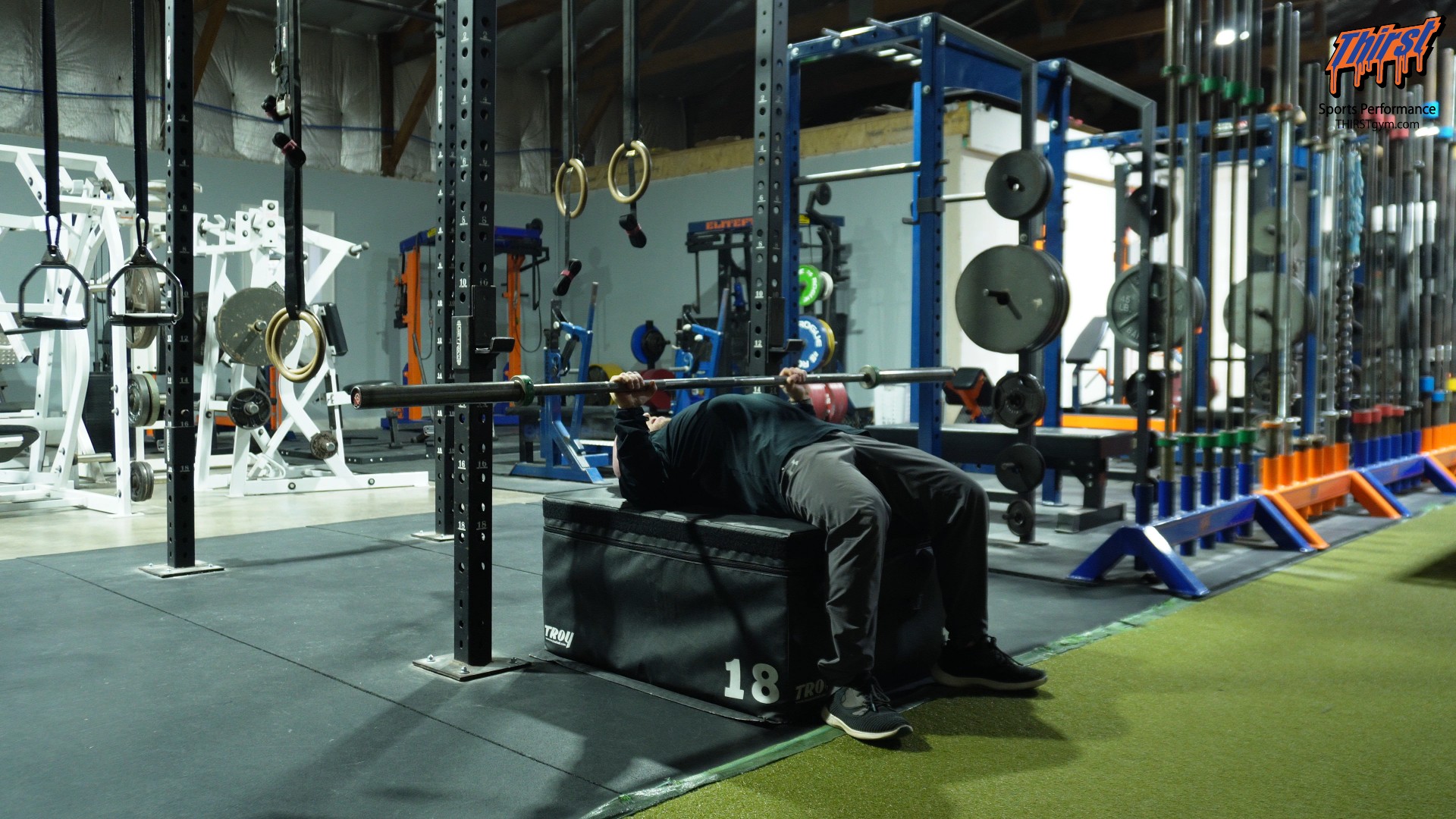
The setup for this exercise is straightforward but requires a few specific pieces of equipment. You will need a barbell, a power rack or rig of some kind to hold the bar at the appropriate height, and a plyo box. The key detail on the box is height — you want one that sits at approximately 18 inches off the ground, which matches the height of a standard flat bench. A softer, wider plyo box is ideal, and positioning it lengthwise inside the rack will give you the most stability and the most accurate simulation of a bench press setup. The width of the box is what makes this variation work. Rather than lying directly on the floor as you would in a traditional floor press, the box creates an elevated surface that allows you to maintain your normal bench press body position while still producing the floor press range of motion restriction at the top of the movement.
How to Perform the Barbell Floor Press Off a Plyo Box
Position yourself on the box just as you would on a regular bench, bringing your hips to the near end and lying back with your feet flat on the floor. From here, your setup should mirror your standard bench press entirely — hands at your normal grip width, upper back tight, lats engaged, and leg drive established before you ever touch the bar. Unrack the barbell and lower it under control until your upper arms, specifically the back of your triceps, make contact with the surface of the plyo box. That contact point is the defining feature of this movement. It halts the descent at the same position a floor press would, preventing the bar from traveling through the full range of motion that a traditional bench press would require. From there, drive the bar back to lockout using the same pressing mechanics you would apply in competition or in your regular bench press training.
Why Use This Variation Instead of a Standard Floor Press or Bench Press
The most obvious question is why bother with this setup when you could simply do a floor press on the ground or a bench press on a normal bench. The answer lies in what this variation uniquely preserves and what it uniquely limits. Unlike a traditional floor press performed on the ground, the plyo box version allows you to keep your feet planted and maintain leg drive throughout the movement. This is a significant detail for powerlifters and strength athletes because leg drive is a fundamental component of a technically sound bench press. When you perform a floor press flat on the ground, that element is lost entirely. The plyo box variation keeps it intact.
At the same time, the reduced range of motion this exercise provides makes it an excellent option for athletes dealing with shoulder discomfort or injury. Many lifters can tolerate pressing in a shorter arc even when full-range horizontal pressing causes irritation. By limiting how far the bar descends, this variation allows you to continue training the horizontal press pattern and accumulating upper body pressing volume without aggravating sensitive shoulder tissue.
For powerlifters specifically, this exercise also serves as an effective variation for addressing weak points in the bench press. The floor press range of motion forces you to remain tight off the chest and teaches you to control the bar through the lower portion of the lift. Practiced consistently, it can improve positional awareness and strength in the bottom range of the bench press without the logistical hassle of getting down to and up from the floor repeatedly during a training session.
How to Program the Barbell Floor Press Off a Plyo Box
This exercise is versatile enough to fill several roles in a training program. As a max effort main movement, it works well for working up to a heavy single, double, or triple. This approach suits powerlifters who rotate variations regularly and want to test near-maximal strength in a bench press pattern that differs slightly from competition. As a primary volume movement, three to four sets of three to five repetitions at a challenging but repeatable weight is an effective structure. For those using it as a supplemental movement after completing their main pressing work, two to four sets in the three to ten repetition range will target the triceps, reinforce pressing mechanics, and contribute to hypertrophy that carries over to lockout strength on the bench press.
Who Should Use This Exercise
This variation is particularly well-suited for competitive powerlifters who want a bench press training tool that preserves sport-specific mechanics while introducing a useful constraint, athletes managing shoulder issues who need to reduce range of motion without abandoning the horizontal press entirely, and intermediate to advanced lifters looking to address tricep weakness or sticking points in the upper portion of their bench press. It is also a practical and efficient option for any strength athlete who wants the benefits of a floor press without repeatedly lowering themselves to and rising from the ground between sets.
If you enjoy the floor press as a training tool and have not experimented with the plyo box variation, it is worth adding to your program. The combination of preserved leg drive, reduced range of motion, and true bench press mechanics makes it a uniquely productive pressing option.