

Hatfield Front Foot Elevated Reverse Lunge: A Single-Leg Exercise for Maximum Strength and Hypertrophy
The Hatfield front foot elevated reverse lunge is one of my favorite single-leg exercises for loading the lower body heavy while still hammering the glutes, quads, and hamstrings through a full range of motion. It combines two powerful concepts—the Hatfield style of using your hands for added stability, and front foot elevation for increased range of motion—into a single movement that lets you push more weight, build more muscle, and develop better single-leg strength than almost any other lunge variation I program at THIRST Gym.
Watch the video below on how to maximize this exercise.
Equipment and Setup
To perform this exercise, you’ll need a safety squat bar, an elevation platform, and something to hold onto for stability. For the elevation, I personally like DC blocks, but 45-pound plates or small wooden blocks work just as well. You only need about two to three inches of elevation under the front foot—you do not need a massive block here. Less is more. For the stability component, I run band pegs through my rack to grip, but if you don’t have that option, simply set a barbell across a second pair of J-hooks on the opposite side of the rack. Holding onto the barbell gives you the same Hatfield-style assistance and works perfectly.
Get under the safety squat bar, unrack it like you would a normal squat, and step onto your elevation platform with both feet. Stand tall, brace your core, and reach out to grip your band pegs or barbell. You’re not death-gripping anything here—the hands are there for balance and added stability, not to muscle you through the rep.
Execution and Technique
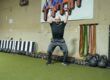
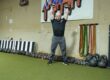
From the standing position, take a big, controlled step back into a reverse lunge. The front foot remains on the elevated surface the entire set, and you want full foot contact on the floor with the back foot. As you descend, let the front knee track naturally over the foot. You don’t need to force it forward over the toes, but you also shouldn’t be intentionally pulling it backwards. Stay relatively heel-heavy on the front foot, keep your chest tall, and avoid the common mistake of letting the torso collapse forward. Drive back to the starting position by pushing through the front foot, then repeat on the other side.
Why I Program the Hatfield Front Foot Elevated Reverse Lunge
There are a few specific reasons this exercise earns a regular spot in my programming. First, the Hatfield setup—using your hands for stability—removes balance as a limiting factor. On a traditional reverse lunge, the amount of weight you can use is often capped not by leg strength, but by your ability to stay upright and stable. By holding on, you can drive significantly more load through the working leg, which is a massive win for both strength and hypertrophy.
Second, elevating the front foot increases the range of motion at the hip and knee. That deeper bottom position creates a bigger stretch on the glutes, hamstrings, and quads, which translates directly into more tension and more hypertrophy stimulus. We know from research and practical experience that loaded stretch under tension is one of the most powerful drivers of muscle growth, and this variation delivers exactly that.
Third, the front foot elevation naturally forces you to shift your center of mass backwards. This keeps the torso more upright throughout the rep, which can be a huge benefit for athletes and lifters working on hip mobility, ankle mobility, or just learning how to load a single leg without dumping into excessive forward lean.
Programming Recommendations
How you program this exercise depends on the role you want it to play in your training. If you’re using it as your main lower body movement of the day, I like to load it heavy in the two to four sets of three to five reps per side range. This builds raw single-leg strength while still allowing enough volume to drive size.
If you’re slotting it in as a supplemental exercise—something performed after a barbell squat, deadlift, or another main lift—then I like to push the volume up for more hypertrophy. Two to four sets of six to eight reps per side works extremely well in that context, and it’s a great way to add quality mass to the legs without beating up the low back further.
Who Should and Shouldn’t Use This Exercise
The one pitfall worth mentioning is that the bar itself weighs 65 pounds, and you have to be able to handle that load through a reverse lunge before this exercise makes sense for you. If you’re newer to strength training or still building up your single-leg work capacity, pump the brakes and stick to goblet split squats, goblet reverse lunges, and other lighter variations until you’ve built the baseline strength.
On the other hand, this is one of the best options I’ve found for lifters who want to load their single-leg work heavy but are dealing with low back issues. The Hatfield setup distributes some of the stability demand into the arms, which dramatically reduces axial loading stress compared to a traditional safety squat bar reverse lunge. For powerlifters in offseason blocks, athletes who need to accumulate single-leg volume without smashing the spine, or anyone returning from a lower back tweak, this variation is a game-changer.
Give it a try in your next lower body session and let me know how it feels. If you have any questions about setup, technique, or programming, drop them in the comments and I’ll be happy to help you out.