
The Split Stance Cable Lift: A Complete Guide to Rotational Core Strength and Change of Direction Performance
The split stance cable lift is one of those underrated core exercises that delivers serious carryover for athletes, powerlifters, and general fitness enthusiasts alike. While most lifters are familiar with traditional anti-rotation work like the Pallof press or standard cable lift and chop variations, the split stance version takes things a step further by integrating lower body positioning that mirrors actual sport demands. At THIRST Gym in Terre Haute, this is one of my go-to exercises for clients and athletes who need to bridge the gap between raw strength and on-field, on-mat, or on-platform performance.
Watch the video below on how to maximize this exercise.
Before getting into execution, it helps to understand why this exercise earns a spot in a well-designed program. The split stance position itself loads one hip more than the other while challenging the lower body to stabilize through the ankle, knee, and hip simultaneously. Add in the diagonal pulling pattern of a cable lift, and you are now training the obliques, transverse abdominis, adductors, and rotary stabilizers of the trunk in a coordinated, athletic pattern. This kind of integrated training is exactly what we need to develop in athletes who change direction, throw, strike, or rotate, and it is also wildly underutilized for powerlifters who could benefit from better trunk control under heavy bilateral lifts.
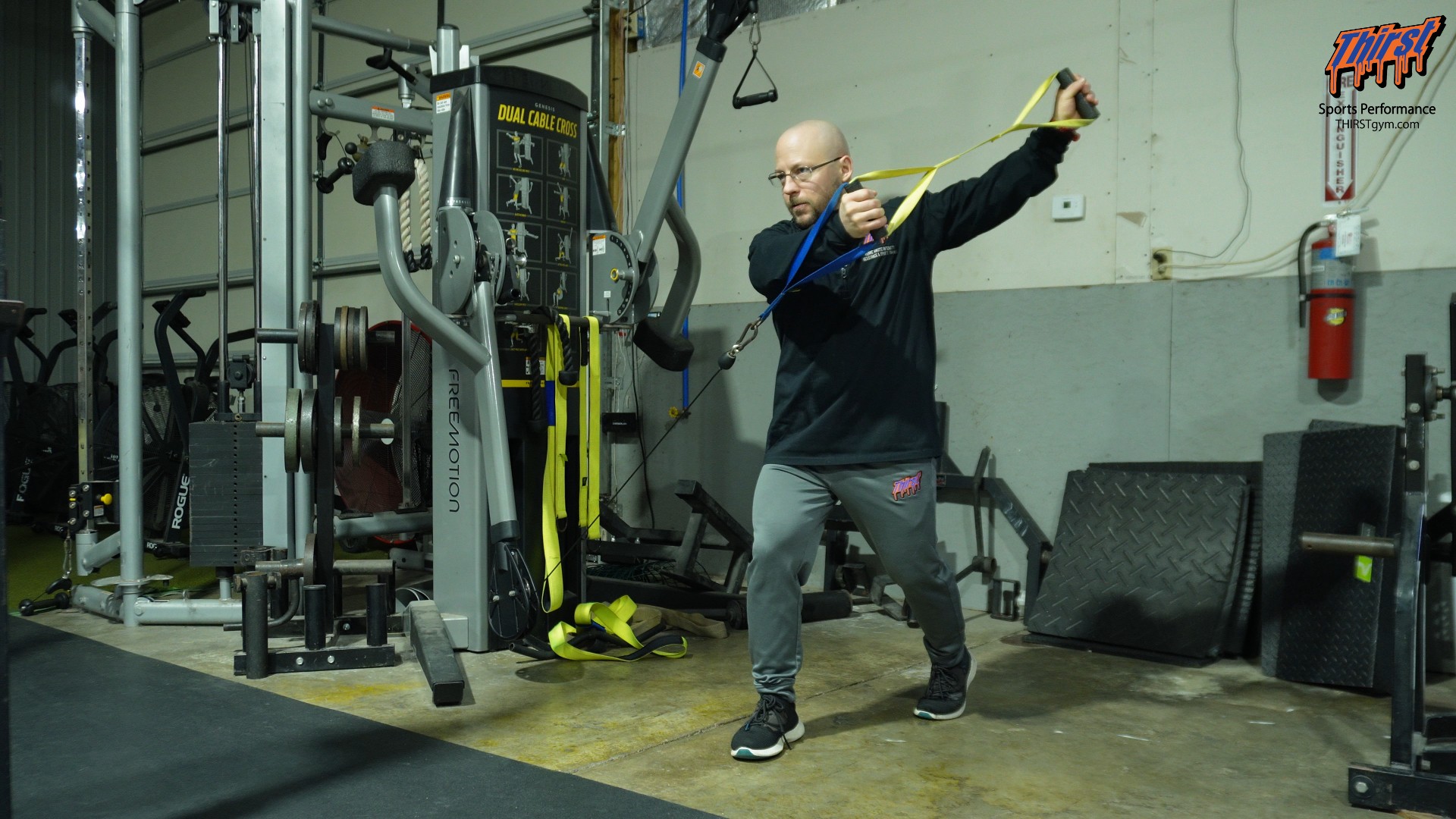
To set up, position a cable stack at the lowest setting and attach a lift and chop strap. I prefer the lift and chop strap over a standard handle because it allows you to grip with both hands in a more athletic position and forces the work to happen through the trunk rather than the arms. Stand perpendicular to the cable column in a split stance, with one leg forward and flat on the ground and the back leg extended behind you with the heel up and weight on the toe. You should be in roughly a quarter-depth lunge or split squat position, not standing tall and not buried deep into a lunge. From here, grab the strap with both hands, fully extend your arms in front of you, and pull the cable diagonally across your body from low to high, then control it back to the starting position.
Where this exercise gets really interesting is the variation in foot position and what it trains. If your inside leg, meaning the leg closest to the cable, is forward, this becomes what I call an out of the cut lift. The work is propulsive in nature and trains the body to push away from a planted leg, which is exactly what happens when an athlete cuts and accelerates in a new direction. This is the variation I prioritize for wrestlers, MMA athletes, football players, and anyone whose sport demands fast change of direction off a planted leg. Conversely, if your outside leg, meaning the leg furthest from the cable, is forward, you are now lifting into the cut. The cable is trying to pull your body away from that planted leg, and your adductor and medial hip musculature have to fire hard to keep you stacked over that leg. This variation is excellent for developing the ability to plant, decelerate, and load the hip, and it tends to be the more demanding option for hip mobility and frontal plane control.
The variation you choose should match your goal. Athletes working on explosive change of direction and acceleration out of a cut benefit most from the inside leg forward variation. Athletes or lifters who struggle to access their hip, feel restricted in the frontal plane, or need to develop adductor strength and hip stability will get more out of the outside leg forward version. For general fitness clients or lifters using this purely as a core accessory, I usually let personal preference dictate. Most people find that the outside leg forward variation feels better through the hip and produces a more controlled, satisfying contraction.
Programming this exercise is straightforward. I typically prescribe two to four sets of eight to twelve reps per side, performed with a load that is challenging but allows for complete control of every rep. The biggest mistake I see is using too much weight and rotating the entire body to move the cable, which turns a precision exercise into a wasted set. The whole point is to keep the pelvis, ribcage, and lower body locked in position while the arms move the cable across the body. If you find yourself heaving the weight with a lot of body English, drop the load and reset.
For powerlifters, this fits beautifully into a warm-up or accessory block on lower body or upper body days, particularly when trunk stability has been a limiter on the squat or deadlift. For athletes, it can be used as part of a movement preparation series, a supplemental core block, or a primer before high-velocity sprint and change of direction work. Combat sports athletes, in particular, will recognize the carryover to shooting takedowns, sprawling, and hip-to-hip transitions in grappling. Plug it in, train it with intent, and you will start to feel the difference in how your body moves under load and at speed.