
Imposter Syndrome in the Fitness Industry: Why Personal Trainers and Strength Coaches Feel Like Frauds (and How to Fix It)
Picture this: you just wrapped a training session with a client. They hit a new personal record, they’re fired up, and they’re telling you that you’re the best coach they’ve ever worked with. On the outside you smile, nod, and accept the compliment. On the inside? A quiet voice is whispering that you have no idea what you’re actually doing. They have no idea, you think to yourself. I’m one Google search or ChatGPT prompt away from being completely exposed.
If that scene sounds familiar, you’re not broken, lazy, or unqualified. What you’re experiencing has a clinical name, decades of peer-reviewed research behind it, and an unusually high prevalence in the fitness industry specifically. It’s called imposter syndrome, and as personal trainers, strength coaches, gym owners, and online coaches, we are statistically among the most vulnerable populations to it. This article is going to break down exactly what imposter syndrome is, why fitness professionals get hit with it harder than almost anyone else, what it’s quietly costing your career and your income, and most importantly, an evidence-based framework you can start using today to manage it.
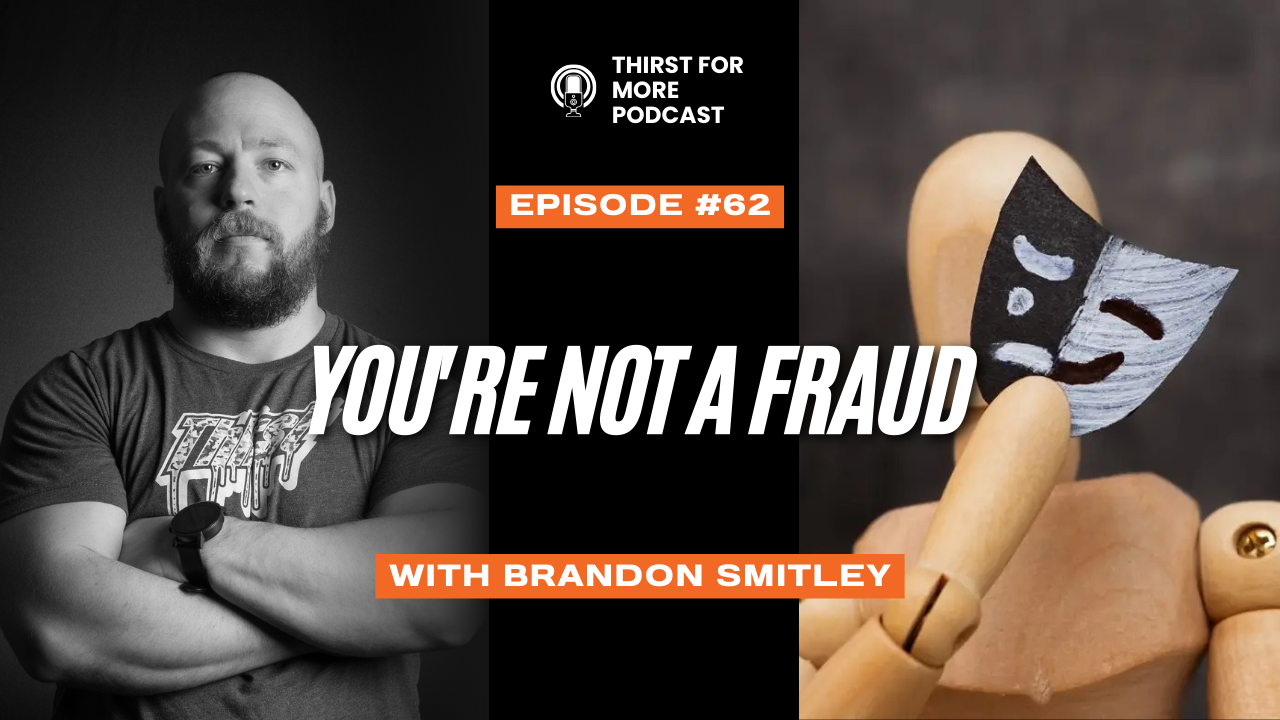
You can also watch the video below that goes along with this article.
What Imposter Syndrome Actually Is (And What It Isn’t)
Before we can fix anything, we need to define the problem properly, because most fitness industry content on this topic gets it wrong from the very first sentence. People in our space throw around the phrase “imposter syndrome” as though it’s a synonym for low self-confidence or a lack of conviction. It isn’t. In fact, a healthy dose of self-doubt early in your career is often a sign of humility, which is something the fitness industry chronically lacks. Most newer trainers walk in believing they’re far better than they actually are. That isn’t imposter syndrome. That’s the opposite problem.
Imposter syndrome was first identified in 1978 by clinical psychologists Dr. Pauline Rose Clance and Dr. Suzanne Imes. Their original paper, published in Psychotherapy: Theory, Research and Practice, described what they called the “impostor phenomenon,” a persistent internal experience of intellectual phoniness in individuals who, by every objective external measure, are highly successful. That last part is critical. Imposter syndrome does not target unqualified people pretending to be qualified. That’s just fraud, and yes, fraud is unfortunately rampant in our industry too. Imposter syndrome specifically targets people who are competent, but who cannot internalize their own competence. There’s a disconnect between what you’ve objectively achieved and what your internal self-assessment will allow you to feel.
The research on prevalence is staggering. A 2020 systematic review by Bravata and colleagues published in the Journal of General Internal Medicine analyzed 62 studies and found imposter syndrome prevalence rates ranging from 9% to 82% depending on the screening tools used and the population studied. Their best estimate was that roughly 70% of all people will experience at least one significant episode of imposter syndrome in their career. So if you’ve been quietly feeling like the only one in the gym who hasn’t figured it out yet, the math says the colleague next to you is probably feeling the same thing.
The Five Types of Imposter Syndrome
Dr. Valerie Young built on the original Clance and Imes research and identified five distinct subtypes of imposter syndrome. As you read through these, you’ll almost certainly recognize yourself in at least one of them, and probably in two or three depending on the situation.
The Perfectionist sets impossibly high standards and then fixates on the small percentage they didn’t hit. A program produces incredible results for a client, but the perfectionist obsesses over the one variable they could’ve tweaked. They deliver a continuing education presentation that earns standing applause, but all they remember is the one question they stumbled on. They major in the minor, focusing on tiny details that nobody else even noticed.
The Expert feels like they need to know absolutely everything about a topic before they’re qualified to speak on it or train a particular population. This is the trainer who has earned a CSCS, a CPT, a corrective exercise certification, a nutrition certification, and is currently signed up for two more courses, but still doesn’t feel ready. They hoard certifications like collecting them will eventually unlock a feeling of legitimacy. There’s nothing wrong with continuing education, and at a bare minimum every fitness professional should hold a credible certification for both liability and baseline competency reasons. But strength and conditioning is a blend of art and science. The best coaches in our field have a strong generalist foundation with a couple of areas of deep expertise. You don’t have to know everything. In fact, if you ever feel like you do know everything, that’s a much bigger problem than not knowing enough.
The Natural Genius judges their competence based on how easily and quickly they pick something up. If you have to work hard to understand a concept like periodization, the compression-expansion model in biomechanics, or PRI principles, the natural genius interprets that effort as evidence of being unqualified. Bill Hartman can rattle off compression and expansion concepts effortlessly because he’s spent years inside that material. The rest of us, even those of us who follow him closely, still have to slow down and double check our thinking, and that’s completely normal. Effort is not evidence of inadequacy. It’s evidence of someone actually doing the work.
The Soloist feels like they have to accomplish everything on their own. Asking a colleague for input on programming around an injury feels like proof of weakness. Reaching out to a mentor feels like an admission of incompetence. The truth is that mentorship and peer collaboration are two of the most powerful tools in this industry. Fitness has so many specialized rabbit holes that nobody can be excellent at all of them. If you’re the conditioning specialist and mobility programming isn’t your strength, outsourcing or asking the mobility expert in your network is not weakness. It’s smart business and faster client outcomes.
The Superhuman pushes themselves to outwork everyone around them, not out of love for the grind but out of fear that slowing down will reveal them. This is the trainer who is first in and last out, not because they’re passionate, but because stopping feels dangerous. There’s a season for hustle, especially early on when you’re building your client base. But once you have a stable book of business, the inability to step away is no longer ambition. It’s anxiety wearing a productivity costume.
The thread connecting every one of these types is this: none of them are about an actual lack of skill. They’re about the story you’re telling yourself about your skill. That distinction matters because it tells us exactly where the work needs to happen.
Why Fitness Professionals Are Especially Vulnerable
The fitness industry is uniquely set up to manufacture imposter syndrome. There are five specific factors that combine to make our field one of the most fertile environments for these feelings to take root.
The first is the low barrier to entry combined with high public judgment. You can become a personal trainer with a weekend course, or in some cases without any certification at all. That isn’t a knock on the people doing the work seriously. It’s just the reality of our industry. When entry into a profession doesn’t require years of formal education, it’s easy to internalize the message that what we do isn’t serious or complex. But the actual work of a fitness professional involves human bodies, injury risk, chronic disease management, mental health, and nutrition. Those are deeply complex domains. The gap between how casually society sometimes treats our profession and how complex the actual work is creates fertile ground for imposter feelings. A 2019 study in the International Journal of Environmental Research and Public Health found that imposter syndrome was significantly correlated with perceived professional legitimacy. When the world doesn’t treat your profession as serious, your own internal sense of fraudulence rises in response.
The second factor is social media comparison culture, and in 2026 this is more amplified than ever. When you scroll Instagram or TikTok and see other trainers with six-pack abs, half a million followers, model-physique clients, and beautifully edited content, you’re comparing your behind-the-scenes reality to their highlight reel. You don’t see their editing process, their team, their personal struggles, or the two hundred videos they filmed before one finally went viral. Research from the American Psychological Association has consistently linked social media use to increased social comparison and decreased self-esteem, particularly in achievement-oriented individuals like fitness professionals. A 2021 study in Computers in Human Behavior by Roseneck and colleagues found that passive social media consumption, the kind of scrolling we all do without engaging, was the strongest predictor of negative self-evaluation. This is uniquely toxic in our industry because we sell appearance and performance. Your body, your client roster, your facility, your brand, all of it is visual and publicly evaluated. You’re not just comparing your knowledge to other coaches. You’re comparing your physique, your gym, your client base, your prices, and your audience size simultaneously.
The third factor is the rapidly evolving science of exercise. What was considered best practice five or ten years ago has often been substantially revised. Static stretching before training sessions, eating every two to three hours to “stoke your metabolism,” and dozens of other entrenched ideas have either been overturned or significantly nuanced. For someone already prone to imposter feelings, every new study can feel like evidence that you’ve been faking it the whole time. But evolving knowledge isn’t personal failure. It’s the entire point of science. The fitness industry’s favorite phrase, “it depends,” exists for a reason. Context matters enormously, and the best coaches present data honestly without cherry-picking results that support what they already believe.
The fourth factor is outcome attribution confusion, and this one rarely gets discussed. When a client succeeds, the imposter attributes that success to the client’s effort, genetics, or luck. When a client doesn’t get the result they wanted, the imposter immediately blames themselves. This is a textbook example of what psychologist Martin Seligman’s research on attributional style describes. People with an internal, stable, global attribution for failure and an external, unstable, specific attribution for success are significantly more likely to experience anxiety, depression, and imposter feelings. Put more simply, you take all the blame and none of the credit. If a client doesn’t lose the ten pounds they wanted but cookies kept showing up after dinner and weekends were full of pizza and alcohol, that’s not your coaching failing. And if a client does succeed, your programming, accountability, and education absolutely deserve credit alongside their effort. It’s okay to take credit for the wins. In fact, it’s necessary.
The fifth factor is professional isolation. Most independent trainers, online coaches, and gym owners work alone. There’s no boss, no department, no team meeting where you can see that everyone else is figuring it out in real time too. College and high school strength coaches typically fare a little better in this regard because they have a coaching staff and an athletic department around them. But for solo operators, you sit alone with your own self-doubt all day. Without a peer reference group readily available, it becomes very easy to assume that everyone else has it figured out and you’re the lone exception. You’re stuck in your own echo chamber, and every doubt bounces back to you with no outside perspective to balance it.
What Imposter Syndrome Is Actually Costing Your Career
Imposter syndrome is uncomfortable, but it isn’t just an internal feeling. It has measurable, documented impacts on your career trajectory, your income, and your professional development.
The first and most financially devastating cost is undercharging and undervaluing your services. When you don’t fully believe you’re worth what you’re charging, you either keep your rates artificially low or you over-deliver to the point of burnout trying to justify your price. A 2015 study in the Journal of Vocational Behavior found that imposter syndrome was significantly negatively correlated with salary negotiation behavior and promotion seeking. People who feel like imposters don’t ask for raises, don’t raise their rates, and don’t pitch premium services. Over a career, that compounds into a massive loss of income. There are coaches in this industry with more than a decade of experience and incredible client outcomes who are still charging less than brand-new trainers at commercial gyms, not because the market won’t support higher rates, but because they don’t believe they deserve them. When my wife and I opened THIRST Gym, our rates were so low I genuinely don’t know how the business stayed afloat. Looking back, given the education and experience I brought to the table, I should have charged accordingly from day one.
The second cost is avoiding growth opportunities. Imposter syndrome makes you self-select out of the very rooms that would advance your career. You don’t apply for the strength coach position because you assume they want someone better. You don’t submit a presentation proposal for a conference because who would want to hear from you instead of Eric Cressey, Mike Boyle, or Dave Tate? You don’t launch the online program you’ve been planning for two years because you’re afraid of public scrutiny. A 2018 study in Frontiers in Psychology by Cokley and colleagues found that imposter syndrome was a stronger predictor of career goal avoidance than actual measured competence. It isn’t your skills holding you back. It’s your perception of your skills. When I hosted a sports performance seminar, I had to push past significant imposter feelings to reach out to coaches like Lee Taft, Mike Robertson, Will Fleming, and the Anto’s. The worst that can happen when you shoot your shot is a no, or being asked to modify the proposal. Most people in this industry never shoot their shot at all.
The third cost is burnout from overcompensation. The Superhuman type is especially vulnerable here. You take on too many clients, work excessive hours, say yes to everything, and pour disproportionate energy into preparation, all to compensate for an inadequacy that isn’t actually there. A 2020 study in the Journal of Personality Assessment by Hutchins and colleagues found a significant positive correlation between imposter syndrome severity and burnout scores, mediated specifically by overwork behaviors. You’re not burning out because the work is too hard. You’re burning out because you’re working ten times harder than you actually need to in order to feel safe.
The fourth cost is knowledge hoarding instead of knowledge application. When you feel like an imposter, you tend to prioritize gathering information over applying it. You spend thousands of dollars on certifications and courses but never actually implement what you learn because you’re waiting until you feel ready. Clance’s own follow-up research found that imposter feelings do not decrease with increased credentials. More certifications won’t fix imposter syndrome. In some cases they make it worse, because each new course reminds you of how much you don’t yet know. The solution isn’t more learning. It’s deliberate application of what you already know.
The REALS Framework for Managing Imposter Syndrome
Now that we’ve defined the problem, broken down why our industry breeds it, and identified the costs, let’s talk about what actually works. The research-backed approach can be remembered through a simple acronym: REALS.
R is for Reframe the Narrative. This step comes directly from cognitive behavioral therapy research, which has decades of evidence supporting its effectiveness. A 2011 meta-analysis by Hofmann and colleagues in Cognitive Therapy and Research demonstrated that CBT-based interventions produced large effect sizes for anxiety and self-defeating thought patterns consistent with imposter syndrome. In practice, this means catching the thought “I don’t know enough to train this population” and replacing it with “I know more than my client needs me to know in this moment, and I’m continuing to learn.” When you catch yourself thinking “that other coach is so much better than me,” reframe it as “that coach has a different set of experiences and a different niche than I do.” Nobody enters this field through the same door. Comparison isn’t a measure of competence. It’s a measure of different paths. This isn’t positive affirmations. It’s evidence-based cognitive restructuring, and it works.
E is for Externalize the Evidence. Imposter syndrome lives in your head, so the antidote is getting evidence out of your head and into a tangible format. Start an evidence file, sometimes called a brag file in the research. Open a note on your phone, a Word document, anywhere you’ll see it regularly, and start documenting client testimonials, before-and-after results, certifications earned, positive feedback from mentors, problems you’ve solved, and clients who’ve referred others to you. When the imposter narrative kicks in, you don’t argue with feelings using more feelings. You argue with evidence. Validation studies on the Clance Imposter Phenomenon Scale have consistently shown that structured self-reflection on concrete achievements significantly reduces imposter scores over time.
A is for Accept the Discomfort. I’m not going to give you a feel-good narrative here. Overcoming imposter syndrome doesn’t mean eliminating the feeling. The research suggests the goal is changing your relationship with the feeling. Acceptance and Commitment Therapy, supported by a 2020 meta-analysis in the Journal of Contextual Behavioral Science by Gloster and colleagues, teaches psychological flexibility, the ability to experience uncomfortable thoughts and emotions without letting them dictate your behavior. You can feel like a fraud and still raise your rates. You can feel underqualified and still apply for the position. You can feel nervous and still launch the program. A wrestling coach told me twenty years ago that feeling pressure and nervousness simply means you care, that what you’re about to do matters to you. That reframe has stuck with me ever since, and it applies directly here. The discomfort isn’t a stop sign. It’s a sign you’re doing something that matters.
L is for Leverage Your Community. Remember the isolation factor we discussed? The research-backed solution is intentional professional community. A 2019 study in the Journal of Counseling Psychology by Chakraverty found that peer mentorship and professional support networks were among the strongest predictive factors against imposter syndrome. Find a mastermind, a Facebook group, a small circle of trusted colleagues, or a mentor you can be honest with. Attend continuing education events that build in time for actual conversation between attendees, not just lecture-and-leave seminars. The Swiss Symposium model, where the breaks are nearly as valuable as the presentations, is a perfect example. Get up, introduce yourself to people, ask questions. Those vulnerable break-room conversations where another coach admits they don’t have it all figured out either are genuinely therapeutic.
S is for Set Competence Benchmarks. Imposters measure themselves against an impossible standard of total mastery. The fix is replacing that standard with specific, achievable competence benchmarks. Instead of “I need to know everything about shoulder rehab like Eric Cressey,” your benchmark becomes “I can identify the three most common shoulder pathologies in my client population, I know when to refer out, and I can program safely around those issues.” That’s concrete. That’s achievable. That’s professionally appropriate. Decades of research in goal-setting theory show that specific, moderately challenging goals produce significantly better performance and self-efficacy than vague aspirational ones. The same principle that applies to your client programming applies here. SMART goals work for fixing imposter syndrome too.
Your Action Plan: Five Steps to Start This Week
Don’t just nod along to this article and forget about it tomorrow. Here are five concrete steps you can take this week, grounded in everything we just covered.
First, start your evidence file today. Open a note on your phone right now. Write down three professional wins from the past month. A client who hit a PR, an athlete who made varsity, a member who finally got off blood pressure medication, a tough programming problem you solved, a positive review or referral. They don’t need to be huge. Get in the habit of updating that file, especially when something significant happens.
Second, identify your imposter type. Of the five types we discussed, which one shows up most often for you? Are you the Perfectionist, the Expert, the Natural Genius, the Soloist, or the Superhuman? You may resonate with several, but one usually dominates. Knowing your pattern is the first step to interrupting it. Write your dominant type at the top of that same note.
Third, have one honest conversation this week. Reach out to a trusted colleague, mentor, or peer and tell them you’ve been wrestling with imposter feelings. Ask if they’ve experienced the same thing. You will be shocked how often the answer is yes. In-person conversation is best, but a phone call or even a long text exchange works. Just don’t keep it bottled up in your own head.
Fourth, write five competence benchmarks for your current role. Not aspirational goals, not “I want to be Eric Cressey.” Real, achievable benchmarks that reflect what good enough actually looks like for your position right now. For me, one of those benchmarks is staying on top of my monthly accounting instead of pushing it off. Another is getting more comfortable asking clients for referrals, because I know my work is good enough to deserve them. Make the benchmarks specific and measurable.
Fifth, audit your social media use. Check the screen time data on your phone. How many hours per day are you passively scrolling? Set a hard daily limit. I keep mine at two hours and rarely come close to hitting it. Then look at what you’ve actually posted in the past few weeks. Does your content reflect the expertise you have? If you’ve been holding back from posting that piece you’ve been drafting in your head for months, post it. You’re qualified enough to have an opinion, and the worst-case scenario is that it doesn’t perform well, which is a recoverable outcome.
Closing Thoughts
Here’s the truth I want to leave you with. The fact that you’re reading this article means you’re investing in your professional development. Actual frauds in this industry don’t worry about being frauds. They don’t seek out research or question their competency, because they’re not invested in being competent. You are. That alone is evidence against the imposter narrative.
Imposter syndrome isn’t a life sentence. It’s a pattern, and patterns can be interrupted, redirected, and managed with the right tools. It probably won’t disappear entirely, especially in an industry like ours that almost guarantees it will surface periodically. I still deal with it myself. But it does not have to run your career, cap your income, or steal the opportunities that should be yours. Reframe the narrative. Externalize the evidence. Accept the discomfort. Leverage your community. Set competence benchmarks. Repeat as needed.
You’re more qualified than the voice in your head wants to admit. Now go act like it.
Need help improving your coaching or personal training business? Contact us to see how we can help you!