
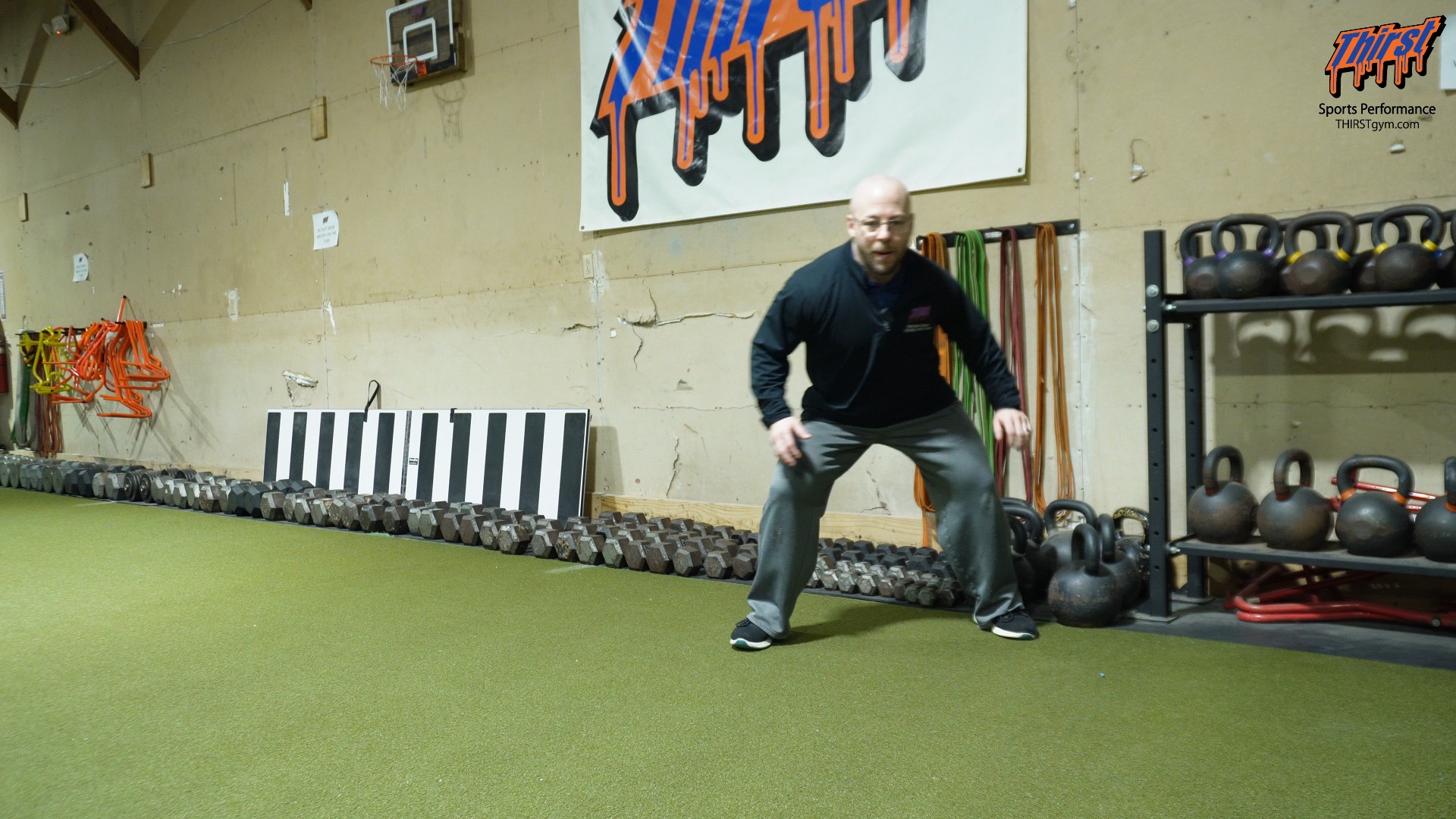
Lateral Power Shuffle: How to Build Explosive Side-to-Side Speed and Agility for Athletes
If you’ve ever watched a wrestler scramble for position, a defensive back mirror a receiver, or a basketball player slide to cut off a drive, you’ve seen lateral movement at its highest level. The ability to move side to side with power, control, and quick change of direction is one of the most underrated qualities in sport, and yet it’s one of the most overlooked in training. At THIRST Gym in Terre Haute, one of my go-to drills for developing this exact quality is the lateral power shuffle. It’s simple, it requires almost no equipment, and when coached correctly, it carries over directly to nearly every field, mat, and court sport out there.
Watch the video below on how to maximize this exercise.
Why Lateral Movement Matters in Athletics
Most sports don’t allow athletes to simply turn and sprint to where they need to go. Wrestling, MMA, football, basketball, soccer, lacrosse, tennis, and volleyball all demand that athletes cover ground laterally while keeping their hips and shoulders square to an opponent or play. That means the shuffle isn’t just a warm-up movement, it’s a foundational athletic skill. If your athletes can’t shuffle efficiently and powerfully, they’re going to get beat by defenders, lose positioning, and struggle to react to what’s happening around them. Building lateral power should be a non-negotiable part of any well-designed speed and agility program, especially for combat sport athletes and field-based team sport players who live and die by their ability to move in small spaces.
The Mechanics of a Quality Shuffle
Before you ever ask an athlete to add speed and power to a movement, you need to make sure the basic mechanics are dialed in. A good lateral shuffle starts with a wide athletic stance, with the feet positioned outside the hips, the chest tall, and a soft break at the knees and hips that loads the posterior chain. From this position, the most important coaching cue I emphasize is that the athlete needs to push, not pull. If I want to move to my right, I should be driving off my left leg, using my outside hip and glute to propel my body sideways. Far too many young athletes try to step first with their lead leg, essentially reaching out and pulling themselves into the movement, which dramatically reduces power output and slows their first move.
Teaching athletes to feel the push from the outside hip is where the entire drill lives or dies. For beginners, I’ll often back things up and use slow shuffles, lateral lunges, and lateral squats to teach them how to load the back hip and feel the glute engage before we ever add speed. Once that pattern is in place, the lateral power shuffle becomes the natural progression that turns positional strength into expressed athletic power.
How to Perform the Lateral Power Shuffle
Set up in your athletic stance with the feet wide, the chest tall, and the knees and hips loaded. From there, the goal is to push aggressively off the outside leg, cover ground laterally, and come to a controlled stop. Throughout the movement, the feet must never cross or come together. The instant your base of support narrows, you lose your ability to redirect, accelerate, or absorb force. In sport, that’s the moment you get crossed up by a defender or beaten to a spot. Maintaining width in the stance keeps you in a position where a single push can take you anywhere you need to go, whether that’s another lateral move, a level change, a sprint forward, or a quick backpedal.
Stay low through the tunnel. I tell athletes to imagine there’s a low ceiling above their head, and if they pop up out of that tunnel, they’ve broken position. Staying low keeps the hips loaded and ready to fire on the next push.
Distance, Sets, and Programming Recommendations
While you could technically perform this drill over long distances, I prefer to keep it short. Five to fifteen yards is the sweet spot for the lateral power shuffle. Anything beyond that and athletes start fatiguing, which means the quality of each push begins to decline and you’re no longer training what you set out to train. Three to five sets per side is plenty in the context of a complete speed and agility session, and it pairs well with linear acceleration work, plyometrics, and other multi-directional drills.
Progressing from Closed to Open Drills
The lateral power shuffle starts as a closed drill, meaning the athlete knows exactly what distance they’re covering and exactly when to start and stop. That’s the perfect environment to lock in mechanics. Once those mechanics are clean under controlled conditions, you can layer in reactive elements by adding a visual or audible cue that tells the athlete which direction to shuffle, when to change directions, or when to explode out into a sprint. This is where the drill becomes truly sport-specific, because in competition no athlete ever knows in advance where they need to go. Building that reactive component bridges the gap between training and performance.
Master the fundamentals first, then progress into the more complex variations as your athletes earn the right to handle them. Whether you’re training high school football players, competitive wrestlers, MMA fighters, or general fitness clients who want to move better, the lateral power shuffle deserves a permanent spot in your toolbox.
If you have questions about how to implement this drill into your programming, drop them in the comments on the YouTube video or reach out through the website. For more athletic development content, podcast episodes, and exercise breakdowns, keep it locked in here at THIRST Gym.