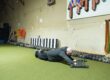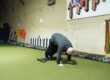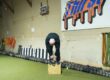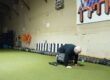

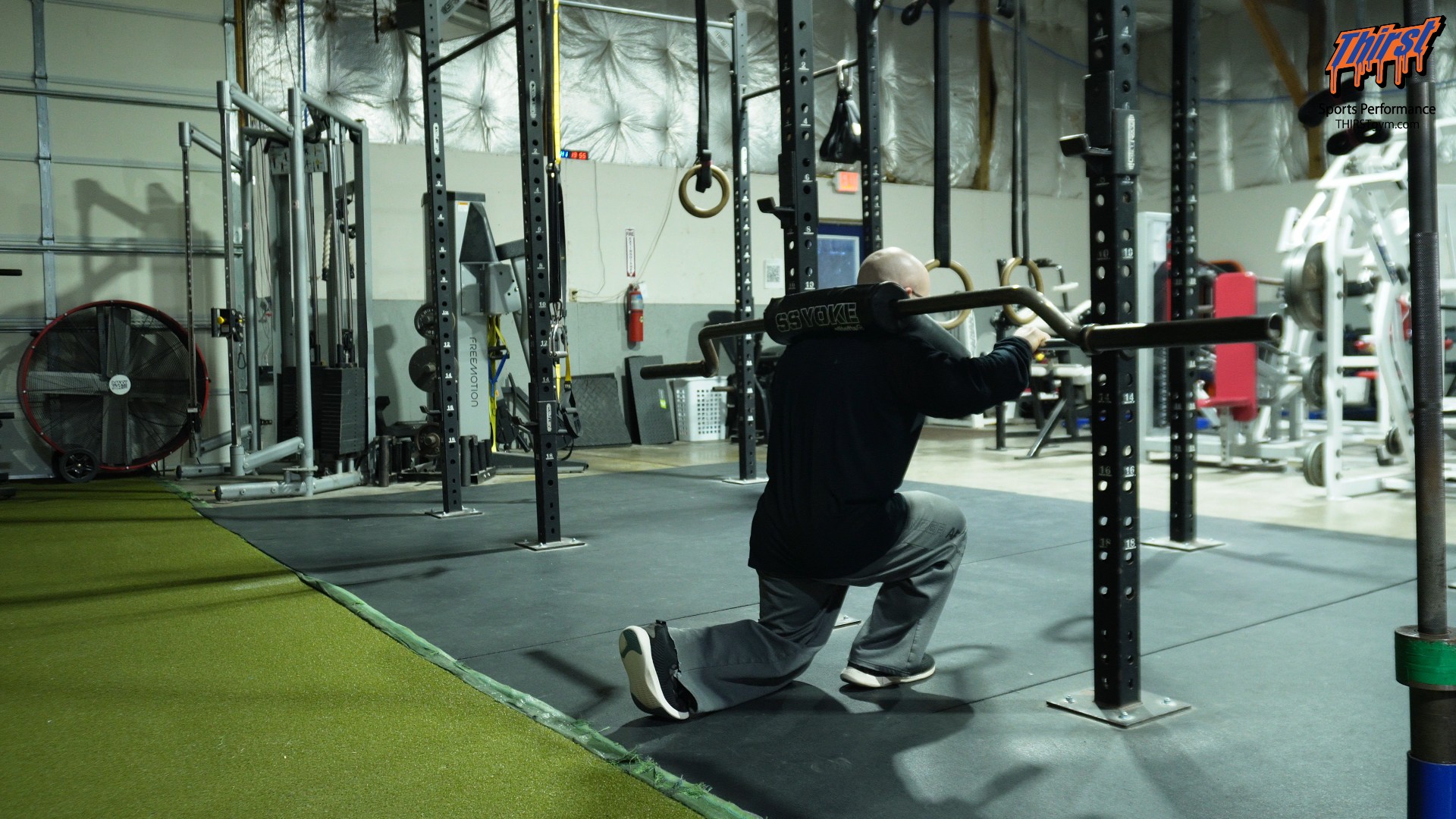
Hatfield Split Squat: How to Build Single-Leg Strength with the Safety Squat Bar
The Hatfield split squat is one of the most underutilized single-leg exercises for athletes and lifters who want to load their unilateral training without sacrificing stability or position. Named after legendary powerlifter Dr. Fred Hatfield, this variation builds on the standard split squat by giving you something to hold onto, which removes the balance demand and lets you focus entirely on driving heavier weights through the working leg. At THIRST Gym in Terre Haute, this is one of my go-to single-leg movements for powerlifters chasing bigger squats, athletes building lower-body strength for sport, and general fitness clients who want to address strength imbalances between sides.
Watch the video below on how to maximize this exercise.
To set up the Hatfield split squat, you need a safety squat bar and a rack of some kind. I prefer using band pegs in the rig because they sit out in front of you in a clean, accessible position and never get in your way during the movement. If you only have a standard power rack at your disposal, a quick workaround is to flip your J-cups around and load a barbell on the opposite side of the rack to give yourself something to grip. Both setups work, and one of the underrated benefits of using band pegs in a rig is the ease of adjusting the height between athletes or clients without unloading and reloading a barbell.
Once your station is set, get underneath the safety squat bar, take your grip on the band pegs or front barbell, and unrack the bar like you would for a normal squat. From here, step into your split squat stance with one leg forward and one leg back. Stride length matters more than people give it credit for. You don’t want to overstride, which puts excessive stress on the front knee and limits depth, and you don’t want to understride, which turns the movement into more of a quad-dominant mini-squat. The sweet spot is a stride that lets you reach roughly 90 degrees at both the hip and the knee of the front leg when you hit the bottom position.
From the top, keep your chest tall, hold lightly onto the band pegs or barbell out in front, and lower yourself straight down until your back knee taps the ground. Drive back up through the front leg and finish tall. Throughout the descent, the front shin can travel forward slightly, but the heel of the front foot must stay firmly planted on the floor. If your heel comes up, you’ve either overstrided, lost position in your hip, or shifted too far onto the toes, and you’ll lose the benefit of loading the glute and quad together. A common cue I give clients is to think about pushing the floor away with the entire front foot rather than just the ball of the foot.
The hands are the part of this exercise that most people get wrong. The whole point of holding the pegs or barbell is to remove instability from the equation so you can load more weight, but it is not meant to be a pull-up assist out of the bottom. I personally don’t even grip the handles. I just rest my palms on them for support, which keeps me honest and forces my legs to do the work. If you find yourself yanking on the bar to stand up, lighten the load. If you want to spare your back knee from contact with the floor, use a pad or simply stop just short of touching down on each rep.
The biggest reason to program the Hatfield split squat is the loading capacity it unlocks. By stabilizing the upper body, you can push real weight through a single-leg pattern, which is something traditional split squats, lunges, and step-ups can’t match once you get strong. This makes the Hatfield split squat an excellent option as a main lift on a lower-body day to replace bilateral squat variations, especially for athletes managing back stress or lifters wanting to address asymmetries. It also works well as a heavy supplemental exercise after your main squat or deadlift, where you’re chasing extra volume on one leg at a time without frying your central nervous system the way another barbell movement might.
There is one programming caveat worth mentioning. The safety squat bar itself already weighs around 65 pounds, which is a meaningful starting load. For younger athletes, beginners, or anyone still building baseline lower-body strength, that starting weight may simply be too much, and a more traditional dumbbell or kettlebell-loaded split squat will serve them better until they grow into the bar. For intermediate and advanced trainees, however, the safety squat bar’s starting weight is a feature, not a bug, because it allows for serious unilateral overload.
For sets and reps, I typically program the Hatfield split squat for two to four sets of three to eight reps per leg, depending on the goal. Lower reps in the three to five range work well when I’m using it as a primary strength movement, while six to eight reps fit better when I’m using it as a supplemental exercise for hypertrophy and structural balance. Adjust based on the athlete in front of you, the training phase, and what the rest of the program is asking of their lower body.
If you have questions about how to fit the Hatfield split squat into your training, drop them in the comments below or reach out through THIRST Gym. This is a movement I keep coming back to with my powerlifters, combat athletes, and general fitness clients because it solves a real problem in single-leg training, and once you’ve used it for a training cycle, you’ll understand why.