
Sandbag Shoulder Carry: How to Build Core Stability, Oblique Strength, and Conditioning for Athletes
The sandbag shoulder carry is one of the most underrated loaded carry variations for developing lateral trunk stability, oblique strength, hip mobility, and overall work capacity. Whether you’re a powerlifter looking to bulletproof your midsection, a combat sport athlete who needs to handle awkward odd-object loads, or a general fitness client chasing better core stability and conditioning, this exercise delivers a tremendous return on investment for the time you spend doing it. At THIRST Gym, I program the sandbag shoulder carry frequently with athletes across nearly every demographic because the carryover to real-world performance is hard to beat.
Watch the video below on how to maximize this exercise.
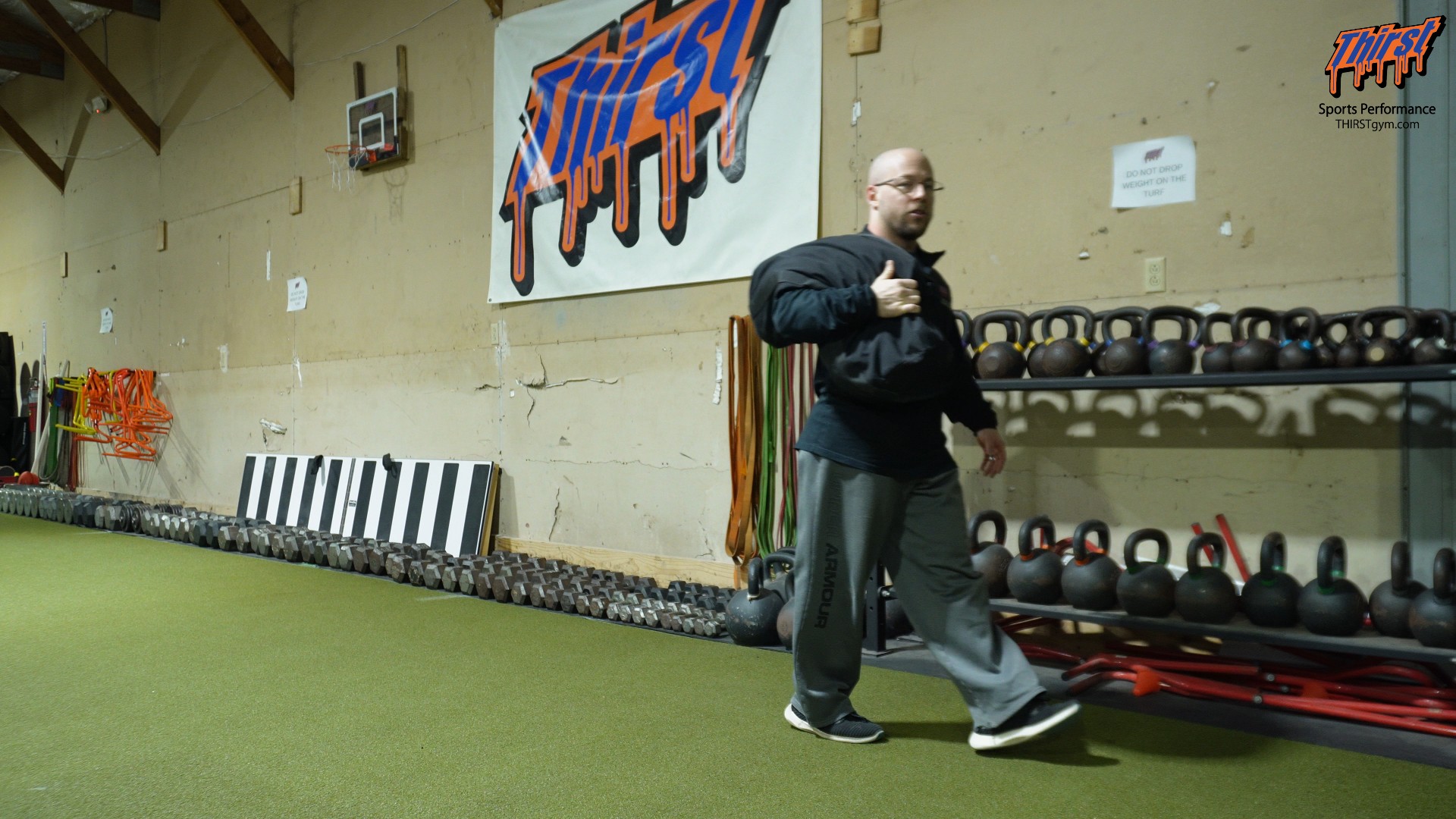
To perform the sandbag shoulder carry, you’ll need a sandbag that’s heavy enough to actually challenge you. Loadable sandbags tend to be the most practical option for most lifters because you can scale the weight up or down depending on the goal of the session, but pre-filled sandbags work just fine if that’s what you have access to. From there, the movement itself is straightforward in terms of mechanics but demanding when it comes to execution. You’re going to lift the sandbag from the floor up onto one shoulder, secure it firmly against your body, and then walk a designated distance before switching to the opposite side and repeating.
The setup is where most people miss the boat. The sandbag needs to actually sit on your shoulder rather than be cradled in your arms or pulled across your chest. Once it’s racked, your job is to resist letting it pull you sideways. The temptation when you have a heavy load on one shoulder is to lean toward the opposite side to counterbalance it, but that’s the exact pattern you’re trying to train against. Instead, you want to stay tall through the spine, keep your belly button pointed straight ahead, and feel your obliques on the side opposite the load working hard to keep your torso upright. If you’re doing it correctly, the side without the sandbag should feel the work just as much as, if not more than, the side carrying the load.
This is what makes the sandbag shoulder carry such a valuable anti-lateral flexion exercise. You’re forcing the obliques, quadratus lumborum, and the deep stabilizers of the trunk to fire isometrically while you walk, and that builds a kind of rotational and lateral stability that translates directly into squatting, deadlifting, sprinting, and contact sports. As a bonus, holding that load on one shoulder while walking also opens up the opposite hip and demands a little more from your hip mobility on each step, which is why athletes often notice better movement quality after consistent exposure to this drill.
For powerlifters, the sandbag shoulder carry is a phenomenal accessory tool to address the lateral trunk weaknesses that often show up under heavy squats and deadlifts. For combat sport athletes, particularly wrestlers, MMA fighters, and grapplers, it mimics the awkward load distribution of carrying or controlling another human body, which makes it one of the most sport-specific conditioning tools available. For general fitness clients, it’s a no-nonsense way to build a stronger midsection while simultaneously improving aerobic and anaerobic conditioning. Coaches working with youth and high school athletes can also use lighter sandbag carries to teach posture, bracing, and trunk control before progressing to heavier loaded variations.
Programming the sandbag shoulder carry depends on the outcome you’re chasing. When I’m using it strictly as core or trunk stability work, I’ll typically program it toward the end of a training session for two to four sets of twenty to fifty yards per side using as heavy a load as the athlete can manage while still maintaining a tall, locked-in torso position. If the load is so heavy that they’re caving to one side or rotating to compensate, the weight comes down. When I’m using it within a conditioning circuit or mixed modality day, I’ll shorten the carry distance to twenty to thirty yards per side and drop the load into a moderate range so it can be sustained across multiple rounds without compromising form. In a conditioning context, you can superset the carry with sled pushes, kettlebell work, or jump rope to drive heart rate up and develop aerobic capacity, anaerobic endurance, and even power endurance depending on how the circuit is structured.
A few common mistakes to watch for. The most frequent issue is athletes gripping the bag with their arms and using upper body tension to hold it instead of letting it sit on the shoulder and bracing through the trunk. The second is letting the bag drift forward or pull them off-center, which kills the training effect entirely. The third is picking a load that’s too light to actually challenge the obliques, which turns the drill into a walk rather than a stability exercise. Pick a weight that demands focus, lock your ribs down over your pelvis, and walk with intent.
The sandbag shoulder carry is one of those exercises that punches well above its weight in terms of carryover to the platform, the mat, the field, and everyday life. Plug it into your training two to three times per week and you’ll feel the difference in your bracing, your conditioning, and your overall durability.