
Half Kneeling Lateral Start to Sprint: Build Explosive Lateral Power and Change of Direction Speed for Athletes
The half kneeling lateral start to sprint is one of the most effective sprint variations for athletes who need to develop explosive lateral power production and improve their ability to change direction at high speeds. Unlike traditional linear sprinting drills, this exercise specifically targets the propulsive mechanics that occur when an athlete needs to transition from a lateral position into an all-out sprint, making it an essential tool for sport-specific speed development. Whether you compete in soccer, basketball, tennis, lacrosse, football, or any sport that demands rapid changes of direction, this drill bridges the gap between deceleration and re-acceleration, which is where most athletic plays are won or lost.
Watch the video below on how to maximize this exercise.
Why the Half Kneeling Lateral Start to Sprint Matters for Athletic Performance
Most sports do not happen in straight lines. Athletes are constantly cutting, redirecting, chasing opponents, and reacting to the movement of the ball, puck, or player in front of them. The ability to apply force laterally and immediately convert that into forward sprint mechanics is what separates elite athletes from average ones. The half kneeling lateral start to sprint trains exactly this quality by forcing the athlete to produce horizontal force from a stationary, asymmetrical position before transitioning into a full sprint. This teaches the nervous system how to coordinate the upper and lower body during the most demanding portion of a change of direction sequence, which is the moment after the cut when the athlete must re-accelerate as quickly as possible.
For athletes who tend to look slow or labored coming out of a cut, this drill is a game-changer. It exposes weaknesses in lateral propulsion and hip extension, and it gives coaches a clear window into how well an athlete can re-direct force from a compromised position. Over time, repeated exposure to this pattern teaches the athlete to push through the ground laterally with greater intent and confidence.
How to Set Up the Half Kneeling Lateral Start to Sprint
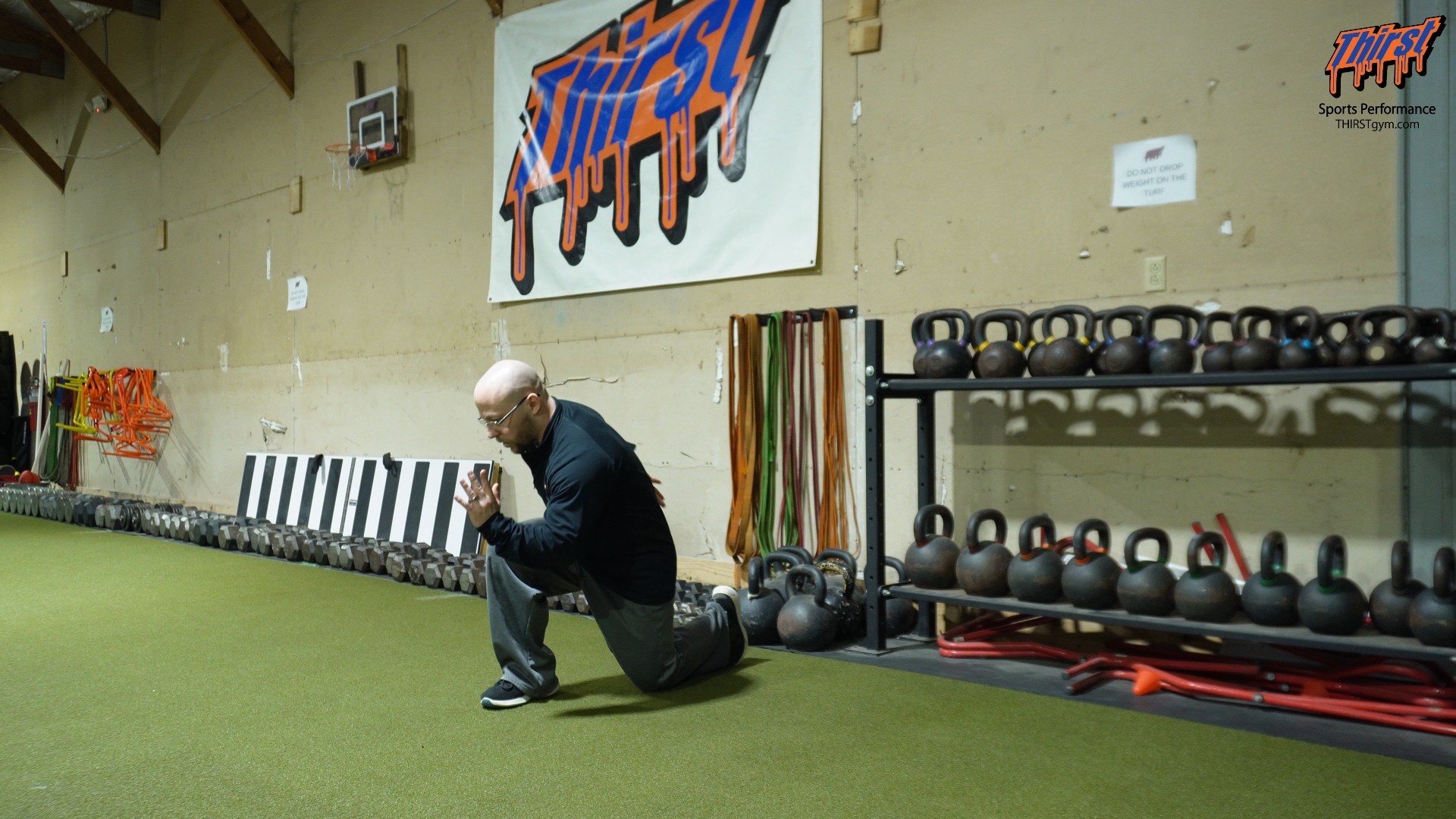
Proper setup is everything with this exercise because the mechanics of the start dictate the quality of the sprint that follows. If you want to sprint to your left, your right leg will be the front leg in the half kneeling position. The front foot should be flat on the ground with the knee tracking forward over the toe, while the back leg is positioned with the knee directly underneath the hip and the toe dug into the turf. Avoid resting the laces of your back foot on the ground because this kills your ability to produce force out of the start. Think of it the same way you would set up a tall kneeling position with the toe actively engaged.
From here, the arm action sets up the sprint. Your right arm, which is the same side as your front leg, should be pulled back behind you toward the back hip pocket at roughly 100 to 110 degrees of elbow flexion. Fingers can stay open or relaxed depending on personal preference. Your left arm comes up in front of your body at approximately 90 degrees, mirroring what would happen naturally during a sprint stride where opposite arm and leg work together. Lean slightly forward to load tension into the front glute and create a strong starting position that allows you to explode out laterally rather than vertically.
Executing the Sprint and Coaching the Mechanics
When the whistle blows or the start cue is given, the back arm rips violently across the body while the front arm drives down and back. The goal is to stay low and travel sideways before transitioning into the sprint, not to pop straight up out of the stance. One of the most common mistakes athletes make is rising too tall too quickly, which eliminates the forward lean that is critical for early acceleration mechanics. Staying low forces a longer push phase, which translates directly into more horizontal force production and faster acceleration. When athletes give 100 percent effort into the ground, staying low actually becomes easier because the body naturally wants to project horizontally rather than vertically.
After the initial lateral push and crossover step, the athlete simply continues into a full sprint for the prescribed distance. Both sides should be trained equally to prevent asymmetries and to build well-rounded change of direction capabilities.
Programming the Half Kneeling Lateral Start to Sprint
The distance you choose dictates the focus of the drill. For technical work and pure mechanics development, 10 to 15 yard sprints are ideal. At this distance, you can program three to six sets of two to four reps per side, giving athletes plenty of opportunities to refine their start position and lateral push mechanics. As you extend the distance to 20, 25, 30, or even 40 yards, the focus shifts toward expressing that lateral power across longer acceleration zones. At those distances, one to two reps per side across three to five sets tends to be more appropriate because fatigue accumulates quickly and the goal becomes maximal output rather than high volume technical practice.
For most athletes, the shorter distances will yield the biggest training effect because the exercise is fundamentally about teaching the body how to get out of a cut and re-accelerate. If you have any questions about implementing this drill into your training program, drop them in the comments section below or reach out directly. Train hard and stay explosive.