
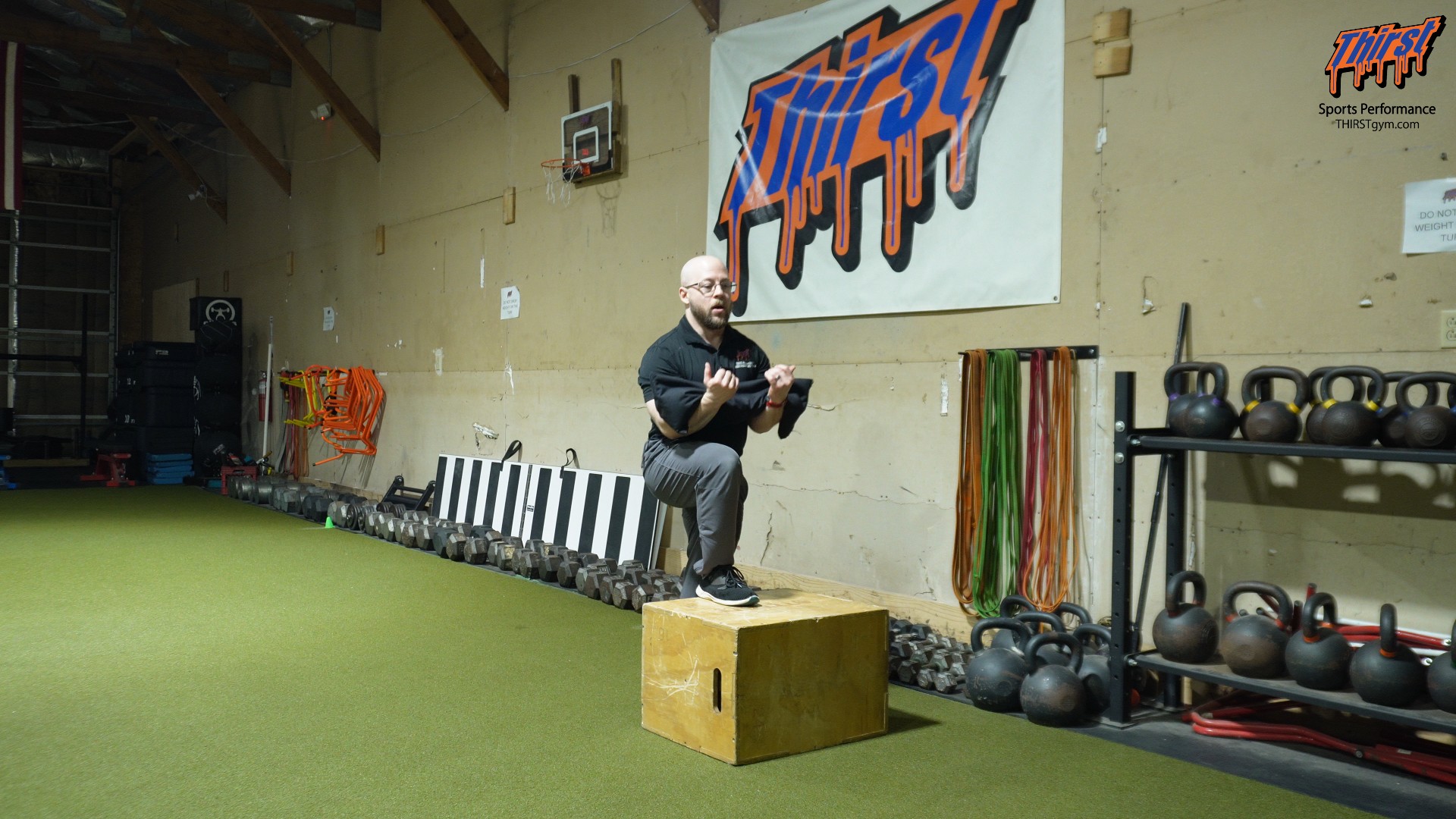
Sandbag Zercher Step-Up: How to Do It, Coaching Cues, Mistakes, and Programming
Single-leg training is one of the most valuable things you can add to a program, and also one of the most commonly butchered. Lifters rush through step-ups, lunges, and split squats as an afterthought, then wonder why they never feel them where they should. When single-leg work is coached and loaded the right way, it builds strength, muscle, balance, and resilience that carry over to the platform, the mat, the field, and everyday life.
That is where the sandbag Zercher step-up comes in. It takes a basic movement everyone knows and makes it harder to cheat. The front-loaded sandbag keeps you upright, the step-up forces each leg to earn its reps, and the low-impact nature lets you push hard without beating up your joints.
Whether you coach wrestlers, powerlifters, high-level athletes, or general population clients, this is an exercise you can teach in minutes and use for years. Here is everything you need to know to set it up, perform it well, and program it for real results.
Watch the video below on how to maximize this exercise.
What Is the Sandbag Zercher Step-Up?
The sandbag Zercher step-up is a single-leg lower body exercise where you hold a sandbag in the crooks of your elbows and step up onto a box or bench. It builds the glutes, quads, and hamstrings one leg at a time while the front-loaded hold keeps your torso tall and your core working hard.
It is one of the simplest exercises you can add to a program, and also one of the most versatile. You can load it heavy for strength, push volume for hypertrophy, or use it as a low-impact conditioning tool that gets your heart rate through the roof without beating up your joints.
The catch is that most people perform step-ups poorly. They launch off the back leg, fold forward at the top, and turn a glute-dominant movement into a sloppy jump. This guide covers how to set up the sandbag Zercher step-up, how to execute every rep with intent, the mistakes to avoid, and how to program it for strength, size, and conditioning.
Muscles Worked and Benefits of the Sandbag Zercher Step-Up
The primary movers are the glutes and quadriceps of the working leg. When you start each rep from roughly 90 degrees of hip flexion, the glute max does a large share of the work to extend the hip and drive you to the top. The quads handle knee extension, and the hamstrings and adductors assist as hip extensors and stabilizers.
The Zercher hold adds a second layer of training effect. Carrying the load in front of the body demands constant anterior core bracing, and your upper back has to stay engaged to keep the bag from pulling you forward. Your biceps and forearms also work isometrically to cradle the bag in the elbow crease.
Why Train Single-Leg Strength?
Unilateral work like the step-up exposes and corrects side-to-side imbalances that bilateral lifts can hide. On a squat or deadlift, a stronger leg can quietly cover for a weaker one. On a step-up, each leg has to own its rep.
Single-leg training also builds hip and knee stability through the frontal plane. The glute medius and the small stabilizers around the hip have to control the pelvis while one foot does the work. That control carries over to running, cutting, changing levels, and nearly every athletic movement that happens on one leg at a time.
Why Use a Sandbag?
A sandbag is forgiving, comfortable, and easy to grab. It conforms to your arms instead of digging into them like a barbell can in the Zercher position, which makes it far more approachable for most lifters.
The bag also teaches an upright posture almost automatically. Because the load sits in front of your center of mass, you have to stay tall to keep it there. That makes the sandbag Zercher step-up an excellent teaching tool for athletes who tend to fold forward on standard dumbbell step-ups.
Finally, the step-up is low impact. There is no landing force like you get with jumps or sprints, so you can accumulate a lot of quality work while keeping joint stress low.
Equipment Needed and How to Choose Your Box Height
You need two things: a stable box or bench to step onto and a sandbag you can hold comfortably. A plyo box, a sturdy wooden box, or a flat weight bench all work. Make sure the surface does not slide or tip when you load one edge.
For the sandbag, a strongman-style or training sandbag with a durable shell is ideal. Start lighter than you think. The Zercher hold is often the limiting factor before your legs are.
[OPTIONAL AFFILIATE — keep or remove: If you need a durable training sandbag, EliteFTS carries options built to handle heavy use in a commercial or garage gym.]
The Ideal Starting Height
As a default, pick a box that puts your working hip at about 90 degrees of flexion when your foot is on top. You should be able to get your entire foot on the box, not just the forefoot, and still have room to bring your other foot up beside it.
This height gives you a strong balance of range of motion and control. It puts the glutes in a stretched, loaded position at the start of each rep without forcing you into a depth you cannot own.
When to Go Higher
A taller box increases hip flexion and lengthens the range of motion. That can mean more glute recruitment, but there is a trade-off. Most lifters start compensating on a high box by pushing harder off the back leg, which defeats the purpose of the exercise.
Use a higher box only if you can keep the back leg passive and drive the rep with the front leg. If your trailing foot is doing the work, lower the box.
When to Go Lower
A lower box lets you be stricter. You may give up a little glute engagement, but you gain cleaner reps and more control over the working leg.
A lower box is also the right call if you have pinchy or achy hips. Some lifters cannot reach deep hip flexion comfortably, especially while holding a load in front of the body. Lowering the box keeps the exercise productive without forcing the joint into a painful position. You can raise the height over time as mobility and tolerance improve.
How to Hold a Sandbag in the Zercher Position
The Zercher position means holding the load in the crooks of your elbows. With a sandbag, scoop the bag up so it rests across your inner elbows and against your lower chest and upper abdomen. Your palms face you, as if you were holding a book open to read.
Keep your elbows bent and squeeze the bag into your body. Pull your shoulders down and back, and set your upper back tight so the bag does not drag your chest forward. Brace your midsection like you are about to take a punch, and keep that brace through every rep.
The closer the bag sits to your body, the easier it is to stay upright. If the bag drifts away from your torso, your lower back takes on more stress and your posture breaks down. Treat the hold as part of the exercise, not just a way to carry weight.
To get the bag into position safely, deadlift it to your hips, then lap it on your thighs in a partial squat. From there, slide your forearms under the bag and stand up with it in the elbow crease. Avoid curling a heavy bag straight up with your arms extended.
How to Perform the Sandbag Zercher Step-Up
Stand facing the box with both feet on the floor and the sandbag locked into the Zercher position. Stand close enough that you can place your whole foot on the box without reaching.
Plant the Working Foot
Drive one knee up and place the entire foot flat on the box. Your knee should track in line with your toes, and your shin should be close to vertical. Shift your weight toward your heel before you start the rep.
Pull Yourself Up With the Front Leg
This is the most important cue in the entire exercise. Think about pulling your body up to the box with the front leg rather than pushing off the floor with the back leg. Stay heel heavy on the working foot and drive through the whole foot to stand up.
Your back leg should feel almost passive, like it is just along for the ride. When you get this right, you will feel the work shift into the glute and the hamstring of the working side. That pull-don’t-push intent is what separates an effective step-up from a glorified jump.
Finish Tall at the Top
Stand all the way up with your hips fully extended and your torso vertical. Lightly tap the trailing foot on the box beside the working foot. Do not let your chest fall forward to reach the top position.
Control the Lowering Phase
The eccentric, or lowering portion, deserves as much attention as the way up. Lower yourself under control by sitting back into the hip of the working leg. Let the glute load up as you descend instead of dropping off the box.
A slow, controlled descent builds strength and muscle through the full range and protects the knee. A two- to three-second lower is a good default when training for strength or hypertrophy.
Two Ways to Handle the Working Foot
You have two options between reps. The first is to step the working foot back down to the floor and bring it back up to the box for every rep. That adds an active hip flexion component and a bit more coordination demand.
The second is to leave the working foot on the box for the whole set. You lower the trailing foot to the floor, tap, and drive right back up. This saves time and effort, keeps tension on the working leg, and is the better choice when you are doing all reps on one side. Use the step-down version only if you actively want that repeated hip flexion.
Common Sandbag Step-Up Mistakes and How to Fix Them
The step-up looks simple, so mistakes go unnoticed. These are the errors that show up most often, along with the fixes that clean them up.
Pushing Off the Back Leg
This is the biggest and most common mistake. The lifter gets a big push off the trailing leg to launch themselves up, and the working leg barely contributes. From the side, it looks like a small jump onto the box.
The fix starts with intent. Cue yourself to pull your body up with the front leg and keep the back foot light. If the back leg still takes over, lower the box, reduce the load, or have the back foot rest on its heel or toes only. You can also pause for a second with your weight shifted onto the front foot before you drive up. When the front leg does the work, you will feel the glutes and the rest of the posterior chain far more.
Leaning Too Far Forward
The second most common error happens near the top. The lifter folds forward at the hips and drops the chest to get over the box. Some forward lean is natural at the start of the rep, but an excessive hinge shifts stress to the lower back and turns a leg exercise into a hip hinge.
The goal is to stay as vertical as possible. The Zercher sandbag hold helps here because front-loaded weight naturally encourages an upright torso. If you still fold, keep the bag tight to your chest, brace harder, and use a box low enough that you can stand up without leaning.
Letting the Knee Cave In
If the working knee drifts inward as you drive up, the hip stabilizers are not controlling the femur. Cue the knee to track over the middle toes and slow the rep down. Lighter loads and a lower box usually solve it.
Dropping Off the Box
Many lifters work hard on the way up and then fall back to the floor. That throws away half the training effect and puts unnecessary stress on the knee of the trailing leg. Own the eccentric, sit back into the working hip, and lower with control every rep.
Letting the Bag Drift Away From the Body
As fatigue builds, the arms relax and the bag slides away from the torso. That pulls you forward and makes the lower back work harder. Re-squeeze the bag between sets or rack it and reset if it keeps drifting.
Progressions, Regressions, and Variations
The sandbag Zercher step-up scales easily in both directions. Adjust box height, load, tempo, and hold to match the lifter in front of you.
Regressions
For beginners, start with a bodyweight step-up onto a low box to groove the pull-with-the-front-leg pattern. Once that is clean, add a light sandbag in the Zercher position. If the hold itself is the problem, a goblet-held dumbbell or kettlebell gives a similar upright posture with a simpler grip.
Lowering the box is the fastest regression of all. It reduces range of motion, makes it easier to stay strict, and is the best option for lifters with cranky hips.
Progressions
The simplest progression is more load. Move up in sandbag weight once you can complete all reps with a passive back leg and a controlled eccentric.
You can also raise the box as long as reps stay clean, slow the eccentric to three to five seconds, or add a pause at the bottom with the working foot on the box. A paused start removes momentum and forces the working leg to produce force from a dead stop.
Variations
The lateral step-up, performed from the side of the box, places more demand on the glute medius and frontal-plane control. The crossover step-up, where you step onto the box across your body, challenges the hip in a rotational position that matters for field and mat sport athletes.
You can also swap the sandbag for a barbell in the Zercher position once a lifter has the strength and tolerance for it. The barbell allows heavier loading but is far less comfortable in the elbows, which is exactly why the sandbag is the better starting point for most people.
How to Program the Sandbag Zercher Step-Up
Once the technique is dialed in, the exercise is easy to plug into almost any program. How you load it depends on whether the goal is strength, muscle, or conditioning.
For Strength and Hypertrophy
As a standard strength or hypertrophy accessory, perform three to four sets of six to 10 reps per leg. Use a load that lets you finish every rep with a passive back leg and a controlled two- to three-second eccentric. When you can hit the top of the rep range on every set, add weight.
Place it after your main lower body lift, such as a squat, deadlift, or trap bar pull. On a lower body day, it pairs well with a hamstring or posterior chain movement. On a full-body day, it can stand in as the primary single-leg exercise.
For Conditioning
The sandbag Zercher step-up is an outstanding conditioning tool. You can grab a sandbag and go, the hold is comfortable, and alternating legs lets you rack up a high volume of quality work. Heart rate climbs fast, and you are still training single-leg strength the whole time.
It is also low impact. There is no landing or pounding, which makes it easier on the joints than running, jumping, or many traditional conditioning drills. Keeping the working foot on the box reduces impact even further and lets you string together long, continuous efforts.
Program Conditioning Work Intelligently
Do not turn this into 10 minutes of nonstop stepping. Grinding step-ups for long, unstructured bouts leads to sloppy reps and the exact back-leg push and forward lean you are trying to avoid.
Instead, assign a set number of reps per leg or alternate legs for a fixed work interval, then rest or rotate to another modality. For example, alternate legs for 30 to 45 seconds and follow it with a bike, rower, sled push, or a carry before resting. Repeat that circuit for four to six rounds.
Another option is to perform eight to 10 reps per leg as one station in a larger conditioning circuit. Mixing in other modalities keeps the quality of each rep high and spreads fatigue across different muscle groups and energy systems.
Progressing the Conditioning Version
Progress conditioning work by extending the work interval, shortening rest, adding rounds, or increasing sandbag weight, but change only one variable at a time. If form starts to degrade, the session has crossed from productive work into junk volume.
Who Should Use the Sandbag Zercher Step-Up?
This exercise checks a lot of boxes for a wide range of people. The same movement can be loaded, scaled, and programmed differently depending on who is doing it.
High-Level Athletes
For athletes in season or carrying a heavy practice load, the sandbag Zercher step-up delivers single-leg strength and conditioning without adding much joint stress. It is easy to recover from, easy to coach, and easy to slot into a short session.
Wrestlers and Combat Sports Athletes
Wrestlers, MMA fighters, and grapplers spend much of their time in awkward, front-loaded positions with a bent torso and one leg doing the work. Holding a sandbag in the Zercher position builds the upper back, arms, and trunk strength to control an opponent close to the body. The single-leg drive builds the hip strength needed for level changes, shots, and finishes, and the conditioning version builds work capacity without pounding joints that already take a beating on the mat.
Powerlifters
For powerlifters, the step-up is a valuable accessory that builds the glutes and quads through a full range and addresses side-to-side imbalances that show up under the bar. It provides productive lower body volume with far less spinal loading than more squatting, which matters during heavy training blocks.
General Population and Older Adults
For general fitness clients and older adults, the step-up is about as functional as an exercise gets. Climbing stairs, getting off the ground, and stepping onto a curb all rely on single-leg strength and balance. Lower box heights and lighter sandbags make it approachable, and the low-impact nature makes it a great fit for anyone trying to preserve their joints, feel good, and still get in quality work.
Final Thoughts on the Sandbag Zercher Step-Up
The sandbag Zercher step-up is simple, scalable, and effective. Pick a box that puts your hip near 90 degrees, hold the bag tight in the crooks of your elbows, pull yourself up with the front leg, stay tall, and own the way down.
Use it for six to 10 reps per leg to build strength and muscle, or alternate legs in structured intervals for low-impact conditioning. Whether you coach wrestlers, powerlifters, high-level athletes, or general population clients, it is one of the easiest ways to add quality single-leg work to a program.