
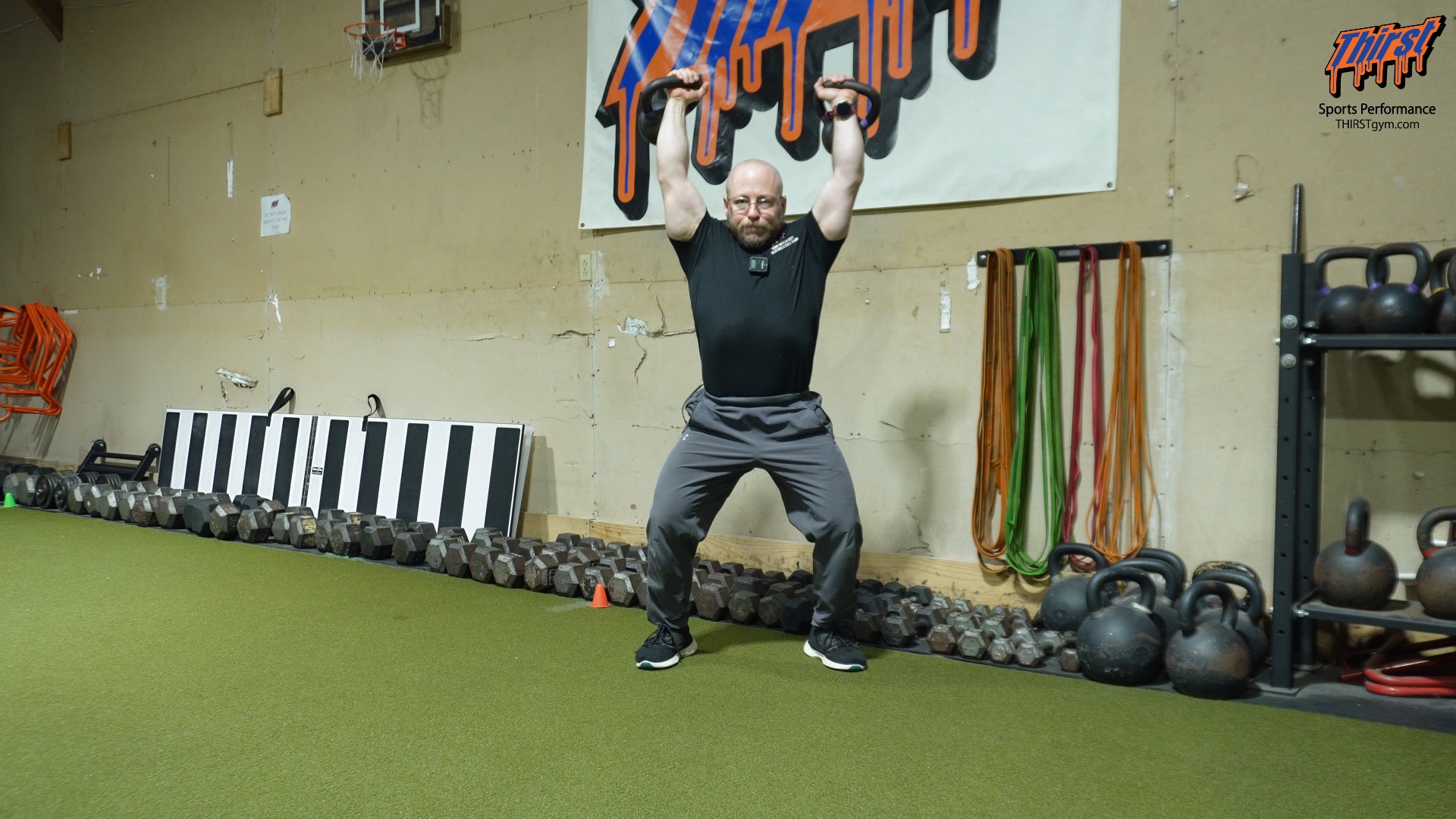
Double Kettlebell Clean to Push Jerk: Technique, Programming, and Coaching Tips for Explosive Power
The double kettlebell clean to push jerk is one of the most effective full-body power exercises you can program with nothing more than two kettlebells and a little open floor. It pairs a hip-driven clean with an explosive push jerk, so you get triple extension, coordination, and overhead stability in one movement. It’s a great fit for athletes who want to build power without a barbell, coaches who need an explosive option for a crowded gym floor, and lifters who want more out of their kettlebell training than swings and goblet squats.
Because it has two distinct parts, it’s also easy to perform poorly. A sloppy clean leads to a bad rack position, and a bad rack position ruins the jerk. A weight that’s too light turns the whole thing into a shoulder press with extra steps. This guide covers how to perform the double kettlebell clean to push jerk correctly, how it differs from the push press, how to pick the right load, and how to program it for strength, power, and conditioning.
Watch the video below on how to maximize this exercise.
What Is the Double Kettlebell Clean to Push Jerk?
The double kettlebell clean to push jerk is a two-phase exercise. First, you clean two kettlebells from between your legs into the front rack position at your shoulders. Then you perform a push jerk: a short dip, a violent drive through the legs that gets your feet off the ground, and a fast catch with the arms locked overhead as you drop back under the bells.
Both phases are powered by the hips and legs. In the clean, hip extension sends the bells up to the rack. In the push jerk, leg drive and triple extension of the ankles, knees, and hips send them overhead. The arms guide and receive the weight, but they are not the engine. That full-body demand is what separates this lift from a pressing exercise and makes it a true power development tool.
Equipment and Setup
You need two kettlebells, ideally the same weight. Mismatched bells pull you off balance in the clean, change your timing on the drive, and make the overhead catch uneven. If you only have two different weights available, use the single-arm version until you can get a matched pair.
You also need some space. You’ll be moving two loaded implements between your legs, up to your shoulders, and overhead, and your feet will leave the ground on every jerk. Clear the area around you, make sure your ceiling is high enough to lock out comfortably, and keep other athletes out of your lane.
<!– [OPTIONAL ELITEFTS MENTION — keep or delete] –> If you’re outfitting a garage gym or adding to your facility, EliteFTS carries quality kettlebells and conditioning equipment that hold up to this kind of explosive training. <!– [END OPTIONAL MENTION] –>
Benefits of the Double Kettlebell Clean to Push Jerk
Power Development Through Triple Extension
The biggest reason to use this exercise is triple extension: the ankles, knees, and hips extending together to produce force into the ground. That same pattern drives sprinting, jumping, tackling, shooting a takedown, and nearly every explosive action in sport. The push jerk trains it aggressively, because your goal on every rep is to drive hard enough that your feet actually leave the floor.
Full-Body Coordination
The clean asks your hips to deliver the bells to the right place at the right time. The jerk asks your legs, trunk, and arms to coordinate a drive and a catch in a fraction of a second. Training both in sequence builds the kind of timing and body awareness that carries over to athletic movement far better than isolated strength work.
Overhead Stability With Two Independent Loads
Unlike a barbell, two kettlebells move independently. Each arm has to stabilize its own load, so a weaker or less stable side gets exposed quickly. Catching two bells overhead with locked elbows and a braced trunk builds shoulder stability, upper back strength, and trunk control that transfers to pressing, throwing, and grappling.
An Accessible Alternative to Barbell Olympic Lifts
Barbell cleans and jerks are excellent, but they require coaching time, technical proficiency, bumper plates, and a platform. The double kettlebell version gives you many of the same power benefits with a lower technical barrier and far less equipment. That makes it practical for team settings, home gyms, and athletes who don’t have the background to train the barbell lifts safely.
Push Jerk vs. Push Press: What’s the Difference?
Lots of lifters use these terms interchangeably, but they are different exercises with different training effects.
In a push press, you dip and drive with the legs, but your feet stay on the ground. The leg drive starts the weight moving, and then the arms finish the press to lockout. It’s an explosive movement, but there’s no true triple extension and no drop under the load.
In a push jerk, you dip and drive with enough force to fully extend through the ankles, knees, and hips and leave the ground. While the bells are still traveling upward, you drop back under them and catch them with your arms already locked, landing in a partial squat. You should be able to feel and hear your feet move. The push jerk is more explosive, more powerful, and allows you to move more weight overhead than the push press because you’re getting under the load rather than pressing it all the way up.
That distinction matters for programming. If your goal is power, the push jerk is the better tool. If your goal is conditioning, the push press is usually more efficient, which we’ll cover below.
How to Perform the Double Kettlebell Clean
Before you work on the double kettlebell clean, you should be competent at the kettlebell swing. The clean is built on the same hip hinge and hip snap, and if your swing is not solid, the clean will expose it. If you aren’t confident with the swing yet, spend time there first.
Stance
You can technically clean two kettlebells from a conventional, hip-width stance. Traditionally, however, kettlebell cleans are performed from a wider athletic stance so the bells can travel back between your legs, just like a swing. Set your feet slightly wider than shoulder width, with the toes turned out a little. The bells should sit on the floor slightly in front of you.
The Hike
Hinge at the hips, keep a long, neutral spine, and grab both handles. Brace your trunk and hike the bells back between your legs, much like snapping a football. Your forearms should make contact high on your inner thighs, and your hips should load behind you. This is where the power comes from, so the position needs to be strong and loaded, not rushed.
The Hip Drive
Snap the hips forward aggressively, the same way you would on a hard swing. Instead of letting the bells float out in front of you, keep your elbows close to your body and guide the bells up along a tight path close to your torso. The hips do the work. The arms simply keep the bells close and steer them to the rack.
The Turnover and Front Rack Position
As the bells rise, rotate the wrists and punch your hands through the handles so the kettlebells roll softly around your forearms instead of flipping over and crashing into them. Your hands should come all the way through the handles and finish in a strong, neutral wrist position.
A useful cue: at the receiving position, it should look like you’re about to punch yourself in the chin. Your fists sit near your chin, your elbows stay tucked close to your ribs, and the kettlebells rest on the outside of your forearms and upper arms.
Avoid a limp, bent-back wrist and avoid letting the elbows drift out wide with the bells hanging away from your body. That position is hard on the elbows and shoulders, feels awful even with a light bell, and leaves you in no position to drive the bells overhead. The kettlebell should rest on the outside of your body, and your hand should be fully through the handle.
How to Perform the Push Jerk
Once the bells are secure in the front rack, you move into the push jerk. Think of it in three parts: dip, drive, and catch.
The Dip
Keep your torso upright, your elbows tucked, and your weight balanced over the middle of your feet. Bend the knees in a short, quick, controlled dip, roughly a quarter squat. The knees travel forward, not the hips back. This is not a squat and not a hinge. If your chest drops forward, the bells will pull you forward and the drive will go out in front of you instead of straight up.
The Drive
Reverse the dip immediately and drive hard through the floor. Extend fully through the ankles, knees, and hips. The goal is to leave the ground. You should be able to feel and hear your feet move as you push and jump. This is the triple extension that makes the push jerk so effective for power, so don’t cut it short to save time or effort.
The Catch
As the bells travel upward off the drive, punch them overhead and drop back under them. Land in a partial squat with your arms locked out and the bells stable overhead. The catch should be fast and violent. You are not pressing the bells up from your shoulders; you are getting underneath them while they are still moving. Your ribs should stay down, your trunk braced, and your biceps close to your ears.
The Finish and Return
Stand up to full extension with the bells locked overhead and pause briefly to show control. To lower, bring the bells back to the rack position under control, softening the knees as they land to absorb the weight. From the rack, you can either let the bells drop back between your legs to clean again or perform another jerk from the rack, depending on how you’re programming the movement.
Common Mistakes and How to Fix Them
Banging the Forearms on the Clean
If the bells are slamming into your forearms, they are traveling too far from your body and flipping over the hand instead of rolling around it. Keep the elbows close, guide the bells up a tighter path, and actively punch your hands through the handles at the top. Practicing single-arm cleans with a lighter bell can help clean up the timing.
Limp Wrists in the Rack
A bent-back wrist puts strain on the joint and makes the rack unstable. Keep the wrist neutral and stacked, as if you’re delivering a punch, and make sure your hand is all the way through the handle.
Elbows Flared Out Wide
When the elbows flare, the bells drift away from the body, the shoulders take on stress they shouldn’t, and the drive into the jerk loses its connection to the legs. Tuck the elbows against your ribs so the load is supported by your torso and your legs can transfer force directly into the bells.
Turning the Dip Into a Squat or a Hinge
A dip that’s too deep or that sends the hips back kills the drive and pulls the bells forward. Keep it short, upright, and knee-driven.
Pressing Instead of Catching
If you finish every rep by grinding the bells up with your shoulders, you’re performing a push press, not a push jerk. Drive harder, get your feet off the ground, and focus on dropping under the bells with locked arms.
Using Weight That’s Too Light
This is the most common mistake with this exercise, and it gets its own section below.
Choosing the Right Weight
The double kettlebell clean to push jerk should be performed with moderate to heavy weights, and most people should go heavier than they think.
If the kettlebells feel like they’re rattling around and moving on you, they’re likely too light. Light bells don’t demand any real involvement from the lower body, so the movement turns into a fast shoulder press. A good test: if you could easily strict press the bells for the same number of reps, they are too light for the push jerk.
The right weight forces your legs to drive hard and requires you to actually get under the bells to catch them. That is what makes it a full-body exercise and what produces the power adaptation you’re after. Of course, heavier doesn’t mean sloppy. Choose the heaviest pair you can clean into a clean rack and catch overhead with locked elbows on every rep.
Programming the Double Kettlebell Clean to Push Jerk for Strength and Power
This exercise is best used for strength and power development. For that purpose, a range of three to six sets of two to five repetitions works well.
Keep the reps low because the quality of each rep matters more than the total volume. Every rep should be as explosive as possible, both in the hip extension of the clean and in the dip and drive of the jerk. Once speed starts to drop or technique starts to break down, the set is over, even if you could technically grind out more reps.
Place it early in your session, after a thorough warm-up and before your main strength work or heavy accessory training. Power exercises are most effective when you’re fresh. Rest long enough between sets to fully recover, usually around ninety seconds to two minutes or more, so each set can be performed at full intent.
A typical example for an athlete in a power-focused block might look like four sets of three reps with a heavy pair of kettlebells, done before squats or deadlifts. For an athlete in a general preparation phase, five sets of five with a moderate pair builds technical consistency while still demanding real explosiveness.
Using the Double Kettlebell Clean to Push Jerk for Conditioning
You can use this exercise for conditioning, but it isn’t the best choice for most situations.
When conditioning is the goal, you want to get as much quality work done in as little time as possible, or within whatever time parameters you’re working with. The push jerk demands a full triple extension and a drop under the load on every rep. That’s great for power, but it limits how much total work you can accomplish in a given time frame. The double kettlebell push press, which keeps your feet on the ground, lets you accumulate more quality work more efficiently.
If you still choose to use the push jerk in a conditioning setting, cap your sets at five to six reps. Each rep relies on hip extension, speed, and power, and when fatigue builds, those are the first qualities to disappear. Once you’re exhausted, technique suffers, and you end up just trying to get the weight overhead any way you can. That’s when the risk goes up and the training benefit goes down.
A sensible approach is to use an every-minute-on-the-minute format with three to five crisp reps each minute, which builds work capacity while protecting the quality of every rep. For higher-density conditioning circuits, swap in the double kettlebell push press.
Progressions and Regressions
The double kettlebell clean to push jerk sits near the top of the kettlebell power hierarchy, so it’s worth building toward it in stages.
Start with the two-handed kettlebell swing to establish the hip hinge and hip snap. Progress to the single-arm kettlebell clean to learn the path of the bell and the turnover into the rack. From there, move to the double kettlebell clean and practice holding a strong front rack position. Separately, train the double kettlebell push press from the rack to build the dip-and-drive pattern and overhead stability. Then introduce the double kettlebell push jerk from the rack, focusing on getting the feet off the ground and catching with locked arms. Finally, put it all together with the clean to push jerk.
If the double version is too demanding, regress to the single-arm kettlebell clean to push jerk. It allows you to focus on one side at a time and keeps the load more manageable. You can also break the movement into its parts, training the clean and the jerk separately within the same session, until you’re ready to link them.
Once you’ve mastered the double kettlebell clean to push jerk, advanced lifters can progress to heavier bells, perform the movement as part of a kettlebell complex, or explore a split jerk catch for an even greater overhead load.
Who Should Use the Double Kettlebell Clean to Push Jerk?
Wrestlers and Combat Sports Athletes
Wrestlers, MMA fighters, and grapplers need explosive hips, a strong trunk, and stable shoulders that can produce and absorb force from awkward positions. The double kettlebell clean to push jerk trains all three. Keep it in the strength and power portion of the program during the offseason and early preseason, and use lower volumes as competition approaches so it supports performance rather than adding fatigue.
Powerlifters
Powerlifters spend most of their time in slow, maximal-effort lifts. A small dose of explosive work develops rate of force development, improves general athleticism, and builds upper back and shoulder resilience without beating up the joints the way heavy barbell work can. Use it as a primer or general preparation exercise with low reps and moderate loads.
Field and Court Sport Athletes
Football, basketball, volleyball, and track athletes rely on triple extension for sprinting, jumping, and change of direction. This exercise trains that pattern with a practical tool that can be run efficiently in a team setting.
Swimmers
The triple extension in the drive resembles the explosive push used in starts and wall turns, and the overhead catch builds shoulder stability. Because swimmers already accumulate considerable shoulder volume in the pool, keep the overhead volume modest and monitor how the shoulders respond.
Youth Athletes
Youth athletes can benefit from this exercise once they’ve built competence in the swing and clean. It teaches explosive full-body movement with a lower technical barrier than barbell Olympic lifts. Start with light bells and the single-arm version, and prioritize technique over load.
General Fitness Clients and Older Adults
General fitness clients can use this exercise to build power and athleticism, which are qualities that often get neglected in standard training programs. For older adults, power is one of the first qualities to decline with age, so explosive training has real value. However, the landing and overhead catch of the push jerk may not be appropriate for everyone. The double kettlebell push press or single-arm clean is often a better starting point, allowing for a progression toward the jerk only if joint health and training history support it.
Final Thoughts
The double kettlebell clean to push jerk is a powerful, efficient exercise for building explosiveness, coordination, and overhead strength with minimal equipment. Master the swing first, clean the bells into a strong rack with tucked elbows and neutral wrists, and drive hard enough on every jerk to get your feet off the ground. Choose bells heavy enough that your legs have to do the work, keep reps low, and use it primarily for strength and power. For conditioning, the push press usually gets the job done more effectively.