
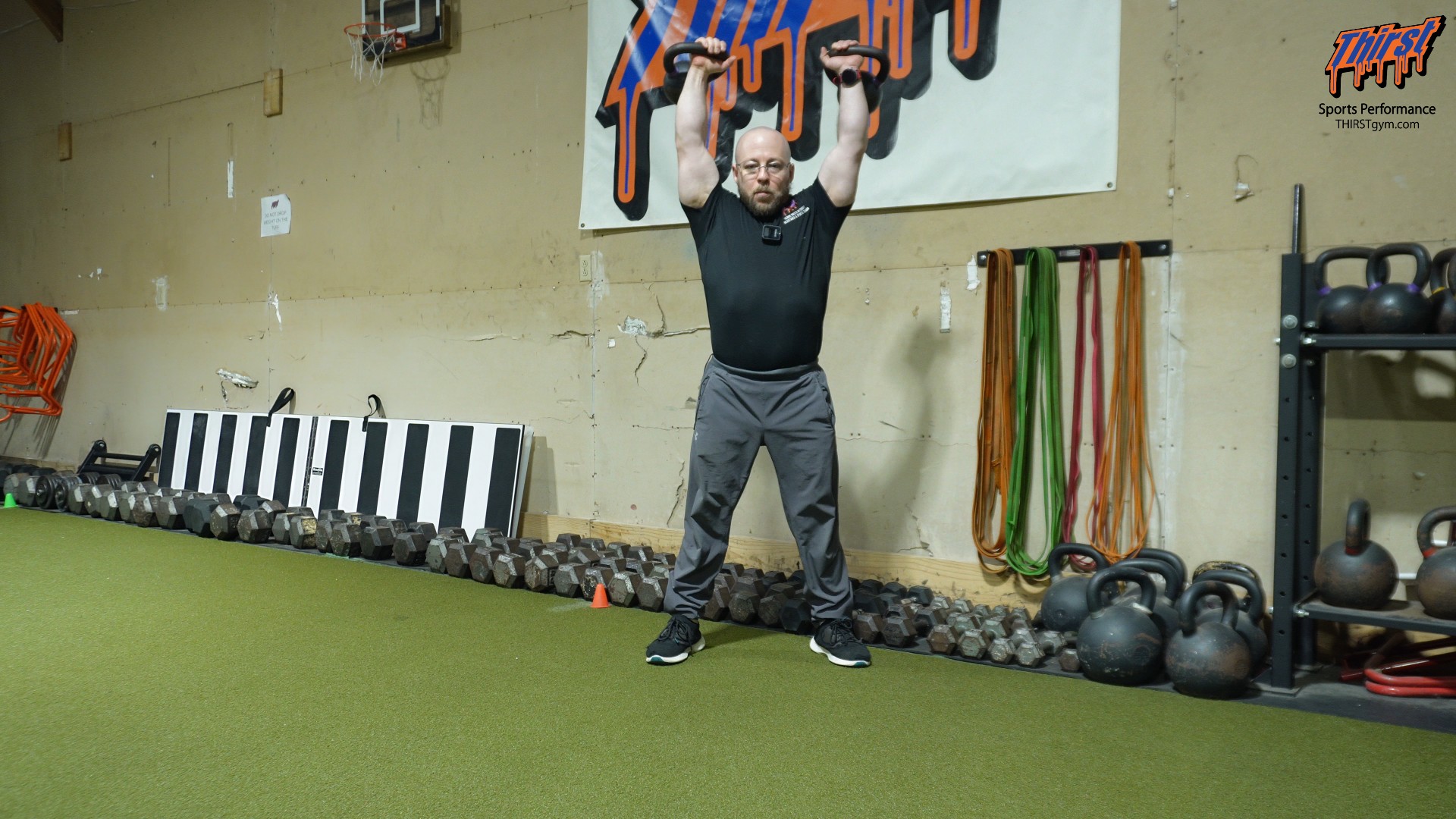
Double Kettlebell Clean to Push Press: Technique, Programming, and Coaching Cues
If you’re short on training time and want an exercise that builds strength, power, and conditioning at once, the double kettlebell clean to push press belongs in your program. This full-body kettlebell movement combines a powerful hip-driven clean with an explosive overhead push press, training the posterior chain, legs, core, shoulders, and triceps in a single fluid rep. Used correctly, it’s one of the best bang-for-your-buck exercises available to athletes, coaches, and everyday lifters.
This guide covers setup and technique, the biomechanics behind the movement, the most common mistakes, progressions and regressions, and how to program the exercise for either strength and power development or conditioning.
Watch the video below on how to maximize this exercise.
What Is the Double Kettlebell Clean to Push Press?
The double kettlebell clean to push press is a two-part movement performed with two kettlebells, ideally of the same weight. First, you clean both kettlebells from a hinge position into the front rack position. Then, without setting them down, you use a short dip and drive of the legs to press both bells overhead. The bells return to the rack, drop back into the hinge, and the next rep begins.
What makes this exercise so effective is that both halves are driven by hip extension. The clean uses a hip snap much like a kettlebell swing, and the push press uses a quick knee and hip extension to transfer force from the lower body through the trunk and into the arms. That is the same pattern of producing force from the ground up that shows up in sprinting, jumping, tackling, takedowns, and nearly every athletic skill.
You don’t need much to perform it: two kettlebells and enough space to hinge and press overhead safely.
Muscles Worked and Training Benefits
The clean portion trains the glutes, hamstrings, and spinal erectors through an explosive hip hinge, while the lats and upper back guide the bells into position. The push press brings in the quads, glutes, and calves during the drive, then the deltoids, triceps, and upper chest during the press. The entire time, the core and trunk work hard to keep the spine stable while two loads move independently.
The benefits reach well beyond the muscles involved. Because the movement demands rapid force production, it develops lower- and upper-body power. Because it trains the body as one connected system, it reinforces the ability to transfer force from the hips into the upper body, a quality that carries over to many sports. And because it involves a large amount of muscle mass, it raises the heart rate quickly, which makes it a strong conditioning tool when programmed correctly.
How to Perform the Double Kettlebell Clean to Push Press
Setup and Stance
Place the two kettlebells in front of you and take an athletic stance, slightly wider than hip width. This wider base gives the bells room to travel between your legs during the backswing without hitting your thighs.
The traditional method is for the bells to swing back between the legs, the same path as a double kettlebell swing. You can also clean from a more conventional position, with the kettlebells starting beside or just outside your feet, similar to a deadlift or suitcase-style pull. Both approaches work, so use the one that feels most natural and lets you move the most weight with the best positions. Most lifters will find the between-the-legs version more fluid for continuous reps.
Hinge at the hips with a flat back, grip both handles, and tension your lats before the first pull.
The Double Kettlebell Clean
Hike the bells back between your legs as if starting a swing. Then snap your hips forward aggressively. The hip extension, not the arms, should create the upward momentum.
As the bells float up, keep them close to your body and rotate your hands around the handles so the bells settle onto the outside of your forearms. The key is that your hands move around the kettlebells rather than the kettlebells flipping over your hands. A useful cue: finish with your fists positioned so that you could punch yourself in the face. That puts your wrists neutral, your knuckles up, and your forearms vertical.
In the front rack, the elbows stay tucked close to the ribs, the bells rest against the forearms and chest, and the torso stays tall with the ribs down. A solid rack sets up everything that follows.
The Push Press
From the rack, perform a short, quick dip by bending the knees a few inches while keeping the torso vertical and the heels down. Then drive hard through the floor, extending the knees and hips, and use that momentum to press both kettlebells straight overhead until the elbows lock out with the biceps near the ears.
This is not a squat. You shouldn’t sit into a deep or big squat to generate momentum. The dip is short and snappy, and the drive is violent. Think “dip, drive, press.” The legs start the bells moving, and the arms finish the lockout.
Lower the kettlebells under control back to the front rack, then let them drop back into the hinge for the next clean. Clean, dip, drive, press, back down, and repeat.
Breathing and Bracing
Take a breath and brace before each clean. Many lifters do best with a sharp exhale at the top of the hip snap, a quick reset of the brace in the rack, and a second forceful exhale during the drive and press. Holding a full, rigid brace for too many consecutive reps will fatigue you quickly, so find a breathing rhythm that keeps the trunk stable without leaving you gasping.
The Biomechanics: Why Hip Extension Drives Everything
The clean is essentially a kettlebell swing that ends in a different place. Instead of projecting the bells forward to chest height, you guide them up and into the rack. The force comes from a rapid hip extension, where the glutes and hamstrings contract explosively to drive the hips through.
The push press uses a similar principle. The quick dip loads the quads and glutes with a brief stretch, and the drive converts that elastic energy into vertical force. Because the legs can produce much more force than the shoulders, the push press lets you move heavier loads overhead than a strict press, and it trains the upper body to accept and continue force produced by the lower body.
That transfer is what makes this exercise valuable for athletes. A wrestler finishing a shot, a lineman driving through a block, and a volleyball player attacking the ball all rely on force that starts at the ground, travels through a stable trunk, and finishes through the arms. The double kettlebell clean to push press trains that chain directly.
Common Mistakes and How to Fix Them
Curling the Kettlebells Into the Rack
Pulling the bells up with the biceps turns a power exercise into an inefficient arm exercise and usually leads to a sloppy rack. Fix it by thinking of the clean as a swing with a short finish. Keep the arms relatively relaxed, let the hips create the momentum, and simply guide the bells into place.
Banging the Forearms
If the bells slam into your wrists on every rep, they are flipping over your hands instead of your hands moving around them. Keep the bells close to your body on the way up, and actively punch your hands through the handles as the bells rise so they settle softly.
Squatting the Hinge
Letting the knees drift far forward and turning the backswing into a squat takes the glutes and hamstrings out of the movement. Push the hips back, keep the shins more vertical, and feel tension in the hamstrings at the bottom of each hike.
Dipping Too Deep or Shifting Forward in the Push Press
A dip that is too deep or too slow bleeds away the elastic energy the push press depends on. A dip that shifts the weight to the toes or tips the chest forward sends the bells forward rather than up. Keep the dip short, keep the heels down, and keep the torso vertical so the drive goes straight up.
Pressing Before the Legs Finish
If the arms start pressing before the knees and hips reach full extension, you lose the benefit of the drive. Finish the leg drive first, then let the arms take over.
Overarching the Lower Back Overhead
Flaring the ribs and arching the lower back at lockout usually signals a load that is too heavy or limited shoulder mobility. Squeeze the glutes, keep the ribs down, and finish with the bells over the midfoot and the head slightly through the arms.
Progressions and Regressions
If you’re new to double kettlebell work, build the movement in stages rather than jumping straight into the full combination.
Start with the single kettlebell swing and single kettlebell clean to learn the hip snap and the hand position of the rack. From there, practice the double kettlebell swing to get comfortable managing two bells between your legs. Next, work the double kettlebell clean alone until your rack is consistent and your forearms stay quiet. Separately, practice the double kettlebell push press from a rack you set up deliberately. Once each piece is solid, combine them.
For regressions, a single kettlebell clean to push press, done one side at a time, reduces coordination demands and exposes asymmetries. Lifters with shoulder limitations can swap the push press for a landmine press while keeping the double kettlebell clean.
For progressions, increase the load, add a pause in the rack to challenge the trunk, or move toward the double kettlebell clean and jerk, which adds a rebend under the bells and allows heavier loads overhead. Advanced lifters can also build complexes, such as a clean, front squat, and push press, performed as one continuous sequence.
How to Program the Double Kettlebell Clean to Push Press
The most important programming decision is knowing your goal. This exercise can be used for strength and power or for conditioning, and the loading, reps, and structure look very different for each.
For Strength and Power Development
When the goal is full-body strength and power, keep the reps low and the kettlebells moderate to heavy. Aim for 3 to 6 sets of 2 to 5 reps, performed as a standalone exercise with ample rest between sets, often two to three minutes.
Every rep should be fast and explosive. Drive the bells up as powerfully as possible, chase a high-quality hip extension in the clean, and use the dip and drive to transfer that extension into the press. When bar speed slows or technique begins to break down, the set is over. Fatigue is not the goal here; quality and intent are.
Place the exercise early in the session, after the warm-up and any sprints or jumps, while the nervous system is fresh. It works especially well for athletes who need upper-body power, as well as for anyone short on time who wants the most training effect from a single movement.
For Conditioning
The double kettlebell clean to push press is also an excellent conditioning tool, particularly within mixed-modality work, because it gets a lot of work done in a short amount of time. For conditioning, use light to moderate kettlebells.
Even so, keep the reps relatively modest, generally 5 to 8 per round, with 8 on the high end. It’s tempting to program sets of 15 or 20 to crush people, but this is a technical movement, and technique breaks down quickly as fatigue builds. High-rep sets of a technical lift are where form deteriorates and injuries happen.
A smarter approach is to keep the kettlebells relatively heavy for 5 to 8 quality reps and pair the movement with other exercises, such as a bike sprint, sled push, rower, or bodyweight movement, that drive the heart rate up. The double kettlebell work will raise your heart rate quickly on its own, and the pairing makes the session demanding without forcing sloppy reps.
When possible, use controlled work and rest intervals. For example, perform 6 double kettlebell clean to push presses followed by 30 seconds on an assault bike, rest 90 seconds, and repeat for 5 to 6 rounds. The clean and press stays crisp, the bike drives up the conditioning demand, and the rest keeps quality high.
The exercise can also appear in chippers and other formats where reps accumulate over time. Whatever structure you use, the rules stay the same: keep the technique dialed in, stay safe, and don’t chase fatigue with excessive reps.
Who Should Use This Exercise?
For wrestlers, MMA fighters, and grapplers, the double kettlebell clean to push press builds the hip power and overhead strength endurance that carry over to finishing shots, lifting opponents, and hand fighting through the back half of a match. The conditioning version fits well into combat sport energy system work, especially when paired with carries, sled work, or sprawls.
For field and court athletes, including football players, volleyball players, and throwers, the power version develops the lower-to-upper-body force transfer these sports require. Kettlebells are also more forgiving on the wrists and shoulders than a barbell for many athletes.
Powerlifters can use it as a general physical preparedness tool during off-season blocks to build work capacity and shoulder health without heavily loading the spine.
General fitness clients will appreciate the efficiency. One movement trains nearly every major muscle group and elevates the heart rate, which makes it a strong choice for busy schedules.
Youth athletes and older adults can benefit as well, but they should start with the single kettlebell version and light loads, and spend more time on the progressions before moving to two bells. Swimmers and athletes with a history of shoulder issues should check that they can press overhead with good position and no pain before loading this movement.
Final Thoughts
The double kettlebell clean to push press is a simple setup with a big payoff. It combines an explosive hip hinge with a powerful overhead drive, building strength, power, and conditioning in one movement. Program it heavy and low-rep when the goal is power, keep it moderate and controlled when the goal is conditioning, and in every case let technique set the limit. Master the clean, own the rack, drive with the legs, and this exercise will earn a permanent place in your training.