
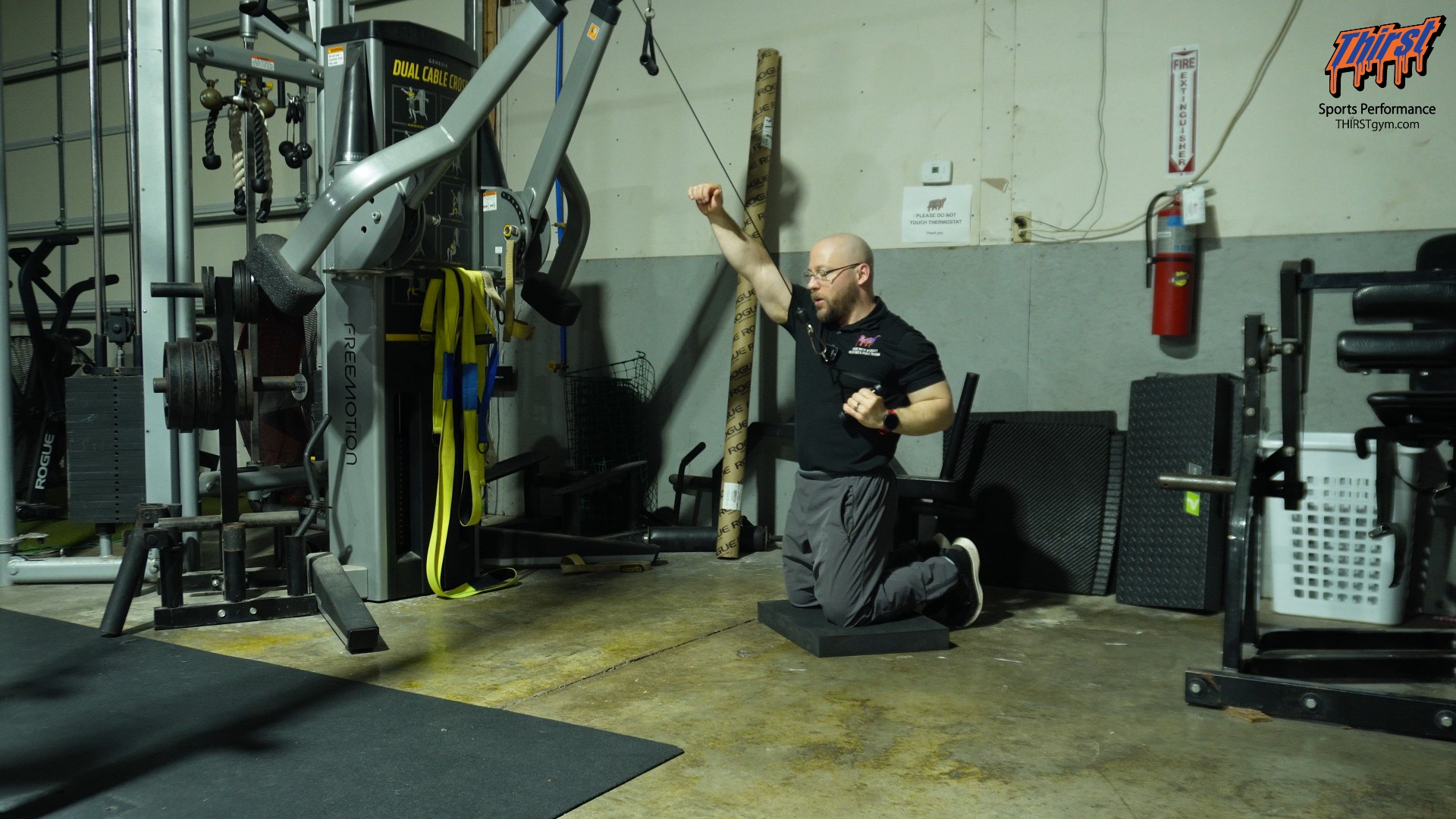
Tall Kneeling Single Arm High Cable Row with Opposite Reach: Technique, Benefits, and Programming
Some exercises exist to build as much muscle as possible. Others exist to teach the body how to work as one connected system. The tall kneeling single arm high cable row with opposite reach belongs in the second group, and that is exactly why it earns a place in so many training programs. It combines a pulling pattern, controlled trunk rotation, scapular movement, and a demanding hip and core position into one efficient drill.
For beginners who struggle to understand how the ribs and pelvis should line up, it is a practical teaching tool. For intermediate lifters, it links the upper and lower body in a way that carries over to bigger lifts. For stronger athletes pressed for time, it can prepare the upper body for bench press or overhead pressing in only a few sets. This guide covers how to set up and perform the exercise, what it trains, the mistakes to avoid, and how to program it.
Watch the video below on how to maximize this exercise.
What Is the Tall Kneeling Single Arm High Cable Row with Opposite Reach?
This exercise is a unilateral cable row performed from a tall kneeling position, with the cable anchored above head height. While one arm rows the handle down and back, the opposite arm reaches forward toward the cable’s anchor point, which allows the torso to rotate slightly through the upper back.
Three things happen at the same time. The pulling arm trains the lats and upper back through a high-to-low line of pull. The reaching arm drives the shoulder blade forward around the rib cage. The hips, glutes, hamstrings, and abdominals work to hold a tall, stacked position so that the rotation comes from the upper back rather than from the lower back or the hips.
Equipment and Setup
You need a cable machine with the pulley set in the high position. If your machine does not adjust all the way up, set it as high as possible so the cable starts somewhere above your head. Attach a standard single handle, often called a D-handle.
A foam balance pad, such as an Airex pad, placed under the knees makes the position far more comfortable, especially for longer sets. It is optional, but most lifters will appreciate it.
Face the cable stack and set up far enough away that the cable stays under tension when your arm is extended toward the anchor point. Grab the handle in one hand and lower into the tall kneeling position.
How to Perform the Exercise
Establish the Tall Kneeling Position
Kneel on both knees with your toes dug into the floor. Push your hips forward until your hips, shoulders, and knees form a straight line. Bring your ribs down so that you are not arching through the lower back. Squeeze your glutes and hamstrings hard enough to feel them working. You will probably feel your abdominals engage as well, which is normal and intended. This is your stacked position, and holding it is half the exercise.
Set the Arms
Hold the cable handle in one hand with the arm extended up and toward the machine. Bring your free hand in close to your chest. This is the starting position.
Row and Reach
Drive the elbow of the working arm down and back toward your hip, rowing the handle to your side. As you row, extend the free arm forward and up so it reaches toward the spot the cable handle just left, as if you were replacing it. Let your upper body rotate slightly as the rowing side pulls back and the reaching side moves forward.
Return with Control
Reverse the movement slowly. Let the rowing arm extend back toward the anchor while the reaching arm returns to your chest. Reset your position if needed and repeat for the prescribed repetitions before switching sides.
Throughout every repetition, the torso stays long and locked in. The glutes and hamstrings stay engaged. The rotation is small and controlled, coming from the upper back and shoulder blades rather than from twisting at the hips.
Coaching Cues That Clean Up Technique
A few simple cues solve most technique problems. Tell the athlete to “stay tall” so they grow through the crown of the head rather than sinking into the hips. “Ribs down” keeps the lower back from arching. “Squeeze the glutes” locks the pelvis in place and keeps the hips from drifting back. For the arms, “elbow to your back pocket” gives the row a clear finish point, while “replace the handle” gives the reaching arm a target and encourages the shoulder blade to glide forward.
What This Exercise Trains
Rib Cage and Pelvis Alignment
The biggest benefit of this exercise is how well it teaches a stacked position, with the rib cage sitting directly over the pelvis. Many lifters, especially those with excessive anterior pelvic tilt, default to an arched lower back with the ribs flared up. Telling them to fix it rarely works. Putting them in a tall kneeling position, where the arch has nowhere to hide, gives them immediate feedback on what a neutral position feels like.
Glutes and Hamstrings
In tall kneeling, the glutes and hamstrings hold the hips in extension and keep the pelvis from tipping forward. Lifters who have trouble feeling these muscles during hinges or squats often find them here, because the position makes the connection between hip extension and a neutral pelvis obvious.
Upper Back and Lats
The high cable angle creates a downward and backward line of pull, which brings the lats heavily into the movement alongside the rhomboids, mid-traps, and rear delts. Because the work is unilateral, it also exposes and helps address side-to-side differences in strength and control.
Rib Cage Mobility and Scapular Movement
The opposite reach is what separates this from a standard cable row. As the reaching arm extends, the shoulder blade glides forward around the rib cage, which engages the serratus anterior. As the rowing arm pulls back, the shoulder blade retracts and moves down. Combined with slight rotation through the upper back, this gets the rib cage moving and allows the scapulae to travel through a fuller range. It is a controlled way to improve upper body mobility while still requiring the whole body to stay connected.
Why the Tall Kneeling Position Matters
Kneeling removes the ankles and knees from the equation and takes away the ability to cheat with the legs. The narrow base forces the core and hips to stabilize every rep, and any compensation, such as sticking the butt out or leaning back, becomes obvious right away.
The trade-off is load. The tall kneeling position limits how much weight you can use, so this is not the exercise for chasing maximal loads. That limitation is part of its value. It keeps the focus on position and control, and you can add load gradually only as long as you can hold proper technique.
Common Mistakes to Avoid
Sitting the Hips Back
When the glutes switch off, the hips drift back and the lifter ends up partially sitting on their heels. This breaks the stacked position and removes much of the hip and core demand. Keep the hips pushed forward and the glutes squeezed.
Arching and Leaning Back
As the weight gets heavier, many lifters lean back and arch through the lower back to finish the row. This flares the ribs and moves the stress into the lumbar spine. If you cannot finish the rep without leaning, the weight is too heavy.
Twisting From the Hips
The rotation should come from the upper back. If the hips and pelvis twist along with the torso, the lifter has lost control of the lower half. Keep the belt line square to the machine.
Rushing the Reach
Throwing the free arm forward with no intent turns it into a passive gesture. Reach with purpose, feel the shoulder blade move around the rib cage, and control the return.
Loading Too Heavy
This is a movement quality exercise first. Adding weight at the cost of position defeats the purpose.
Who Should Use This Exercise
Beginners and Intermediate Lifters
For newer lifters, this exercise links together many skills at once, including core bracing, pelvic control, glute engagement, and scapular movement. It builds the positional awareness that makes squats, deadlifts, and presses easier to learn and safer to load.
Powerlifters and Strength Athletes
Stronger lifters can use it as part of an upper body warm-up before bench press or overhead pressing. A few sets get the upper back, lats, and shoulder blades moving and help set a stable rib cage position before heavier work. It is a time-efficient choice when a session is short, because it covers mobility, activation, and core work in one movement.
Wrestlers and Combat Sports Athletes
Wrestlers, grapplers, and MMA athletes constantly pull while rotating, often from the knees. Training the ability to pull hard through one arm while the hips and trunk stay controlled has direct carryover to those demands, and the rotational component builds control through the upper back and midsection.
Swimmers and Overhead Athletes
Athletes who spend a lot of time with the arms overhead benefit from the combination of lat work, serratus engagement, and controlled rib cage movement, all trained without forcing the lower back to compensate.
Older Adults and General Fitness Clients
Because loads stay modest and the kneeling position is stable, this is a good option for older adults and general fitness clients working on posture, upper back strength, and trunk control.
Regressions and Progressions
Regressions
If the full movement is too much to coordinate, remove the reach and perform a tall kneeling single arm high cable row only, with the free hand resting on the chest. Once that is solid, add the reach back in. Lifters who cannot hold tall kneeling can start in a half kneeling position, which offers a wider base, before moving to both knees.
Progressions
Once technique is consistent, add load gradually. You can also slow the lowering phase to three or four seconds or add a brief pause at the end of each row. When the goal shifts toward building the lats and upper back, move to heavier variations such as standing single arm cable rows, chest-supported dumbbell rows, or pulldowns, where position is less limiting and load can rise.
How to Program the Tall Kneeling Single Arm High Cable Row with Opposite Reach
Perform two to four sets of eight to twelve repetitions per side. Choose a weight that lets you finish every rep without losing the stacked position, leaning back, or letting the hips drift.
The exercise works in several places within a session. It can go in the warm-up before an upper body day to prepare the upper back and shoulder blades. It can serve as an accessory after main lifts, where it reinforces position and control. It also pairs well with a pressing movement in a superset, since the pulling and reaching demands complement the pressing pattern.
For beginners and intermediates, keep the emphasis on movement quality and consistency. For advanced lifters, use it as preparation and move to heavier rowing variations when lat development is the priority.
Final Thoughts
The tall kneeling single arm high cable row with opposite reach is not about moving huge weight. It teaches the ribs and pelvis to stay stacked, gets the glutes and hamstrings involved, trains the upper back and lats, and improves how the shoulder blades move around the rib cage, all in one efficient exercise. Whether you are a beginner learning to control your trunk, an intermediate lifter connecting your upper and lower body, or an experienced athlete preparing for a heavy press, it covers a lot of ground in very little time.