
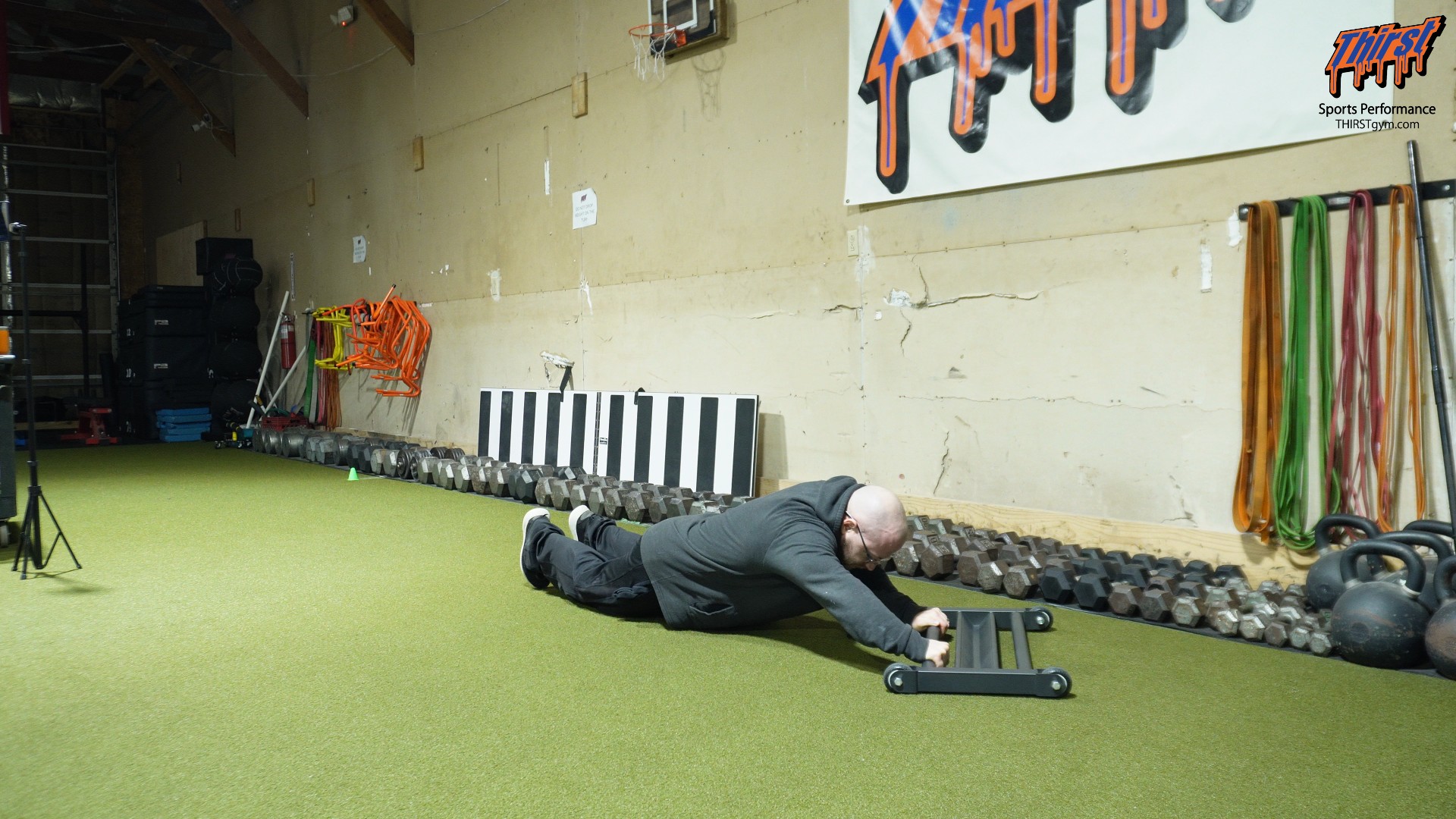
Glute Ham Roller Three-Way Ab Fallout: Technique, Muscles Worked, and Programming
If the standard ab wheel rollout or barbell fallout has gotten easy, the answer isn’t more reps. It’s a harder problem for your trunk to solve. The glute ham roller three-way ab fallout does exactly that by taking a proven anti-extension core exercise and adding direction. Instead of rolling straight out and back, you roll to the right, down the middle, and to the left, forcing your abs, obliques, lats, and shoulders to control your position through three different lines of pull.
Watch the video below on how to maximize this exercise.
What Is the Glute Ham Roller Three-Way Ab Fallout?
The three-way ab fallout is an advanced progression of the traditional ab wheel fallout or barbell rollout. You kneel behind a glute ham roller, hold the handles, and roll out into a long, extended position before pulling yourself back to the start. What makes it “three-way” is that each repetition includes three separate fallouts: one angled to the right, one straight ahead, and one angled to the left.
A straight fallout is primarily an anti-extension exercise, meaning your abs work to keep your lower back from arching as your arms travel overhead. Once you start veering off to one side, you add anti-lateral flexion and anti-rotation demands on top of that. Your trunk now has to resist being pulled into extension, bent sideways, and twisted, all at once. That’s a lot closer to what your core actually deals with in sport and under a heavy barbell.
Equipment You’ll Need
You need a glute ham roller or a similar rolling apparatus, plus a little open floor space in front of and beside you. Most glute ham rollers have handles through the center, which makes this an easy crossover use for a tool you may already own for hamstring work. If yours doesn’t have handles, place your hands on the middle portion of the plate itself. That works just fine.
A pad or folded mat under your knees is a good idea, since you’ll be spending the whole set on them.
The Start Position Sets Up Everything
Start on your knees. I think most people should do this exercise from their knees, period. Very few people have the trunk strength to perform a fallout from their feet with proper technique, and this variation is already plenty challenging when it’s done right.
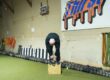
The most important detail in the setup is hip position. Bring your hips forward so your butt isn’t sticking out behind you. Think about squeezing your glutes, tucking your ribs down, and creating a straight line from your knees through your hips to your shoulders. From there, lean forward into the roller so your weight is loaded onto your hands before you ever start moving.
The reason this matters is simple. If you start with your hips pushed back, the first half of the rep is just your hips catching up to your shoulders, and your abs don’t do much of anything. When your hips start forward and stay forward, your trunk is under tension from the first inch of the rollout to the last.
How to Perform the Three-Way Ab Fallout
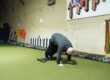
From your start position, reach out and let the roller travel away from you at an angle toward your right. Get as long as you can while keeping your hips underneath you and your lower back from sagging. Push into the handles, pull yourself back to the start, and reset your position.
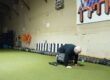
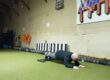
Next, go straight down the middle, just like a traditional fallout. Reach long, own the end position, and pull back.
Finally, veer out toward your left, reach as far as you can control, and return. That’s one repetition. From there you go back around the clock: right, middle, left.
Breathe in and brace before each rollout, keep that brace through the long position, and exhale as you pull back in. Move at a controlled pace on the way out. The lengthening portion of the rep is where most of the value is, so don’t rush it.
How to Steer the Roller
To get the roller to turn, you have to reach harder with the hand opposite the direction you want to go. It works like a steering wheel. If you want to veer right, your left hand reaches farther and drives the roller around. If you want to veer left, your right hand does the reaching.
This isn’t just a steering trick. That harder reach gets the shoulder moving and lets the scapula travel the way it’s supposed to when your arm goes overhead. It also puts the entire side of your body on that reaching arm into a long position. Your lat, your QL, and your obliques all get lengthened under tension, and then they have to help pull you back. That combination of getting long and staying strong is what makes this variation so valuable.
Muscles Worked and Why the Angles Matter
The rectus abdominis does the heavy lifting on every fallout by resisting lumbar extension as your arms move away from your body. The obliques and QL pick up a much bigger share of the work on the angled reps, since they’re controlling side bending and rotation while being stretched. The lats are loaded throughout, both as they lengthen overhead and as they help pull the roller back in. The serratus anterior and the muscles around the shoulder blade work to control the scapula during the reach, and the glutes stay on the entire time to hold your hips forward.
The takeaway is that you’re training the trunk and shoulders as a connected system through a long range of motion. For anyone who spends a lot of time in shortened, braced positions, that loaded length through the lats and lateral trunk is a big benefit on its own.
Common Mistakes to Avoid
The first mistake is letting the hips drift back. If your butt shoots behind you as the roller moves out, you’ve turned the exercise into a hip hinge and taken your abs out of it. Keep the hips forward and let your whole body travel as one piece.
The second is going farther than you can control. If your lower back sags or you feel the rep in your lumbar spine instead of your abs, you’ve gone too far. Shorten the range until you can hold position, and earn the extra inches over time.
The third is steering by twisting your torso rather than reaching. The turn should come from the opposite hand reaching longer, not from cranking your shoulders and hips around.
The fourth is doing too many reps, which leads right into programming.
Sets, Reps, and Programming
Because every repetition contains three fallouts, the volume adds up fast. Five reps is really fifteen rollouts. Don’t program this one for high reps.
I like starting people with two to three repetitions per set and building toward four to five over time. That’s where I keep it myself. Two to three sets is plenty, and you can plug it into any training session that works for you. It fits well at the end of a lower or upper body day as your primary core movement, or paired with an accessory exercise that doesn’t heavily tax the lats and abs.
Progress by adding range of motion and cleaner control first, then reps. Once you can do three sets of five with a full reach in all three directions and no loss of hip position, you’ve built a serious trunk.
Regressions and Progressions
If you can’t yet hold your hips forward through a straight fallout, this isn’t your exercise yet. Build up with stability ball rollouts, which shorten the lever and give you a more forgiving surface, then move to a standard kneeling ab wheel or barbell fallout. Rolling toward a wall so it stops you at a set distance is a great way to control range while you build strength.
Once the straight fallout is solid, the three-way version is the next step. From there, you can progress by slowing the lowering phase, adding a pause at full reach, or widening the angle of your right and left reps. Again, stay on your knees. Going from your feet adds far more risk than reward for almost everyone.
Who Should Use This Exercise
Wrestlers and combat sports athletes get a lot out of this one, because they constantly have to stay strong through the trunk while reaching at odd angles, whether that’s sprawling, scrambling, or fighting for position. Powerlifters benefit from the combination of lat engagement and anti-extension strength, both of which carry over to staying tight under a squat and locked in on a deadlift. Swimmers and overhead athletes get loaded trunk control in a long, arms-overhead position that mirrors what their sport demands. General fitness clients with a good training base can use it as a challenging step up from the basic ab wheel.
Beginners, youth athletes who are new to training, and older adults are usually better served by the regressions above until they’ve built the foundation.
The Bottom Line
The glute ham roller three-way ab fallout takes a great core exercise and makes it more complete. Start from your knees, get your hips forward, reach hard with the opposite hand to steer, and get as long as you can control in all three directions. Keep the reps low, keep the quality high, and run it for two to three sets. If you have questions about fitting it into your program, reach out.