
Hatfield Bulgarian Split Squat: How to Do It, Muscles Worked, and Programming
The Hatfield Bulgarian split squat is one of the most effective single-leg strength exercises you can add to your training program. By combining the classic Bulgarian split squat with the stability of a fixed support — typically band pegs or J-hooks mounted in a rack — and loading it with a safety squat bar, this variation removes the balance demand from the equation and lets you focus entirely on building lower body size and strength. Whether you’re an athlete looking to develop serious unilateral leg strength or a lifter chasing bigger quads and glutes, this exercise deserves a spot in your program.
Watch the video below on how to maximize this exercise.
Equipment You Need
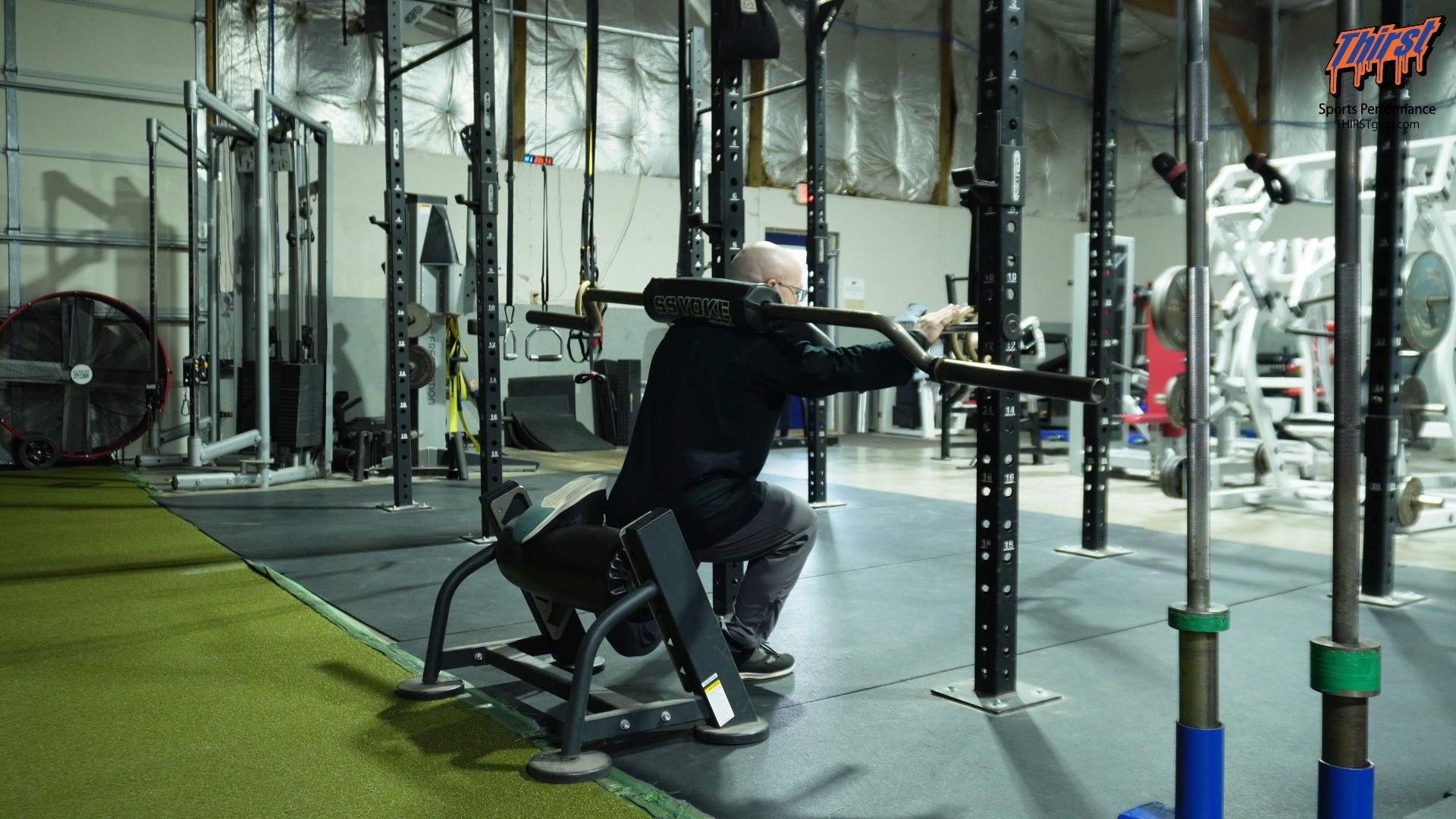
To perform the Hatfield Bulgarian split squat, you’ll need a few specific pieces of equipment. First, a safety squat bar is essential — it distributes the load across your upper back and shoulders more comfortably than a straight bar, and its cambered design helps you stay upright through the movement. Second, you need a split squat pad, utility bench, box squat box, or plyometric box to elevate your rear foot. Aim for something around knee height — not too high, not too low. Finally, you need something to hold onto for stability. Band peg attachments mounted in your rack or rig work great for this, though a barbell set in J-hooks on the opposite side of your rack is another solid option.
How to Perform the Hatfield Bulgarian Split Squat
Setting up correctly makes all the difference with this movement. Load your safety squat bar, get under it, and grab onto your band pegs or handles. Unrack the bar just like you would for a regular squat, then step back and place the top of your rear foot on your split squat pad. Your front foot should be positioned far enough forward that when you descend, your shin stays relatively vertical and your knee tracks over your toes.
From here, the execution is straightforward. Keeping your chest tall and your weight distributed across your entire front foot — heel heavy, but still maintaining full contact — descend into the split squat by bending both knees and lowering your rear knee toward the floor. Go down as deep as your mobility allows, then drive through your front foot to return to the starting position.
The key technical point Brandon emphasizes is that the handles are there purely for balance, not assistance. You should not be pulling or pushing through your arms to help yourself up. Your legs do the work. The grip on the handles simply takes the wobble out of the movement so you can load your lower body to its true limit without stability being the bottleneck.
Muscles Worked
The Hatfield Bulgarian split squat is a compound lower body movement that trains the entire front leg. The primary muscles targeted are the quadriceps, glutes, and hamstrings of the working leg. Because of the single-leg nature of the exercise, the hip stabilizers and adductors of the front leg also receive significant training stimulus. The safety squat bar places less stress on the wrists, elbows, and shoulders compared to a straight bar, making it a more joint-friendly loading option for the upper body while the legs absorb the full demand.
Why Use the Hatfield Variation?
The traditional Bulgarian split squat is a brutally effective exercise, but the limiting factor for many lifters is balance and grip — either the dumbbells or kettlebells become too heavy to hold, or the instability of the movement prevents loading the legs to their true capacity. The Hatfield variation solves both problems at once. By holding onto a fixed structure, you remove the stability variable and allow your legs to handle significantly more load than they could otherwise manage.
That said, if you’re an athlete, it’s still important to include some traditional unassisted single-leg work in your program. Hip stabilizer development matters for athletic performance and long-term joint health. Think of the Hatfield Bulgarian split squat as a complement to your training, not a replacement for balance-demanding movements.
Programming the Hatfield Bulgarian Split Squat
This exercise is versatile enough to serve as either a primary lower body movement or an accessory lift depending on your training goals.
As a main movement, treat it like you would a primary squat variation. Work in the three to five rep range for three to five sets per leg, pushing as heavy as you can while maintaining clean technique. This approach is particularly well-suited for athletes and strength-focused lifters who want to maximize single-leg force output without the complexity of a barbell back squat or front squat.
As an accessory movement, back off the load slightly and increase the rep range. Two to four sets of five to ten reps per leg will drive significant hypertrophy in the quads, glutes, and hamstrings. Be prepared — higher rep sets on this exercise are demanding on the cardiovascular system and will leave your legs sore the following day. That soreness is a sign the muscles are being challenged and adapting to the work.
Either way you program it, the Hatfield Bulgarian split squat is a proven tool for developing bigger and stronger legs. Add it to your training and give your lower body a new stimulus to grow.