
Toe Taps to Lateral Push Out: A Reactive Agility Drill for Athletic Change of Direction
Agility is one of the most talked-about qualities in sport, and also one of the most misunderstood. Walk into most training facilities and you’ll see athletes running pre-planned ladder patterns or memorized cone drills and calling it “agility work.” But true agility isn’t a choreographed dance you rehearse until it becomes automatic. True agility is the ability to perceive something happening in your environment, decide what to do about it, and move your body decisively in response — all inside a fraction of a second. The toe taps to lateral push out drill is built specifically to train that reactive quality, and it does so while simultaneously developing the ankle stiffness and tendon resilience that make explosive lateral movement possible in the first place.
This drill earns its place in a program because it bridges two worlds that usually get trained in isolation. On one side you have the low-level, high-frequency foot speed and tissue-preparation work that keeps athletes springy, durable, and ready to move. On the other side you have the higher-order reactive decision-making that determines whether an athlete can actually express those physical qualities when the game demands it. Toe taps to lateral push out stitches those two pieces together into a single, repeatable drill that’s deceptively simple to set up and surprisingly demanding to do well.
Watch the video below on how to maximize this exercise.
What the Drill Looks Like
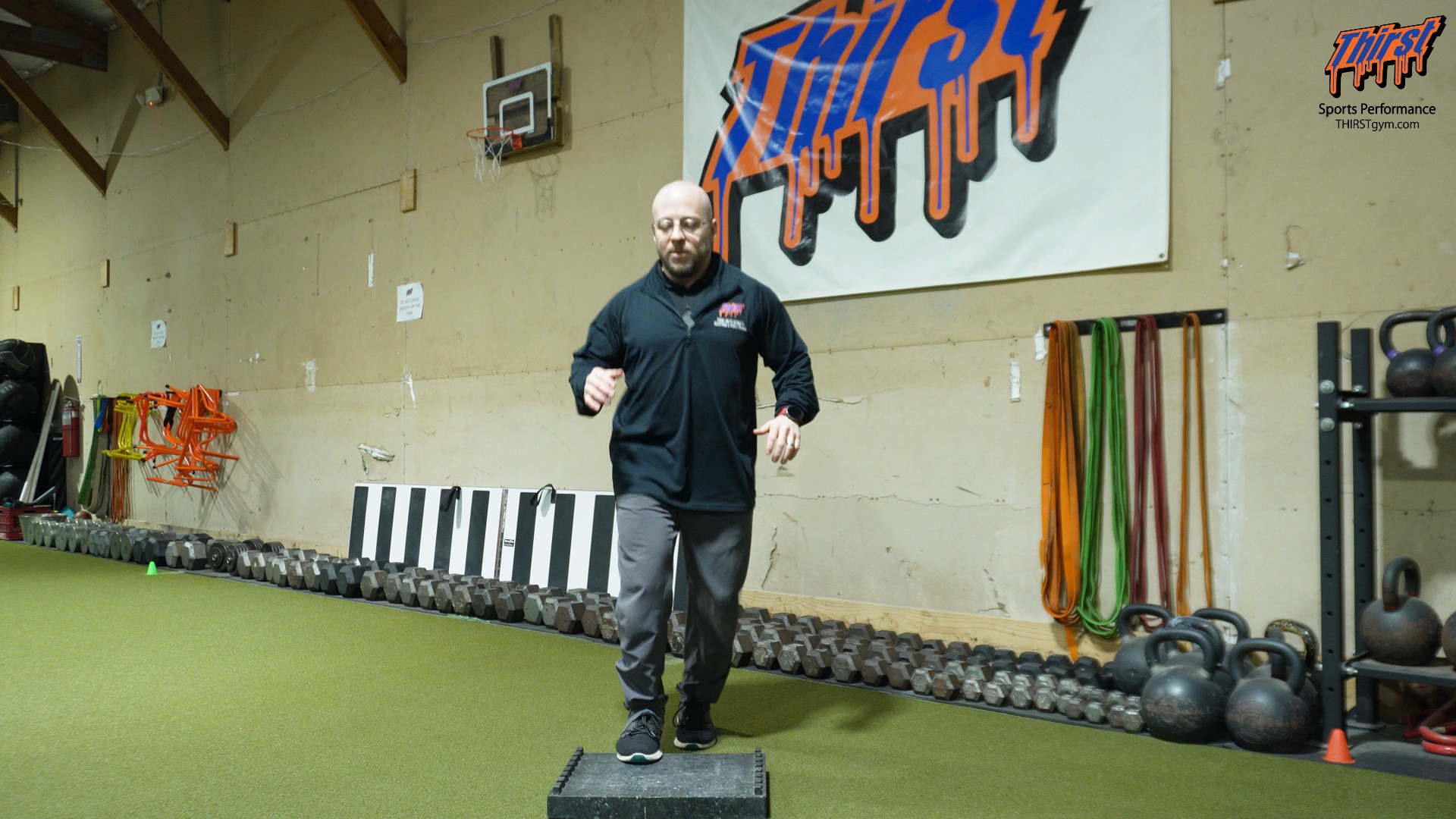
The setup couldn’t be more minimal. You need a low object roughly two to three inches tall — a small plyo box, a bumper plate, an aerobic step, or a sturdy block all work fine. You also need a few feet of open floor on either side so you have room to shuffle and push laterally without running into anything. That’s it. No ladder, no cones, no specialized equipment. The accessibility is part of the appeal, because it means the drill can live in a warm-up, in a movement-prep circuit, or as a standalone reactive station without disrupting the flow of a session.
The movement has two distinct phases. The first phase is the toe tap itself. The athlete stands tall in an athletic posture and alternates tapping the top of the box with the ball of each foot, switching feet as quickly as possible while staying upright and controlled. Think of it as a fast, rhythmic, low-amplitude foot exchange — not a stomp, not a big knee drive, just quick, light, springy contacts. This continues for a set window of time, typically five to ten seconds.
The second phase is the reaction. At a random point during the tapping, a stimulus fires — most commonly a timer beep, but it can just as easily be a coach’s verbal call or a hand signal. The instant that stimulus hits, the athlete has to read where their feet currently are and push laterally out of the drill in a designated direction. Because the feet are constantly alternating, the athlete can never pre-plan which leg will be loaded when the beep sounds. That uncertainty is the entire point, and it’s what separates this from a rehearsed pattern.
Ankle Stiffness and the Stretch-Shortening Cycle
Before the reactive layer ever comes into play, the toe tap portion is doing valuable work on its own. Rapid, low-impact foot contacts are one of the best ways to prepare the ankle complex, the Achilles tendon, and the surrounding connective tissue for the demands of athletic movement. Every time an athlete sprints, cuts, jumps, or changes direction, the lower leg has to absorb force and return it almost instantaneously. That ability to absorb and rebound efficiently is governed largely by tendon stiffness — and stiffness here is a good thing, not a limitation. A stiff, springy tendon stores elastic energy on impact and releases it to propel the next movement, much like a tightly wound spring.
High-frequency toe taps train exactly this quality. The contacts are quick and shallow, which keeps the impact low and the volume manageable, while still demanding that the ankle and Achilles cycle through rapid loading and unloading repetitions. Over time this kind of work helps build resilient tendons that tolerate the repetitive stress of practice and competition, and it primes the nervous system to keep the ankle “ready” rather than soft and collapsing. For athletes returning from lower-leg issues, or for younger athletes who simply haven’t developed much foot speed yet, this low-impact stimulus is an ideal entry point. It develops the springiness we want without hammering the joints.
It’s worth emphasizing that springiness is trainable. Athletes who feel heavy-footed or who seem to “stick” to the ground on direction changes often lack the ankle stiffness to redirect force quickly. Spending time on light, fast contacts like these — done consistently and with intent — chips away at that problem in a way that heavy lifting alone never will.
The Frontal Plane: The Direction We Tend to Neglect
The overwhelming majority of conditioning work happens in the sagittal plane — straight-ahead, forward-and-back movement like running, squatting, and most jumping. That’s fine, but it leaves a glaring hole, because a huge share of athletic moments and a frustrating number of non-contact injuries happen in the frontal plane, moving side to side. Cutting to evade a defender, shuffling to mirror an opponent, planting to redirect, sprawling laterally to defend a shot — these are frontal-plane events, and they place unique demands on the hips, knees, ankles, and the body’s ability to decelerate and re-accelerate sideways.
Toe taps to lateral push out is deliberately a frontal-plane drill. The toe taps themselves involve a subtle lateral exchange, and the push out is a pure side-to-side action. Training this plane intentionally teaches the body to produce and absorb force laterally, which is precisely the capacity most field and court sports demand and most programs underdevelop. By rehearsing the mechanics of getting sideways under a small dose of fatigue and reactive pressure, athletes build a more complete movement base than straight-line work alone can provide.
The Reactive Element: Why the Stimulus Changes Everything
Here’s where the drill goes from a decent tissue-prep exercise to a genuine agility tool. In the world of motor learning, skills are often divided into “closed” and “open” categories. A closed skill is performed in a predictable, unchanging environment — think of a pre-planned cone drill where the athlete knows the pattern in advance. An open skill is performed in a dynamic, unpredictable environment where the athlete must respond to changing stimuli — which is exactly what happens in live competition. Pre-planned drills are closed skills. Real agility is an open skill.
The timer beep transforms a closed exercise into an open one. Because the athlete is alternating feet and cannot predict when the stimulus will fire, they’re forced into a real perception-decision-action sequence. When the beep sounds, they have to register it, instantly assess which leg is currently loaded, recognize that they can’t push off the leg that’s up on the box, and then commit to pushing off the correct leg to drive laterally. That cognitive layer — “left leg is up, so I have to push off the right” — is the same kind of split-second processing an athlete does when reading a defender or reacting to a ball.
You can feel this cognitive load the first few times you try it. There’s a real moment of “wait, which leg do I go with?” That hesitation isn’t a flaw in the drill; it’s the drill working. You’re training the brain-to-body connection under time pressure, which is the part of agility that pre-planned work simply never touches. As the athlete repeats it, that decision gets faster and cleaner, and the reaction starts to feel automatic — which is exactly the adaptation we’re chasing.
Lateral Push Out vs. Lateral Bound: A Small but Important Distinction
It’s easy to hear “push out” and assume the goal is a big, maximal lateral leap. It isn’t. The push out is intentionally a modest, repositioning movement — what you might call a “big little push.” The athlete loads the appropriate leg and pushes just far enough to get their hips and feet displaced sideways, the way you would to get in front of an attacker, cut off a driving lane, or reposition to mirror an opponent. It’s about getting square and in position, not about covering maximum distance.
This is a meaningful coaching point. A full lateral bound is a different exercise with a different intent — it’s a power and distance expression. The push out here is a reactive repositioning, and treating it like a max-effort bound changes the quality of the movement and the adaptation you get. Coaches who have followed Lee Taft’s work will recognize this action as a redirectional step, and that’s a perfectly good way to think about it. The label matters less than the intent: a controlled, decisive push to relocate the body sideways in response to a cue.
Progressions and Variations
Once an athlete is comfortable with the basic lateral version, the drill scales in several directions. The most natural progression is the diagonal push out. Instead of pushing purely sideways off the ground, the athlete pushes off the box itself to drive diagonally backward — the kind of action you’d use to open the hips and chase an opponent who’s beaten you to a back angle. This adds a new vector and a new layer of decision-making. One important caution: because you’re now pushing off the box rather than the floor, the box has to be genuinely stable and able to handle that force. A wobbly or lightweight object becomes a hazard the moment you load it diagonally, so check your equipment before adding this variation.
For athletes or coaches who want more control over volume and symmetry, there’s a simple regression. Rather than reacting to a random beep, you can program a set number of toe taps per side before the push out. Because the feet alternate, counting taps guarantees an even number of contacts on each leg and ensures both sides get equal work. You lose the reactive element when you do this, so it’s not “true” agility in that moment — but it’s a useful way to introduce the pattern, manage fatigue, or satisfy the need for balanced loading before layering reaction back in.
Beyond those, you can vary the stimulus itself. A coach pointing left or right turns the beep into a visual reaction. Calling out a direction turns it into an auditory-processing task. Mixing lateral and diagonal cues within a single set forces the athlete to choose between multiple movement solutions on the fly. Each of these increases the open-skill demand and more closely mirrors the chaos of live play.
Common Mistakes to Watch For
The first and most common error is posture. Athletes tend to either stand too rigidly upright or collapse forward and round over as they fatigue. The target is a tall but athletic posture — chest up, eyes forward, hips loaded and ready — so that when the stimulus fires, the body is in a position to push immediately rather than having to reorganize first. Sloppy posture during the taps almost always leads to a slow, clumsy push out.
The second mistake is anticipating the beep. Some athletes, especially competitive ones, start subconsciously predicting when the stimulus will come and pre-load a leg in advance. The moment they do this, the drill collapses back into a closed, pre-planned skill and loses its reactive value. Randomizing the timing — and occasionally varying how long the tap window lasts — keeps athletes honest and keeps the reaction genuine.
The third is over-bounding. As discussed, the push out should be a controlled repositioning, not a maximal leap. Athletes who treat it as a long jump tend to lose balance on landing and need a big recovery step to get back under control, which defeats the purpose. Keep it tight, decisive, and recoverable.
Finally, watch the equipment. A low object that slides, tips, or flexes under load turns a clean drill into an injury risk. This becomes especially important with the diagonal variation where the athlete actively pushes off the object.
Programming the Drill: Timing, Volume, and Placement
The standard work window for the toe taps is five to ten seconds before the stimulus fires, and that range covers most athletes well. Five seconds keeps it crisp and reaction-focused; ten seconds layers in a bit of fatigue, which can be useful for athletes who need to make decisions when they’re tired. Because the rep ends with a reactive push, the reps will naturally be randomized — you can’t cleanly prescribe “three per side” without sacrificing the reactive quality, so think in terms of total reps or total work rather than rigid symmetry.
Placement matters. This drill is most valuable when the nervous system is fresh, so it belongs early in a session — in the movement-prep or warm-up block, or as a dedicated reactive station before heavy power or speed work. Reactive quality degrades quickly under deep fatigue, and the whole point here is fast, clean decision-making, so burying it at the end of an exhausting session undercuts its purpose. A handful of quality reps with full attention will always beat a long, sloppy grind.
In terms of who it’s for, this is a drill best reserved for more advanced athletes. It works extremely well for upper-level high school athletes and beyond who already have a base of coordination, foot speed, and movement competence to build on. Younger or less experienced athletes can absolutely use the toe taps on their own as a tissue-prep and foot-speed tool, then graduate to the reactive push out once they’ve earned the coordination to handle it. Layering reaction onto an athlete who hasn’t yet mastered the underlying movement tends to produce frantic, low-quality reps rather than the sharp, decisive ones we want.
Who Benefits Most
Combat sport athletes get enormous value from this drill. Wrestlers, grapplers, and mixed martial artists live in the frontal plane — circling, repositioning, sprawling, and reacting to an opponent’s level changes and shots. The reactive push out maps directly onto the constant, unpredictable lateral repositioning that those sports demand, and the ankle-stiffness work supports the explosive scrambles and direction changes that define a match.
Court and field sport athletes benefit just as much. Basketball players defending on the perimeter, soccer players mirroring an attacker, football defensive backs flipping their hips, and tennis players recovering across the baseline are all performing reactive lateral movements under time pressure. Training the perception-action loop in a controlled setting builds the foundation those moments draw on.
Even general fitness clients and recreational athletes can use a scaled version of the toe taps for ankle health, foot speed, and coordination, holding off on the reactive layer until it’s appropriate. The drill flexes to meet a wide range of needs, which is exactly what you want from a foundational movement tool.
Bringing It Together
Toe taps to lateral push out is a small drill that does a lot of work. It builds the ankle stiffness and tendon resilience athletes need to be springy and durable, it trains the frequently neglected frontal plane, and most importantly it introduces a genuine reactive element that turns a closed, rehearsed pattern into an open, decision-driven skill. That reactive component is what makes it real agility training rather than just patterned movement — and it’s the reason this drill is such a useful tool for preparing advanced athletes for the lateral change-of-direction demands of their sport.
Set up a low box, dial in your work window, randomize the stimulus, and keep the push out controlled and decisive. Layer in the diagonal variation as athletes progress, watch the common mistakes, and place the drill early in the session when the nervous system is sharp. Done with intent, it’s one of the more efficient ways to develop reactive lateral movement in a minimal-equipment setting.