
Band Resisted Cable Straight Arm Lat Pulldown: Build Bigger Lats and a Stronger Bench Press Setup
The straight arm lat pulldown is one of the most underrated movements in the gym. It is a clean, joint-friendly way to isolate the lats, teach proper shoulder mechanics, and build the kind of upper back strength that carries over to nearly everything else you do under a barbell. But here is the truth most lifters never realize: the standard version leaves a lot of potential on the table. With one small adjustment — a mini band looped around your wrists — you can dramatically increase how much your lats fire, recruit your triceps and posterior shoulder, and turn a basic accessory into one of the best back-priming exercises you can do before a heavy bench press.
This is the band resisted cable straight arm lat pulldown, and once you feel the difference, it is hard to go back to the regular version.
Watch the video below on how to maximize this exercise.
What Is the Band Resisted Cable Straight Arm Lat Pulldown?
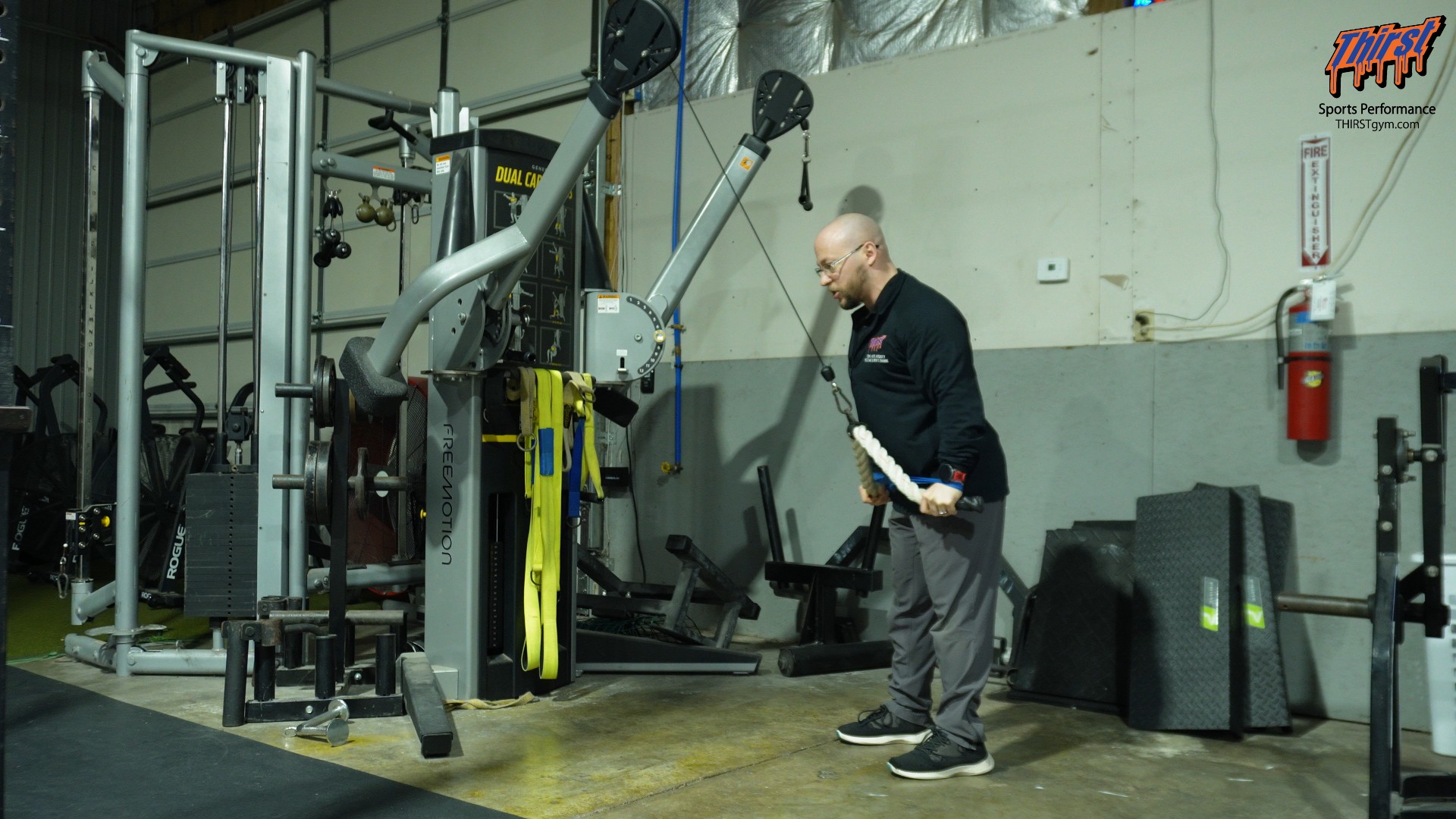
At its core, this is a straight arm lat pulldown performed on a cable machine with a rope attachment, with a light mini band wrapped around both wrists. You actively press out against the band the entire time you perform the movement, which forces your lats, rear delts, and upper back to work harder than they would with the cable alone.
The straight arm portion of the exercise trains shoulder extension — driving your arms from overhead down toward your hips while keeping the elbows relatively locked. That motion is almost entirely lat-driven, which is exactly why it is such a valuable movement for building back thickness and improving your ability to “find” your lats during big lifts. The band adds a second job: by pushing outward, you introduce a small amount of shoulder abduction and external rotation tension that recruits even more of the surrounding musculature. The result is a more complete, more demanding, and frankly more effective rep.
How to Set Up and Perform It
Setting this exercise up takes only two pieces of equipment beyond the cable machine itself, and the whole thing comes together in seconds.
Start by grabbing a small mini band. It does not need to be a heavy, high-tension band — the goal is simply to create enough resistance that you have to actively press out to keep it engaged. A light band is more than enough for most people. Loop it around both wrists so it sits snugly, and make sure you can maintain steady tension on it throughout the entire set.
Next, attach a rope to a cable machine and set the cable to the top position. Take an end of the rope in each hand and step back from the machine so the cable is loaded and there is no slack. Set your feet roughly square and find a tall, stable position.
From here, the first cue is the most important one: press out into the band. You should feel the band trying to pull your wrists together while you actively resist it. Keep that outward pressure the entire time. Now perform your normal straight arm lat pulldown — drive the rope down and slightly out toward your sides, leading with the lats, while continuing to pull the band apart. As you reach the bottom of the movement, you should feel a strong contraction through your lats, with a noticeable assist from your triceps and upper back. Control the rope back up to a long, lengthened starting position and repeat.
That combination of pulling down with the cable and pulling apart against the band is what makes this exercise so effective. You are no longer just moving weight — you are creating tension in multiple directions, which forces the back to engage in a much more meaningful way.
Why the Band Makes Such a Big Difference
If you have ever done a straight arm pulldown and felt it more in your shoulders or arms than your back, you are not alone. Many lifters struggle to truly feel their lats working, and that is where the band changes the game.
When you press outward against the band while pulling the rope down, you create what is essentially a co-contraction — multiple muscle groups firing at once to stabilize and produce force. This taps into a principle strength coaches refer to as irradiation, where tension in one area increases muscle recruitment in the surrounding areas. By giving your hands and arms something to actively press against, you “wake up” the entire upper back and posterior shoulder. The lats respond by contracting harder, the rear delts and mid-back kick in to control the outward pressure, and even the triceps get involved as they help stabilize the straight-arm position.
The end result is a rep where you can actually feel your back working the way it is supposed to. For lifters who have spent years chasing a stronger mind-muscle connection with their lats, this single tweak often does more than dozens of cues ever could.
How It Builds a Better Bench Press
Here is where this exercise becomes especially valuable, and why it deserves a spot in the warm-up of anyone who cares about pressing strength.
A strong, stable bench press starts long before the bar leaves the rack. It starts with the setup — specifically your ability to set your upper back, retract and depress your shoulder blades, and create a tight, supportive base to press from. Lifters who fail to set their back properly tend to lose tightness, drift out of position, and leak power on every rep. The fix is learning to engage and “turn on” the upper back before you ever touch the barbell.
The band resisted straight arm lat pulldown is a near-perfect tool for this. The movement teaches you to actively engage your lats and pull your shoulders into a strong, packed position — exactly the feeling you want to recreate when you set up on the bench. Using it as a primer before your pressing work helps you find that position, get blood flowing into the upper back, and rehearse the tension you need before you load up your heavy sets. By the time you lie down on the bench, your back is already switched on and you know exactly what a properly set upper back should feel like.
In other words, it is not just a back exercise. It is a way to bench more weight, more safely, with better positioning.
Common Mistakes to Avoid
Like any exercise, the band resisted straight arm lat pulldown is only as good as your execution. A few common errors will rob you of the benefits.
The first is letting the band go slack. The entire point is to maintain constant outward pressure, so if your wrists drift together and the band loses tension, you have essentially turned it back into a regular pulldown. Keep pressing out from the first rep to the last.
The second mistake is bending the elbows excessively and turning the movement into a triceps pushdown. While you will feel some triceps involvement — and that is normal and even desirable — the elbows should stay relatively locked so the lats remain the primary driver. A slight, fixed bend is fine. A pumping, bending-and-extending elbow is not.
The third issue is cutting the range of motion short. You want to start from a long, lengthened position overhead so the lats are fully stretched, then pull all the way down to a complete contraction. Shortening the top of the movement means you lose the stretch that makes the exercise so productive.
Finally, avoid the temptation to go too heavy. This is a movement built on feel and control, not maximal load. Lighter weight done with intent will always beat heavy weight done with sloppy mechanics here.
How to Program It
How you program this exercise depends on what you are trying to get out of it, and it fits neatly into two main roles.
If you are using it as a primer before bench press or other pressing work, keep it light and focused. Two to three sets of ten to fifteen repetitions is plenty. The goal is not fatigue — it is activation. You want to turn the upper back on, get some blood flow into the area, and rehearse that strong, set-back position before you move into your heavier work. Treat it as a rehearsal, not a workout in itself.
If you are using it as a general accessory exercise to build lat strength and back development, you have a bit more room to push. Two to four sets of ten to twenty repetitions works well. Again, the emphasis should stay on quality reps: a long, lengthened starting position, constant outward pressure on the band, and a strong contraction at the bottom of every rep. As long as you are feeling your lats work through a full range of motion, you are in a great spot.
In both cases, the band stays light and the load stays controlled. This is an exercise where intent and execution matter far more than the number on the stack.
Who Should Be Doing This Exercise
The beauty of this movement is its versatility. Beginners benefit from it because it teaches them how to find and feel their lats — a skill that pays off across every pulling and pressing movement they will ever do. Powerlifters and serious bench pressers benefit from it as a setup primer and upper back builder. Combat sports athletes, wrestlers, and grapplers benefit from the added lat strength and shoulder stability that translate to pulling, controlling, and finishing positions on the mat. And general fitness clients benefit from a low-stress, joint-friendly way to build a strong, healthy back.
If you have access to a cable machine and a single mini band, there is almost no reason not to add this to your training.
Final Thoughts
The band resisted cable straight arm lat pulldown proves that small adjustments can produce outsized results. By simply adding outward band tension to a movement you may already be doing, you increase lat activation, recruit more of the upper back, and create a powerful tool for setting your back before you bench. Whether you use it as a pre-press primer or a dedicated accessory, it is one of the simplest ways to level up the effectiveness of your training.
Give it a try in your next session, focus on feeling your upper back do the work, and pay attention to how much more dialed-in your bench press setup feels afterward. If you have any questions about this exercise or how to fit it into your program, drop them in the comments — and as always, train hard and train smart.