
The Prone IYTW Complex: A No-Equipment Exercise for Bulletproof Shoulders
If you’ve ever finished a heavy bench press session with cranky shoulders, watched a young athlete struggle to “feel” their upper back, or simply found yourself in a hotel room with no equipment and a workout to get through, the prone IYTW complex deserves a spot in your toolbox. It’s one of those humble, unglamorous movements that doesn’t look like much but quietly does a lot of work — and the best part is that you can do it anywhere there’s floor space.
At THIRST Gym in Terre Haute, Indiana, I use this exercise across a wide range of clients, from seven-year-olds learning how to control their own bodies for the first time to seasoned powerlifters and combat athletes who need their shoulders to hold up under serious load. It’s not the flashiest thing in my programming, and as you’ll read below, it’s not always my first choice. But it earns its keep, and once you understand why it works and how to do it correctly, you’ll know exactly when to reach for it.
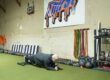
Watch the video below on how to maximize this exercise.
What Is the Prone IYTW Complex?
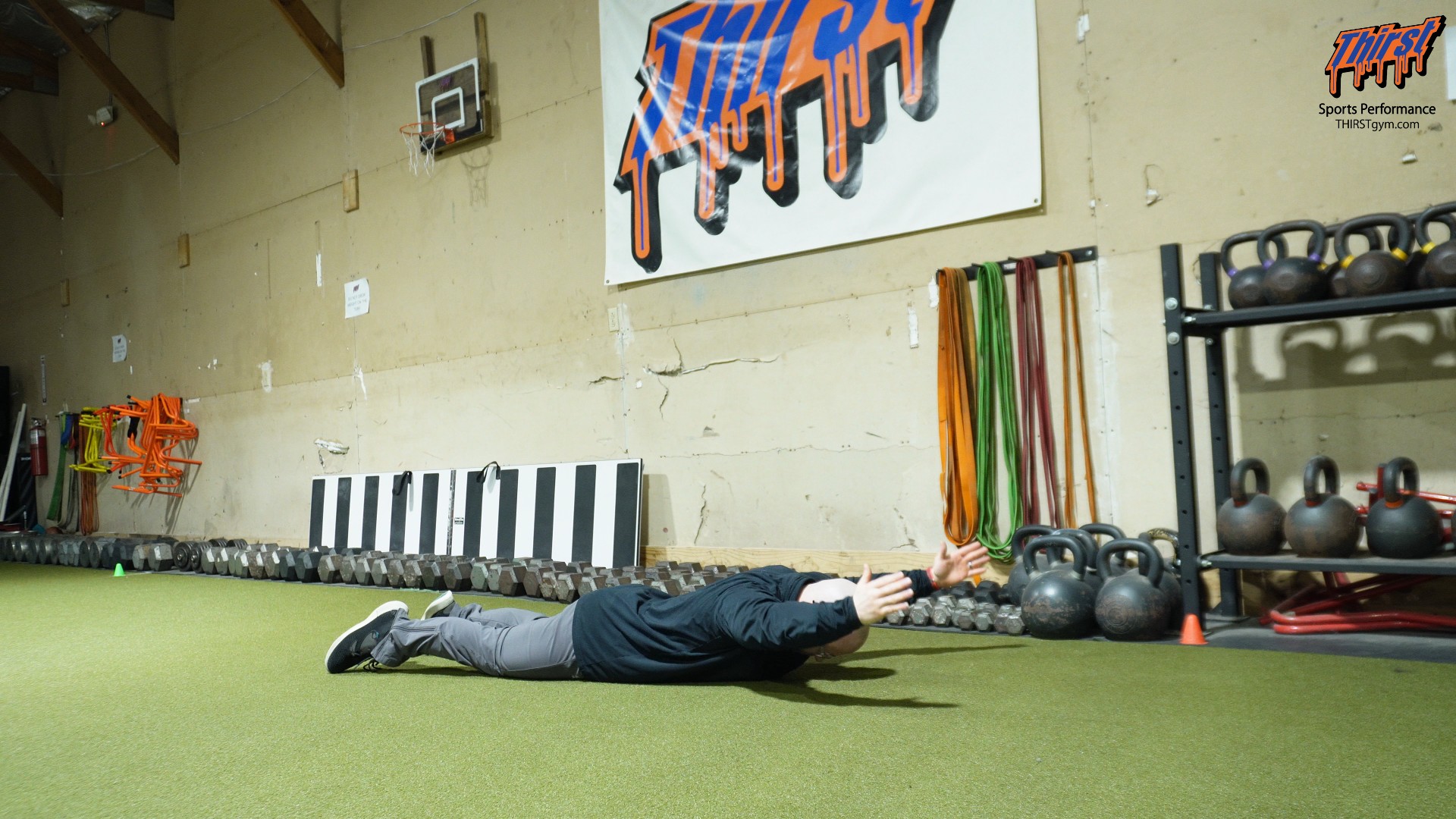
The prone IYTW complex is a bodyweight scapular stabilization drill performed lying face-down on the floor. The name comes from the four arm positions you move through — the letters I, Y, T, and W — each of which targets the muscles of the upper back and shoulder from a slightly different angle. You lift your arms off the floor to spell out each letter, hold the contraction, and then move to the next position.
That’s it. No bands, no dumbbells, no cables, no bench. Just your body and the ground. It’s an exercise you can do at home, in a hotel, on a wrestling mat, in your garage, or in the middle of a gym floor while you wait for a rack to open up.
What makes it valuable isn’t the difficulty — it’s the targeted activation. Each letter biases a different region of the scapular stabilizers and shoulder musculature, so by the time you’ve worked through all four, you’ve touched nearly every muscle responsible for keeping your shoulder blades moving well and your shoulders healthy.
The “Why”: Which Muscles You’re Actually Training
To understand why the IYTW complex is worth doing, you need to understand what your shoulder blades are supposed to do. Your scapulae aren’t just bones that sit on your back — they’re floating platforms that glide, rotate, tilt, and stabilize every time you reach, press, pull, or throw. When the muscles controlling them are weak, slow to fire, or poorly coordinated, the shoulder joint loses its stable base. That’s when you start seeing impingement, nagging front-of-shoulder pain, and athletes who “can’t find” their back during pulling movements.
The IYTW complex trains the muscles that govern that platform:
The lower and middle trapezius are the workhorses here, especially in the Y and T positions. These fibers depress and retract the shoulder blades and assist in upward rotation — exactly what you need when you lift your arms overhead. They’re chronically underused in most people, who tend to live in their dominant, overactive upper traps instead.
The rhomboids sit between your spine and your shoulder blades, and they retract and stabilize the scapula. They light up most in the T and W positions, where you’re squeezing the shoulder blades together.
The posterior deltoids assist in horizontal abduction and external rotation, contributing across the T and W.
And in the W position especially, the external rotators of the rotator cuff — the infraspinatus and teres minor — get involved, which is a big reason this drill earns its reputation as a shoulder-health exercise rather than just an upper-back one.
When you train these muscles to fire on command, you improve scapular control, posture, and overall shoulder stability. For an athlete, that translates to a more stable base for pressing and throwing. For a general fitness client, it often means fewer aches and a stronger, more upright posture. The point of the exercise is not to build big muscles — it’s to wake up and coordinate the small, often-neglected ones that keep your shoulders working the way they should.
How to Perform the Prone IYTW Complex
Find a comfortable spot on the floor and lie face-down on your belly. Rest your forehead lightly toward the ground and keep your head in a neutral position throughout — you don’t want to crank your neck up to watch your hands. Keep a gentle brace through your midsection so your lower back doesn’t arch as you lift, and let your legs stay relaxed on the floor.
From here, you’ll move through the four letters in sequence. For each one, you lift your arms off the floor, hold the top position for at least a one-count, and then lower back down with control before moving to the next letter.
The “I”: Start with your arms extended straight overhead, narrow and in line with your torso — roughly biceps-by-the-ears. Turn your thumbs toward the ceiling. Reach up and lift your arms as high as you can without shrugging or arching, hold the top, then lower. This position emphasizes the lower traps and challenges overhead scapular control.
The “Y”: Now widen your arms to roughly a 45-degree angle from your torso so your body forms a “Y.” Keep your thumbs pointing up and your arms relatively straight. Lift, hold at the top, and lower. The Y is one of the best positions you can find for targeting the lower trapezius.
The “T”: Bring your arms straight out to your sides so they’re perpendicular to your torso, forming a “T.” You can keep your thumbs up or turn your palms down to the floor — that’s a personal preference, and both are fine. Squeeze your shoulder blades together, lift your arms off the ground, hold, and lower. This position hits the mid-traps, rhomboids, and rear delts hard.
The “W”: Finally, bend your elbows to roughly 90 degrees and draw them down and back toward your lower ribs, so your arms form a “W.” This is where you’ll feel the retraction and external rotation most. Pull your shoulder blades down and together, hold the contraction, and release.
That completes one rep of the complex. Move through all four letters in order, and treat each position as its own deliberate effort rather than rushing to connect them. You’re chasing quality isometric contractions, not speed.
The Most Common Mistakes
The IYTW complex looks simple, which is exactly why people get sloppy with it. A few things to watch for:
Using momentum instead of muscle. The whole point is the controlled lift and the hold. If you’re swinging your arms up and bouncing them down, you’ve turned a precise activation drill into a flailing exercise that trains nothing well. Slow down and own each position.
Letting the upper traps take over. If you feel this primarily in the tops of your shoulders and the base of your neck, you’re shrugging instead of recruiting the lower and middle traps. Think about pulling your shoulder blades down your back, not up toward your ears.
Arching the lower back. When the upper back muscles are weak, people compensate by hyperextending the lumbar spine to “help” the arms come up. Keep a light brace through your core and let the movement come from your arms and shoulder blades, not your low back.
Cranking the head up. Lifting your chin to watch your hands stresses the neck and breaks your position. Keep the head neutral, eyes toward the floor.
Skipping the pause. The isometric hold is doing most of the work. Without it, you’re just waving your arms around. Hold every position honestly.
How to Make It Harder
For most healthy adults, the bodyweight version is genuinely easy — and that’s by design when you’re using it as a warm-up. But if it feels too easy and you want more out of it, you have two reliable ways to dial up the intensity.
The first is to add a small amount of weight. I’m not talking about heavy dumbbells — one, two, or three pounds in each hand is plenty to transform this from a gentle activation drill into something that genuinely challenges the upper back. Light plates or small dumbbells work well. A little resistance goes a long way here because these muscles are small and you’re working them in a shortened, disadvantaged position.
The second is to extend the holds. Instead of a quick one-count at the top of each letter, hold every single position for a slow three-to-five-second count. That dramatically increases the time under tension and the demand on those stabilizers, and it’s a great way to make the complex more challenging without adding any equipment at all. If you’re using this purely as a warm-up before you go lift or train, lengthening the holds is often the smartest way to scale it.
Where the IYTW Complex Fits in Your Training
I program this exercise primarily as a preparatory drill or warm-up, and that’s where it shines. Because it requires no equipment and almost no setup, it’s a perfect thing to slot in before you bench press, before an overhead session, before throwing, or before any athletic activity that’s going to demand a lot from your upper body. You’re warming up the tissues, getting the scapular stabilizers firing, and preparing the shoulder for the heavier work to come.
A reasonable starting point is two to three rounds through the full complex, holding each letter for one to three seconds, before your main upper-body work. If you’re adding light weight or extending the holds, you may only need a single quality round to feel the difference. Listen to the muscles — when you feel the upper back switch on, it’s done its job.
You can also use it as accessory work on its own, particularly with the loaded and longer-hold variations, on days when you want a little extra shoulder-health volume without taxing the bigger lifts.
An Honest Coaching Take: When This Isn’t My First Choice
I’ll be straight with you, because that’s how I coach: for most people in most situations, there are better options for building the upper back and bulletproofing the shoulders. If I have access to equipment and a healthy adult in front of me, I’d generally rather have them work through a full range of motion with a chest-supported row variation, or hammer face pulls and band pull-aparts to develop the upper back and overall shoulder stability. Those movements load the muscles through a longer range and tend to deliver more bang for your buck.
So why teach the IYTW complex at all? Because it’s about the right tool for the right moment. When you’re limited on space, equipment, or access — traveling, at home, stuck in a busy gym — this is meaningfully better than doing nothing. It’s low-hanging fruit. You can get a real dose of shoulder-health work with nothing but the floor.
It also has a special place in group and youth settings. I work with seven-to-nine-year-olds in small groups from time to time, and the IYTW complex is fantastic for teaching them proprioception — how to feel, find, and actually activate the muscles of their back. These young athletes often have no idea how to recruit those muscles, and this drill is something I can run with a large group on a whistle or a command, getting everyone some shoulder-health work and body awareness at the same time. For coaches managing groups, that simplicity is a feature, not a bug.
Who Should Use the Prone IYTW Complex
Because it’s so adaptable, this exercise serves a remarkably broad range of people.
Powerlifters and pressing athletes can use it as a quick, equipment-free warm-up to prime the upper back and shoulders before bench day, helping create a more stable platform for the press.
Combat sports athletes — wrestlers, grapplers, and MMA fighters — put enormous demands on their shoulders, and a no-equipment activation drill they can run on the mat before training is genuinely useful. It’s also easy to deploy across a whole training group.
Throwing and overhead athletes benefit from waking up the scapular stabilizers and external rotators before they start launching anything.
Youth and developmental athletes get an accessible introduction to controlling their own bodies and learning where their back muscles even are — a foundational skill that pays off for years.
General fitness clients dealing with desk posture and stiff, achy shoulders can use the complex as a daily dose of activation that requires nothing more than a few feet of floor.
The Bottom Line
The prone IYTW complex isn’t going to win any awards for being exciting, and I won’t pretend it’s the most effective upper-back exercise on the planet — when you’ve got equipment and time, there are heavier-hitting options. But as a no-equipment warm-up, a teaching tool for young athletes, a group-friendly drill, and a “better-than-nothing” option when you’re short on space, it’s hard to beat. Master the four positions, respect the holds, keep the upper traps and lower back out of it, and you’ve got a portable shoulder-health drill you can take literally anywhere.
Give it a try before your next upper-body session and see how much more connected and stable your shoulders feel. If you’ve got questions about how to fit it into your programming, drop them in the comments or reach out — I’m always happy to help you train smarter.