
The In-Place Hip Turn: Building Better Change of Direction for Athletes
Change of direction is one of the most underdeveloped qualities in field and court sport athletes. Everyone wants to get faster in a straight line, but games are rarely won running in a straight line. They’re won in the split second it takes to plant, redirect, and explode after an opponent. The in-place hip turn is one of the simplest, most foundational drills for teaching that skill, and it belongs in nearly every athlete’s warm-up and speed-and-agility toolbox.
This drill trains an athlete to dissociate the hips from the upper body — to rotate and reposition the lower half without losing posture, balance, or the ability to read and react. It’s a concept borrowed from renowned speed coach Lee Taft, and it serves as an entry point into more advanced change-of-direction mechanics. Master this movement first, and everything downstream — crossover steps, lateral pushes, reactive agility — becomes easier to coach and cleaner to execute.
Watch the video below on how to maximize this exercise.
Why the Hip Turn Matters for Change of Direction
The ability to separate hip movement from torso movement is what allows an athlete to stay square to the play while their legs reposition underneath them. Think about a defender guarding an opponent who’s trying to blow past them. The defender needs to keep their eyes and chest oriented toward the action while their hips open, turn, and drive them laterally to cut off the angle. If the torso and hips move as one rigid block, the athlete is slow, upright, and easy to beat.
The hip turn isolates and rehearses exactly that separation. By keeping the chest tall and square while the hips rotate beneath it, athletes build the neuromuscular pattern that carries directly into defensive slides, redirections, and reactive change of direction on the field or court. It also reinforces staying low in an athletic position — the “loaded” posture from which every explosive movement begins.
Equipment and Space Needed
One of the best things about the in-place hip turn is that it requires essentially nothing. There’s no equipment to set up and no specialized surface required. All an athlete needs is a small amount of open space to move and enough room to shift their weight side to side. That makes it ideal as a warm-up drill, a between-set filler, or a movement-quality piece you can run almost anywhere — a turf field, a gym floor, a driveway, or a hotel room the night before a game.
Setting Up the Athletic Stance
Every rep starts from a solid athletic base. The setup is the same posture that underpins nearly every field and court sport, so getting it right pays dividends far beyond this single drill.
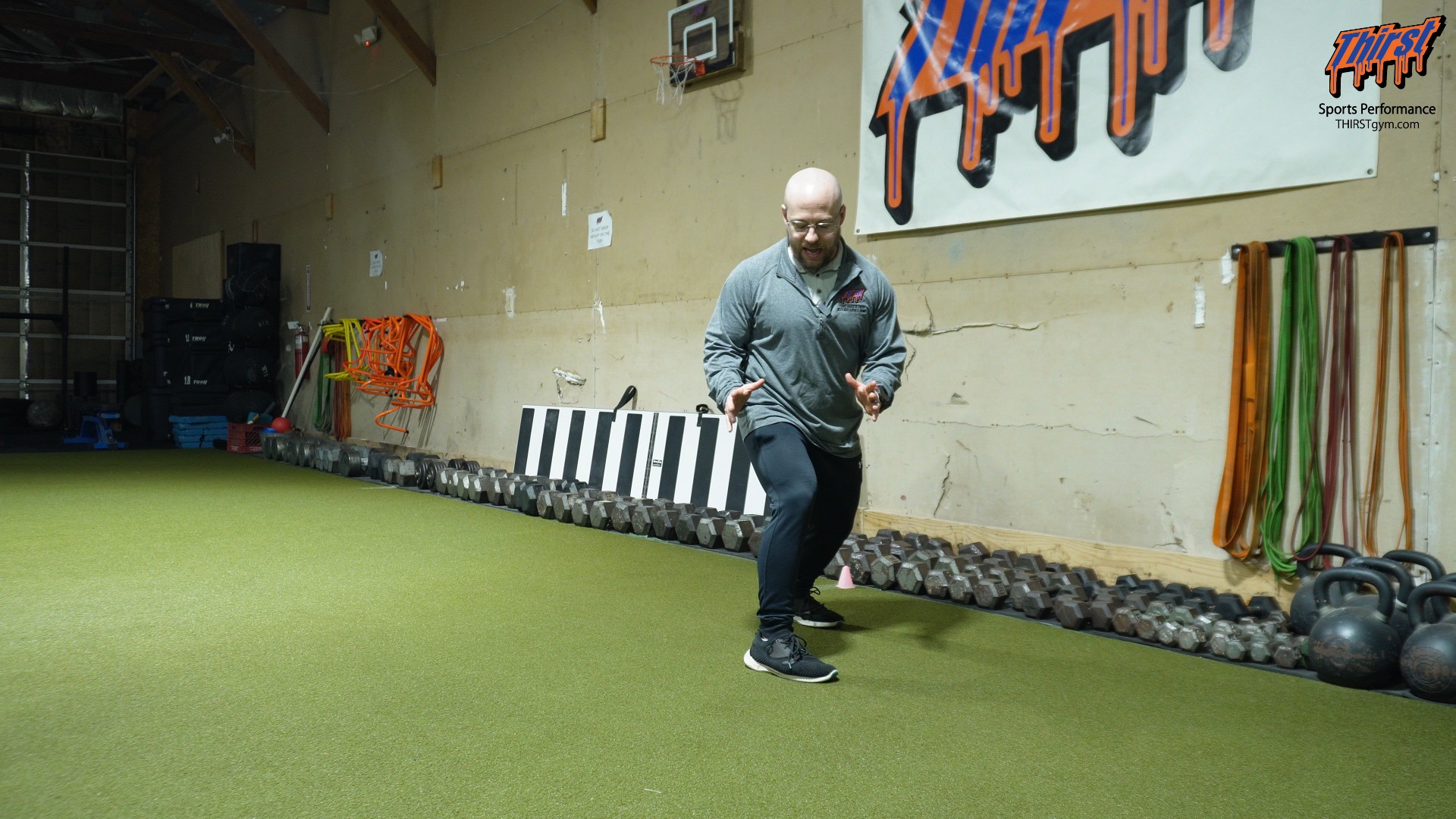
Begin in a wide stance with the feet positioned outside the hips. The knees should be slightly angled out, tracking in line with the toes, and the athlete should sit into a partial squat so there’s tension in the hips and legs. The chest stays tall and the eyes stay up. This is a standard, ready-to-move athletic position: low center of gravity, weight balanced, and coiled to react.
From here, the athlete picks one leg to bring slightly forward as the working orientation. Which leg comes forward doesn’t matter — both sides get trained equally — but establishing that staggered readiness sets up the rotation that follows.
Executing the In-Place Hip Turn
With the athletic stance established, the movement itself is deceptively simple, and that simplicity is the point. On a cue — a whistle, a verbal command, or a visual signal — the athlete rotates the hips to one side. If turning to the left, the hips and lower body swing around toward the left while the torso stays straight, tall, and square.
The critical coaching point is that the upper body remains stable and oriented forward while only the hips turn. The athlete maintains the same low base of support throughout, so everything comes around underneath a quiet, upright chest. The rotation should be fast and crisp — this isn’t a slow, controlled stretch, it’s a rehearsal of an explosive reactive movement.
After turning, the athlete returns to the starting position and resets. That return is intentional and important. Coming back to center trains the athlete to stay low in what’s often called “the tunnel” — that low, loaded posture — and to generate a lateral push off the outside leg. That outside leg is precisely the one an athlete would drive from to explode in a new direction during actual competition, so every rep is building the exact push mechanics that transfer to the game.
What the Hip Turn Trains
Physically, the in-place hip turn develops rotary control through the hips and core while reinforcing the ability to load and unload the outside leg for lateral propulsion. The hip musculature — the glutes, the adductors, and the rotators — all contribute to turning the pelvis while the trunk stabilizers work to keep the torso quiet and square.
But the real value is as much neurological as it is muscular. The drill teaches the athlete’s nervous system to separate hip action from torso action, to stay low under load, and to react to an external cue. Those are trainable skills, and they’re the raw material of elite agility.
The Number One Mistake to Avoid
The most common error, especially among young and inexperienced youth athletes, is jumping up to complete the turn. Instead of keeping the hips low and rotating within that loaded athletic posture, the athlete pops upward — momentarily standing tall to swing the hips around before dropping back down.
This defeats the entire purpose of the drill. Standing up eliminates the low center of gravity that makes change of direction fast and stable, and it wastes time by adding an unnecessary vertical movement into what should be a purely rotational action. Coaches should cue athletes relentlessly to “stay low in the tunnel” and keep the movement confined to the hips. If you see an athlete rising up on their turns, slow the reps down and rebuild the pattern before adding speed or reactivity.
Other common faults include letting the chest rotate along with the hips (losing the dissociation the drill is meant to build) and narrowing the stance until the base becomes unstable. Keep the feet wide, the chest square, and the hips low.
Programming the In-Place Hip Turn
There are two effective ways to program this drill. The first is reactive: have athletes hold the athletic stance and turn on a cue such as a whistle, then immediately return and reset. This method builds the read-and-react component and is excellent for teaching athletes to respond to an external stimulus rather than moving on their own internal rhythm.
The second is volume-based: instruct athletes to complete as many quality hip turns as they can in a short window — five to ten seconds is a good starting point — then repeat on the opposite side. This builds rhythm, work capacity, and repeatability of the movement pattern under a bit of fatigue.
Whichever method you choose, always train both directions equally. Because it requires no equipment and minimal space, the hip turn slots naturally into a dynamic warm-up before any speed, agility, or field-sport session. It also pairs extremely well with plyometrics and other lateral, change-of-direction-focused drills within a larger athletic development block. Use it early in a session while the athlete is fresh, since the goal is clean movement quality rather than conditioning.
Who Should Use This Drill
The in-place hip turn is appropriate for nearly any athlete whose sport demands change of direction — soccer, basketball, football, lacrosse, tennis, combat sports, and beyond. It’s especially valuable for youth and developing athletes who are just learning to control their bodies and establish sound movement patterns, precisely because it’s simple enough to teach quickly but foundational enough to matter for years.
For beginners, keep the movement slow and self-paced until the dissociation pattern is grasped and the athlete can consistently stay low without jumping up. Once that foundation is solid, progress to reactive whistle-based reps, then to timed high-effort sets, and eventually build outward into full change-of-direction drills that layer crossover steps, lateral pushes, and live reactive agility on top of the same core skill. In that way, this humble in-place drill becomes the doorway to a much broader speed and agility curriculum.
Master the hip turn, and you’ve given your athletes a repeatable, low-cost tool for building the exact quality that decides so many competitive moments: the ability to change direction fast, stay balanced, and beat their opponent to the spot.