
Hip Turn to Lateral Pushout: A Change of Direction Drill for Faster, Lower Athletes
Change of direction is where athletic ability gets won or lost. It’s not enough to be fast in a straight line — the athletes who dominate on the field, the mat, or the court are the ones who can reorient their hips, stay low, and explode into a new direction the instant the situation demands it. The hip turn to lateral pushout is a simple but powerful drill that trains exactly that skill: turning the hips efficiently and then converting that reorientation into a decisive lateral push.
This drill builds directly on the standard hip turn, adding a layer of horizontal force production that teaches athletes to attack space rather than simply reset their feet. It’s an ideal addition to a warm-up, a natural next step in a hip turn progression, and a strong pairing with plyometric, speed, and agility work.
Watch the video below on how to maximize this exercise.
What Is the Hip Turn to Lateral Pushout?
The hip turn to lateral pushout is a change of direction drill that combines two athletic actions into one seamless movement. First, the athlete performs a hip turn — reorienting the hips to one side while keeping the torso square. Then, instead of returning the feet to a neutral, squared-up stance, the athlete drives one leg into the ground and produces a single, powerful lateral push.
The goal is not distance for its own sake. The goal is to teach the body to fluidly transition from a reactive hip turn into an aggressive push that could be used to chase a ball carrier, close down an opponent, guard laterally, or shift into any athletic task the moment reads. It trains the connection between reorientation and acceleration, which is the heart of quality change of direction mechanics.
Why This Drill Matters for Change of Direction
Most athletes can turn and most athletes can push. What separates elite movers is the ability to chain those two actions together without wasting time, height, or ground contact. When an athlete pops up out of their stance before pushing, they leak power and telegraph their intent. When they float their feet back to square before reacting, they add an unnecessary beat that a faster opponent will exploit.
The hip turn to lateral pushout eliminates that wasted step. It reinforces the idea that a hip turn is not a finished movement — it’s a loaded position ready to fire. By training the athlete to push immediately out of the turn while staying low, you build a change of direction pattern that is faster, more deceptive, and more transferable to sport.
Space and Equipment You’ll Need
One of the best things about this drill is its accessibility. You don’t need any specialized equipment — just enough open space to move laterally and reset. A few yards in each direction is plenty. A whistle, a clap, or a verbal command is useful for triggering the movement on cue, which adds a reactive element and better mimics the unpredictability of sport. Cones can be added later if you want a visual target for the push, but they aren’t required to get value from the drill.
Setting Up the Athletic Stance
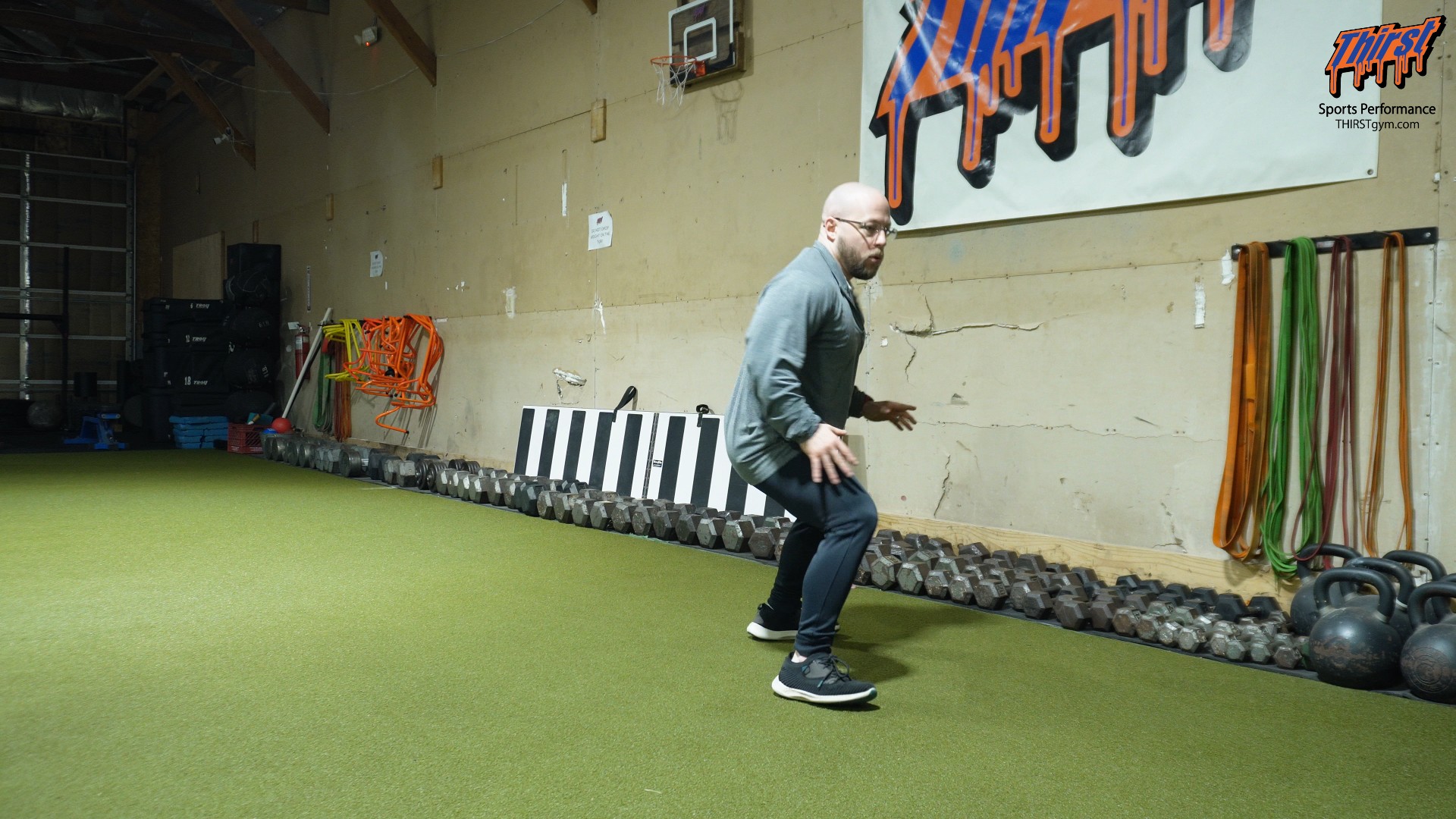
Everything starts from a solid athletic base. Set the feet slightly outside the hips in a comfortable, stable stance. Allow the knees to track out slightly, keeping tension through the hips and legs. The chest stays tall and proud rather than collapsing forward, and the feet remain flat with weight loaded evenly. The sensation should be one of readiness — hips loaded, joints stacked, and the whole body coiled to move.
This loaded athletic position is the foundation. If the stance is sloppy or the athlete is standing too upright, the quality of the hip turn and the resulting push will suffer.
How to Perform the Hip Turn to Lateral Pushout
From the athletic stance, the movement unfolds in two connected phases.
Phase One: The Hip Turn
On the whistle or command, rotate the hips to one side while keeping the torso square to the front. This is the essence of the classic hip turn — the lower body reorients while the upper body stays oriented toward the target or field of play. The athlete should feel the hips rotate underneath a stable, tall torso, with the feet repositioning to accept the turn.
Phase Two: The Lateral Pushout
Here’s where this variation earns its name. Rather than bringing the feet back into a squared-up position, the athlete immediately drives through the outside leg to produce one big lateral push. If the hips have turned to set up a push to the right, the right leg loads and drives horizontally, sending the body laterally into space. The action is one committed, full-effort push — not a series of small shuffles. The athlete pushes, covers ground, and lands back in a controlled athletic position ready to go again.
The whole sequence should feel like a single fluid expression: turn, load, push.
What the Drill Trains
While this looks like a simple movement, it develops several important qualities at once. It reinforces efficient hip reorientation, which is foundational to nearly every cutting and reactive movement in sport. It builds horizontal force production through the pushing leg — the same quality that underpins lateral acceleration and defensive slides. It also trains the athlete to maintain a low, powerful position under time pressure, developing the postural control that separates smooth movers from stiff ones.
From a musculature standpoint, the drill heavily involves the glutes, adductors, and quadriceps as the pushing leg drives laterally, while the hips, core, and stabilizing musculature work to keep the torso controlled and the athlete balanced through the transition.
Coaching Cues That Make the Difference
The single most important coaching point is staying low throughout the entire movement. Athletes have a natural tendency to rise up before they push — popping the hips vertically and then trying to move laterally. This kills power and slows the whole action down.
A cue I like to use is “stay in the tunnel.” Imagine there’s a low ceiling just above the head, and the athlete has to complete the entire turn and push without standing up into it. This keeps the center of mass low and the force horizontal, exactly where you want it for change of direction.
Beyond staying low, emphasize full effort on every rep. This is not a submaximal shuffle. The push should be aggressive and committed, teaching the nervous system to produce meaningful force each time. Reinforce that the hips lead the turn while the torso stays square, and that the push flows directly out of the turn without a pause or a reset in between.
Common Mistakes to Watch For
The most frequent error is rising up out of the stance before pushing. If you see the athlete’s head or hips travel vertically before they travel horizontally, cue them back into the tunnel and lower position.
A second common mistake is turning the torso along with the hips. The value of the hip turn comes from dissociating the lower body from the upper body — the hips reorient while the eyes and chest stay locked toward the target. If the whole body spins as one unit, the drill loses its transfer to reactive sport situations.
Finally, watch for tentative or half-hearted pushes. A soft push defeats the purpose. Encourage athletes to commit fully to one big lateral drive rather than shuffling their feet back to neutral.
Programming Recommendations
The hip turn to lateral pushout works beautifully as a low-fatigue, high-quality movement primer or skill drill. A typical prescription is three to five reps on each side, performed on a whistle, cue, or command to build in a reactive element. Because the emphasis is on full-effort quality rather than volume, keep the reps crisp and stop before form degrades.
This drill fits naturally into a dynamic warm-up, where it wakes up the hips and reinforces good athletic positioning before the main session. It also slots in perfectly as part of a broader hip turn series, giving athletes a logical progression from the base hip turn into force production. And it pairs well with plyometric, speed, and agility work as part of a movement or change of direction training block. Always train both sides evenly to keep the athlete symmetrical.
Who This Drill Is For
The hip turn to lateral pushout is valuable for a wide range of athletes. Field and court sport athletes benefit from the reactive change of direction quality. Combat sports athletes — wrestlers, grapplers, and MMA fighters — gain from the low-position hip reorientation and lateral push, which mirrors the demands of scrambling, guarding, and pursuing on the mat. Youth athletes can use it to build fundamental athletic positioning and coordination early, and general fitness clients can adopt it to develop lateral movement competency and hip control.
Progressions and Regressions
To regress the drill, remove the reactive cue and let the athlete self-initiate the turn and push, focusing purely on staying low and producing a clean lateral drive. You can also shorten the push and slow the tempo while the athlete learns the pattern.
To progress it, add a cone or visual target to push toward, increase the reactivity by using randomized left-right cues, or chain the pushout into a subsequent sport-specific action such as a sprint, a shuffle, or a movement into a defensive task. This turns the drill from an isolated skill into a more complete change of direction sequence.
Bringing It All Together
The hip turn to lateral pushout takes a foundational athletic skill and adds the one ingredient that makes it useful in real sport: an explosive, low, committed push into space. Train it with full effort, keep athletes in the tunnel, and use it consistently as part of your warm-up or change of direction work. Over time, you’ll build athletes who don’t just turn — they turn and go.