

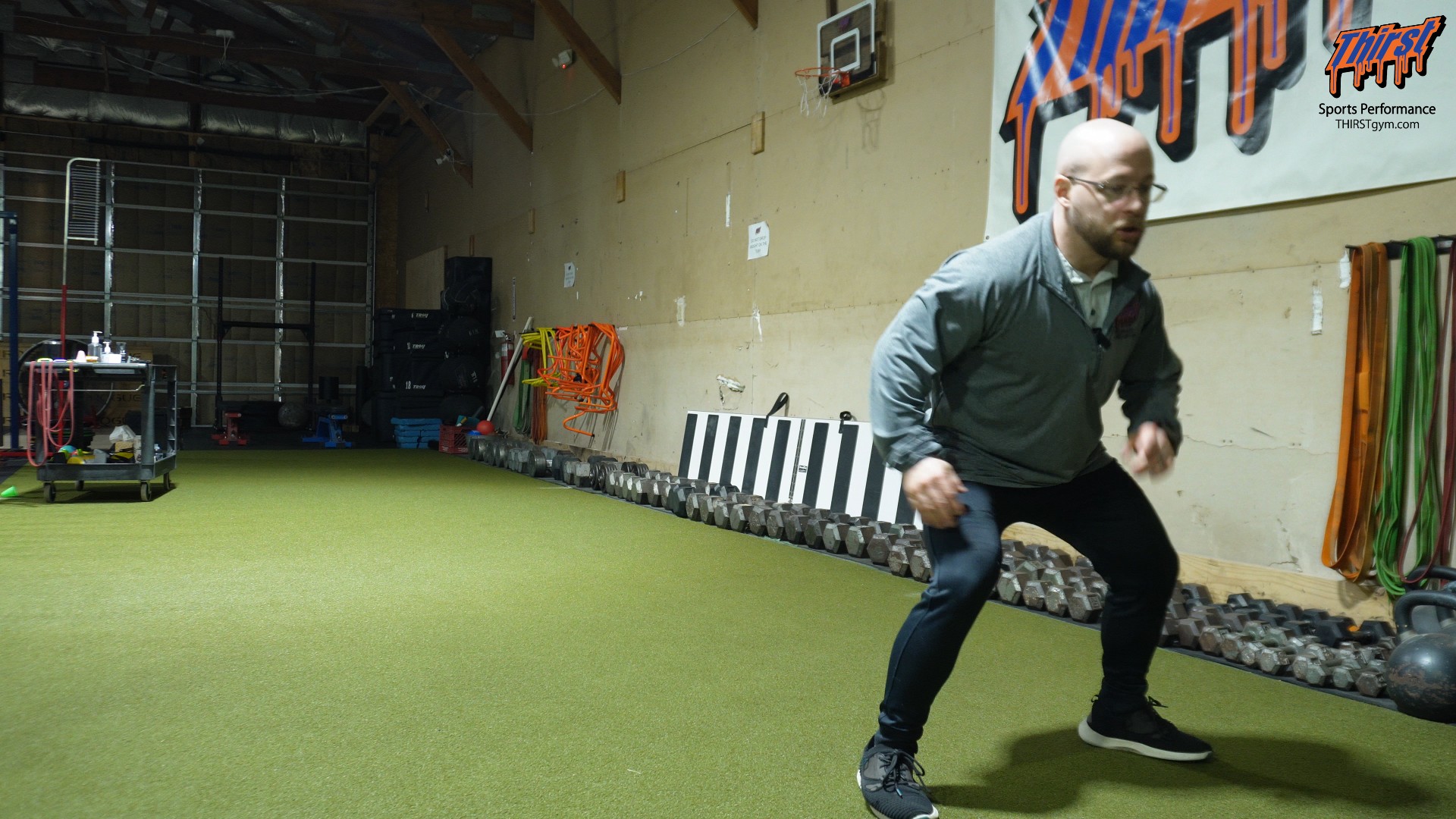
The Hip Turn to Sprint and Back: Building Reactive Change of Direction Speed
Change of direction is one of the most underdeveloped athletic qualities in the weight room and on the practice field. Plenty of athletes can run fast in a straight line, and plenty can perform a clean hip turn in isolation. Far fewer can string those pieces together on demand, reacting to a stimulus, opening the hips, exploding into a sprint, decelerating, and getting back to where they started. The hip turn to sprint and back drill is built specifically to bridge that gap. It takes a foundational reactive movement and layers linear acceleration and a return change of direction on top of it, forcing athletes to make decisions and produce force in the same breath.
This is a more advanced drill, and it rewards athletes who already own the basics. If you coach powerlifters branching into athletic development, combat sports athletes who live and die by their footwork, or field and court athletes who need to react and reaccelerate, this drill deserves a place near the front of your training sessions.
Watch the video below on how to maximize this exercise.
Why the Hip Turn to Sprint and Back Belongs in Your Program
The value of this drill comes from combining three distinct athletic demands into one continuous sequence. First, there’s the reactive change of direction component of the hip turn itself, which trains the athlete to read a cue and reorient the hips efficiently. Second, there’s the linear sprint mechanics of driving out of that turn into a short acceleration. Third, there’s a second change of direction on the way back, as the athlete decelerates, touches the line, and returns through the start position.
Most drills isolate one of these qualities. Sprinting mechanics get trained on their own. Agility ladders and cone drills get their own block. Reactive hip turns often live as a standalone warm-up movement. The hip turn to sprint and back forces the nervous system to connect all three, which is exactly what sport demands. Athletes rarely get to perform a single clean movement in a vacuum. They have to react, accelerate, slow down, and change direction again, often within a second or two. This drill trains that reality.
Space and Equipment You’ll Need
Before anything else, you need room. This is not a drill you can run in a cramped corner of the gym. You’ll want enough open space that an athlete can settle into a wide athletic stance, execute the hip turn, and then sprint out several yards in either direction before returning. A stretch of turf, an open field, a gym floor, or a training bay with at least ten to fifteen yards of clear runway works well.
The equipment demands are minimal. A line to touch on the return leg, whether that’s a floor line, a piece of tape, or a cone, gives athletes a clear target for their change of direction. A whistle or a verbal cue is useful for triggering the reactive element, since part of the point is to have the athlete respond to a stimulus rather than move on their own timeline. Beyond that, you’re working almost entirely with body weight and space.
Mastering the Hip Turn Foundation
The entire drill is built on a quality hip turn, so it’s worth reviewing exactly what that looks like before adding speed.
Setting Up the Athletic Stance
Start in a strong athletic stance. Your feet should be positioned outside of your hips, giving you a nice wide base. The knees track out over the feet rather than caving in, and the feet stay flat and planted. From there, keep the chest tall and dip the hips down into a loaded, ready position. The important detail is that your hips stay above your knees. You’re not dropping into a deep squat, and you’re not standing up tall. You’re settling into that athletic, ready-to-move posture with a wide base and a loaded lower body.
Executing the Hip Turn
From that stance, the hip turn is a rotation of the hips, not a jump. This is the most common place athletes go wrong, so it’s worth emphasizing. You are not jumping up to turn. You stay low, remain in the tunnel, and rotate the hips underneath a relatively square torso. The torso stays tall and stable while the hips do the work of reorienting the body. Staying low through the turn keeps you loaded and ready to explode in the next direction, which is the whole point of the movement.
Adding the Sprint and the Return
Once the hip turn is clean and reliable, you build the full drill on top of it. Settle into the athletic stance facing a direction. On the cue, whether that’s a whistle or a verbal go, execute the hip turn and immediately use that push to explode into a sprint. Cover a short distance of roughly five to ten yards, touch the line at the far end, and then change direction to sprint back through the start position. Run the same sequence to the opposite side so both directions get trained evenly.
The key coaching point that ties everything together is the transition out of the turn. When the cue fires, the athlete should be able to immediately push and jump straight into the sprint with no wasted motion. That only happens if they were already low and loaded during the hip turn. If they stand up tall to execute the turn, they lose the stored energy and the push disappears. The same principle applies to the acceleration itself. Athletes should stay low and drive forward as they build speed, resisting the urge to pop upright, especially since they know they have to decelerate and come back. Staying low forward, driving up through the sprint, keeps them in position to change direction cleanly on the return.
What This Drill Trains
The hip turn to sprint and back develops a full stack of athletic qualities in a single sequence. On the reactive side, it trains the athlete’s ability to read a cue, make a decision, and reorient the hips under control. That decision-making component matters, because in sport the direction of movement is almost never predetermined.
On the physical side, the drill hits the muscles and mechanics of linear acceleration, loading the glutes, hamstrings, quads, and calves as the athlete drives out of the turn. The deceleration and return leg add an eccentric demand, teaching the body to absorb force, slow down efficiently, and redirect. The result is an exercise that builds change of direction ability from two angles, the initial reactive hip turn and the return redirect, while sandwiching a burst of linear sprint mechanics in between.
Common Mistakes to Avoid
The most frequent error is jumping or standing up tall during the hip turn. Athletes instinctively want to rise to rotate, but doing so unloads the hips and kills the explosive push into the sprint. Keep them low and in the tunnel.
The second common mistake is popping upright too early during the sprint. Rising up out of the acceleration phase compromises the drive and makes the return change of direction sloppy. Athletes should stay low and drive forward, especially knowing a redirect is coming.
The third issue is running this drill over distances that are too long. This is a short, sharp exercise focused on reaction and change of direction in small spaces. Long distances turn it into a conditioning drill and dilute the reactive, decision-making quality you’re actually chasing.
The final mistake is programming it wrong within the session, which deserves its own section.
Programming the Hip Turn to Sprint and Back
This drill works best in short, crisp bursts. Keep the working distances short, in the range of five to ten yards out and back, and cap the volume at roughly one to three reps on each side per set. Three to five sets is a solid target. Because the emphasis is change of direction, reactive decision-making, and quality mechanics in small spaces, you never want to run this for extended periods or high rep counts.
Placement within the session is just as important as the sets and reps. This should be a primary exercise or sprint-based drill used to begin a training session. Do not tack it onto the end of a workout, and never run it with athletes who are already in a fatigued state. The whole benefit comes from executing crisp, high-quality reactions and sprints, and that only happens when athletes are fresh. Program it early, while the nervous system is primed, to maximize what you get out of it.
Who Should Be Doing This Drill
Because it layers reaction, acceleration, and change of direction together, the hip turn to sprint and back is best suited to athletes who already have a competent hip turn and reasonable sprint mechanics. Combat sports athletes, including wrestlers, grapplers, and mixed martial artists, benefit enormously from the reactive footwork and rapid reorientation this drill trains. Field and court athletes who need to read a play and reaccelerate will find it directly transferable. Even strength-focused athletes and general fitness clients looking to build athleticism can use it, provided they’ve earned the movement quality to run it safely.
For younger or less experienced athletes, or anyone still refining the hip turn, it makes sense to regress the drill. Master the athletic stance and the hip turn on their own first. From there, add a short sprint out of the turn without the return leg. Once that’s clean and reactive, layer in the change of direction and the return through the start position to build the complete drill. On the progression side, more advanced athletes can vary the cue, change the direction of the initial turn on command, or shorten the reaction window to increase the decision-making demand.
Final Thoughts
The hip turn to sprint and back is a compact, high-value drill that trains the way athletes actually move. It takes a foundational reactive movement and turns it into a complete sequence of reaction, acceleration, deceleration, and redirection, all in a small space and a short window of time. Keep the distances short, the reps crisp, and the athletes fresh, and you’ll build change of direction speed that shows up when it counts. If you’ve got questions about coaching or programming this drill, drop them in the comments and let’s talk it through.